






What Are Big and Small Adjectives With Examples and Usage
Adjectives are words that describe or provide more information about nouns and pronouns. For example, adjectives like red, quick, happy, and annoying can describe things like a red hat, a quick rabbit, a happy duck, and an annoying individual.
When we add a suffix to a noun or verb, we get certain common adjectives. When the suffix -ful is added to the noun ‘beauty’, the adjective ‘beautiful’ is created, and when the suffix -able is added to the verb ‘read’, the adjective ‘readable’ is created.
Similarly, -al, -ary, -able and –ible, –ish, -ic, -ical, -less, -like, -ous, -some, and -y are all common suffixes for adjectives. Some adjectives are participles (verbs ending in -ed or -ing), while others are not derived from nouns or verbs but are unique in their own right, such as near, deep, and slow. Learn more about adjectives by reading through the following content.
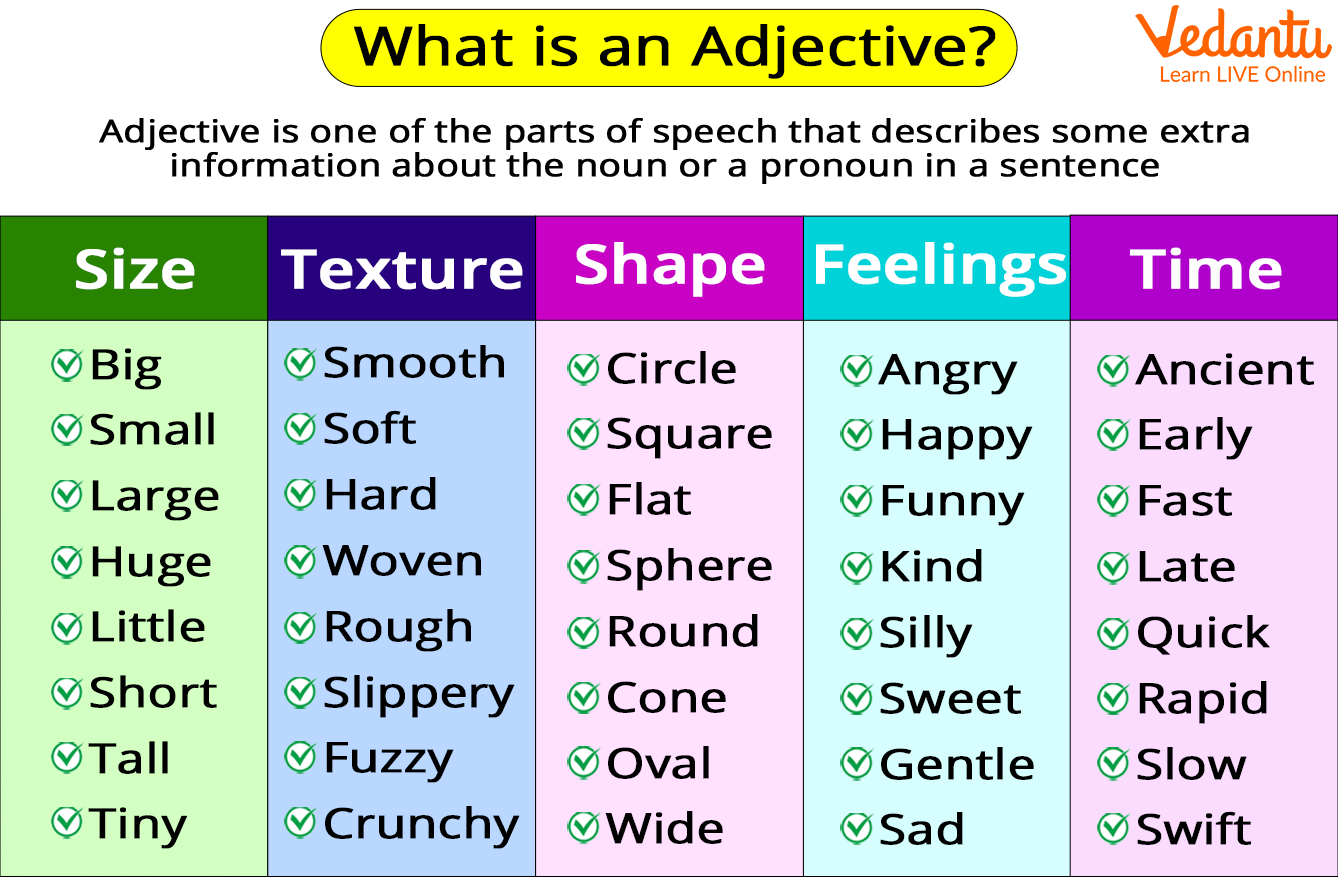
Examples of adjectives
More on Adjectives and their Types
Adjectives are commonly thought of as words, although they are phrases or clauses that can be used adjectivally. The phrase ‘wearing a hat’ modifies the noun man in the sentence "The man wearing the hat winked at me." Hence, it is an adjective phrase. In the sentence "The man, who was carrying a book, winked at me," the clause ‘who was carrying a book’ is an adjective clause since it modifies the noun ‘man’.
Descriptive adjectives are used to describe the qualities of a noun. The word beautiful is a descriptive adjective in the sentence "My friend is a beautiful model."
Quantitative adjectives describe ‘how much’ of the noun there is. In the sentence, "She has a lot of friends," ‘a lot of’ is a quantitative adjective.
The importance of the word and whether it is near or far is highlighted with demonstrative adjectives. The word ‘that’ is a demonstrative adjective in the line "I want that vase."
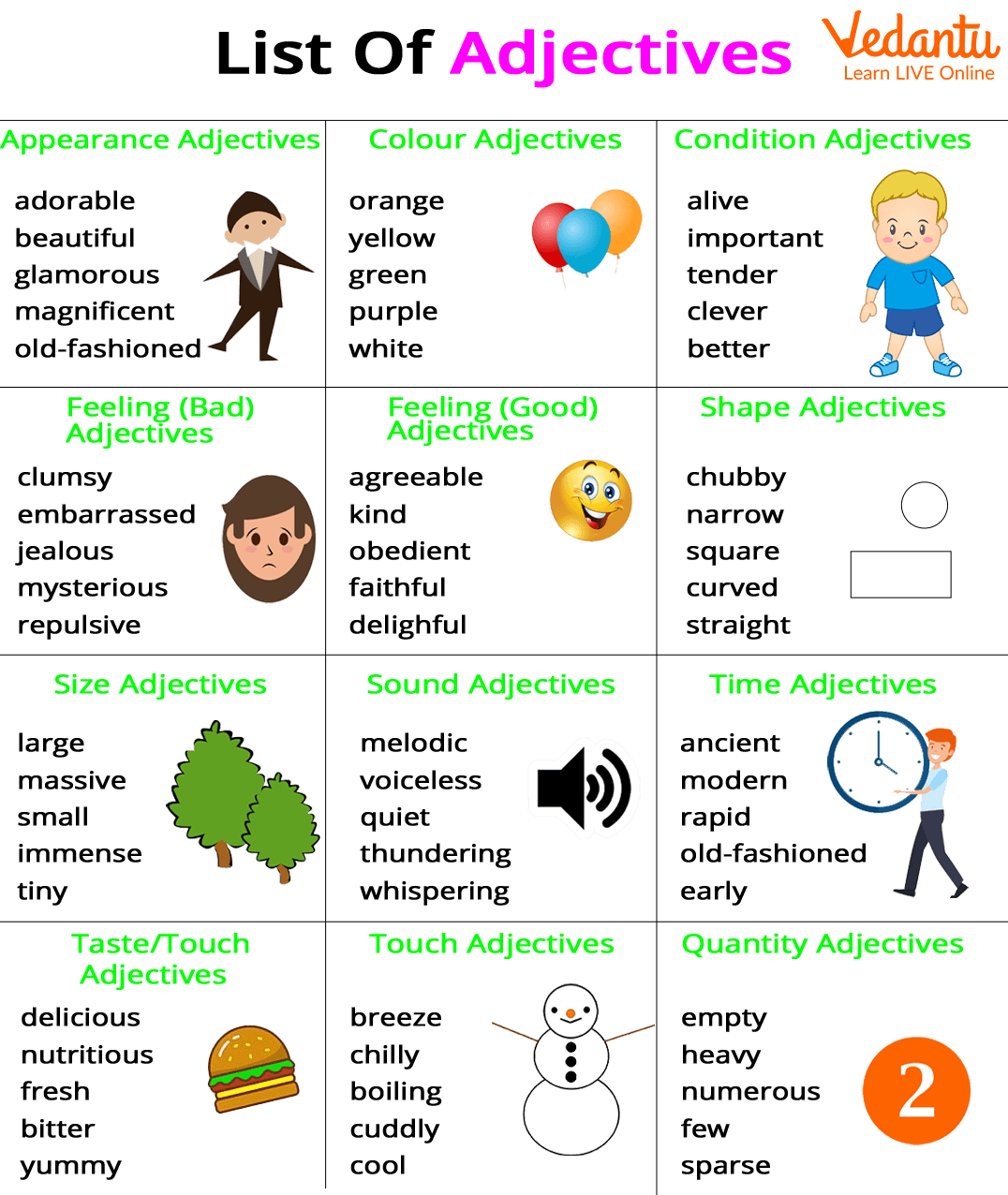
List of adjectives
Big and Small Adjectives
Now, we're going to increase your vocabulary of adjectives that define size by providing you with a lot more words to describe huge and little items. To begin, we'll list some synonyms for the words "big" and "small," and offer some instances of how to use these adjectives so you can see how they're used in context.
Synonyms for Small Adjectives
Little, diminutive, dinky, fine, half-pint, Lilliputian, pint-size (or pint-sized), pocket, puny, pygmy, bantam, shrimpy, slight, smallish, subnormal, dwarfish, toylike, undersized (also undersize), and pocket-size (also pocket-sized).
Small-Related Words
Dwarf, toy runtish, minikin, runty, scrubby, inappreciable, infinitesimal, little bitty, micro, microscopic (also microscopical), mini, miniaturised, minim, minuscule, minute, pinpoint, miniature, stunted bitty, teensy, teensy-weensy, teeny, teeny-weeny, tiny, wee, weeny (also weensy).
Synonyms for Big
Weighty, consequential, earth-shattering, eventful, historic, important, major, material, momentous, monumental, much, earthshaking, significant, substantial, tectonic, material, meaningful.
Words Related to Big
Fatal, fateful, strategic, decisive, grave, heavy, serious, sincere, earnest, distinctive, exceptional, impressive, outstanding, remarkable, prominent, preeminent, valuable, worthwhile, worthy.
Eminent, great, illustrious, noble, notable, noteworthy, outstanding, distinguished, prestigious, famous, notorious, renowned.
All-important, critical, crucial, essential, key, seminal, vital, central, pivotal.
Importance of Adjectives
An adjective is a word that transforms a describing noun or pronoun into a more descriptive noun or pronoun. For example, the object "man" becomes "the tall, lovely man" or "the short, plain man" when the adjective is expanded.
The articles "a, an," and "the" are also used as descriptive nouns. Although "a" and "an" are referred to as "uncertain articles" because they do not refer to a specific person or thing. Since it refers to a certain person or thing, "the" is referred to as a specific article.
It also provides a descriptive idea of the same noun, allowing us to determine the right meaning and state of the article. The meaning of a sentence is completely influenced by the adjective. Its existence adds to the sentence's intrigue.
Conclusion
We hope you have understood what adjectives are and how they are used. You can now expand your vocabulary of adjectives on small and big by taking a note of all the synonyms we have discussed here. To enhance your knowledge of other parts of speech in English grammar, head over to our website today!
FAQs on Big and Small Adjectives in English Grammar
1. What are big and small adjectives in English?
The words big and small are common adjectives used to describe the size of a person, place, thing, or idea. They answer the question “How large?” or “How little?”
- Big means large in size: She has a big house.
- Small means little in size: He found a small coin.
- They are basic size adjectives often taught in beginner English grammar.
2. How do you use big and small in a sentence?
You use big and small before a noun to describe its size. These adjectives usually come before the noun they modify.
- Structure: Adjective + Noun
- Example: It is a big dog.
- Example: She lives in a small town.
3. What is the difference between big and large?
Big and large both mean “not small,” but big is more informal and more common in everyday English.
- Big is often used in speaking: a big mistake, a big brother.
- Large sounds more formal: a large amount, a large building.
- In most size contexts, they can replace each other.
4. What is the difference between small and little?
Small and little both describe size, but little can also show emotion or affection.
- Small is neutral: a small box.
- Little can sound affectionate or emotional: my little sister.
- Little is also used with uncountable nouns: little time, little money.
5. What are the comparative and superlative forms of big and small?
The comparative and superlative forms of big and small are formed by adding -er and -est.
- Big → bigger → biggest (double the final consonant)
- Small → smaller → smallest
- Example: This house is bigger than mine.
- Example: That is the smallest room in the house.
6. Why does big change to bigger and biggest?
The word big doubles its final consonant before adding -er or -est because it follows the consonant-vowel-consonant (CVC) spelling rule.
- Pattern: consonant + vowel + consonant
- Rule: Double the last consonant before adding the suffix.
- Example: big → bigger → biggest
7. Can big and small be used to describe abstract ideas?
Yes, big and small can describe abstract ideas, not just physical size.
- Big decision (important decision)
- Big problem (serious issue)
- Small mistake (minor error)
8. Where do big and small go in a sentence?
Big and small usually come before a noun or after a linking verb in a sentence.
- Before a noun: a big car, a small garden
- After a linking verb: The car is big.
- Common linking verbs: is, are, was, seem, become
9. What are some synonyms for big and small?
Common synonyms for big include large, huge, and enormous, while synonyms for small include little, tiny, and miniature.
- Big: large, huge, giant, massive
- Small: little, tiny, petite, minor
- Choose the synonym based on context and formality.
10. What are common mistakes when using big and small?
Common mistakes with big and small include incorrect comparison forms and wrong word choice in formal contexts.
- Incorrect: more big → Correct: bigger
- Incorrect spelling: biger → Correct: bigger
- Using big instead of large in very formal writing.
