




A concave lens always forms an image which is
(A) Real, inverted, and diminished
(B) Real, erect, and diminished
(C) Virtual, erect, and magnified
(D) Virtual, erect, and diminished
Answer
 Verified
233.1k+ views
Hint: the images that are formed from the convex and concave lens, depend upon the structure of the lens. The concave, consists of certain properties. Knowing the properties, will help in finding the characteristics of the object formation.
Complete step by step answer
The concave lens always forms a virtual, erect and diminished image. As we can observe in the ray diagram which is provided below.
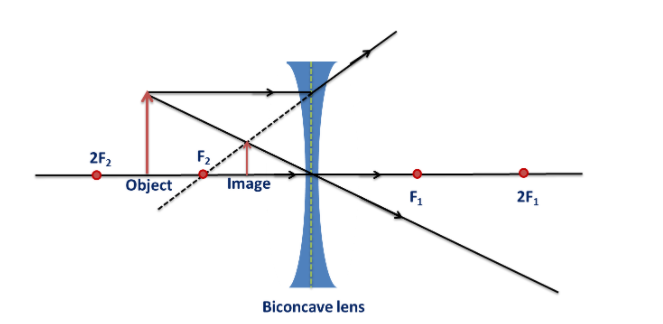
Therefore, we can say that the correct answer to the question which is mentioned in option D.
The property of concave lenses that we should be knowing is that it is thinner in the middle. Which means that if there are some 55parallel rays of light passing through any concave lens then the refracted rays will divert so that they appear to come from one single point which is known as the principal focus.
Additional information:
Concave lens is also known as a diverging lens. This is because it possesses one surface which is curved inward. Concave lens spreads out light rays that are then refracted through it.
A concave lens is used to correct short sightedness which is also known as myopia.
Note: A concave mirror or a converging lens will only produce a real image if the image is located beyond the focal point. By the focal point we mean more than one focal length away. The image that will be formed will be upright and reduced in size.
Complete step by step answer
The concave lens always forms a virtual, erect and diminished image. As we can observe in the ray diagram which is provided below.
Therefore, we can say that the correct answer to the question which is mentioned in option D.
The property of concave lenses that we should be knowing is that it is thinner in the middle. Which means that if there are some 55parallel rays of light passing through any concave lens then the refracted rays will divert so that they appear to come from one single point which is known as the principal focus.
Additional information:
Concave lens is also known as a diverging lens. This is because it possesses one surface which is curved inward. Concave lens spreads out light rays that are then refracted through it.
A concave lens is used to correct short sightedness which is also known as myopia.
Note: A concave mirror or a converging lens will only produce a real image if the image is located beyond the focal point. By the focal point we mean more than one focal length away. The image that will be formed will be upright and reduced in size.
Recently Updated Pages
JEE Main 2023 April 6 Shift 1 Question Paper with Answer Key

JEE Main 2023 April 6 Shift 2 Question Paper with Answer Key
JEE Main 2023 (January 31 Evening Shift) Question Paper with Solutions [PDF]
JEE Main 2023 January 30 Shift 2 Question Paper with Answer Key
JEE Main 2023 January 25 Shift 1 Question Paper with Answer Key
JEE Main 2023 January 24 Shift 2 Question Paper with Answer Key
Trending doubts
JEE Main 2026: Session 2 Registration Open, City Intimation Slip, Exam Dates, Syllabus & Eligibility
JEE Main 2026 Application Login: Direct Link, Registration, Form Fill, and Steps
JEE Main Marking Scheme 2026- Paper-Wise Marks Distribution and Negative Marking Details
Understanding the Angle of Deviation in a Prism
Hybridisation in Chemistry – Concept, Types & Applications
How to Convert a Galvanometer into an Ammeter or Voltmeter
Other Pages
JEE Advanced Marks vs Ranks 2025: Understanding Category-wise Qualifying Marks and Previous Year Cut-offs
Understanding Uniform Acceleration in Physics
Dual Nature of Radiation and Matter Class 12 Physics Chapter 11 CBSE Notes - 2025-26
Understanding Electromagnetic Waves and Their Importance
Understanding the Electric Field of a Uniformly Charged Ring
JEE Advanced Weightage 2025 Chapter-Wise for Physics, Maths and Chemistry