




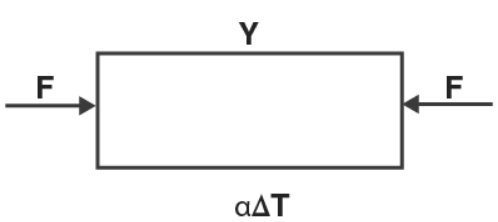
A rod of certain length is acted by two equal forces as shown in the figure. The coefficient of thermal expansion of the rod is \[\alpha \]and area of cross section is A. When the temperature of the rod is increased by $\Delta T$. The length of the rod does not change. The young’s modulus Y will be.
A. $\dfrac{F}{{2A\alpha \Delta T}} \\ $
B. $\dfrac{F}{{A\alpha \Delta T}} \\ $
C. $\dfrac{{2F}}{{A\alpha \Delta T}} \\ $
D. $\dfrac{F}{{3A\alpha \Delta T}}$
Answer
 Verified
233.1k+ views
Hint:As we know the young’s modulus is stress divided by strain so start with the relation between the thermal stress and length of the rod. Then try to find out thermal stress and hence we will get the required relation between force applied, area of cross section, increase in temperature coefficient of thermal expansion and young’s modulus.
Formula used:
\[\Delta l=\dfrac{Fl}{AY}\]
Where Y is the young’s modulus of the rod, l is the length of the rod, F is the force on the rod and A is its cross sectional area.
$\Delta l=\alpha l\Delta T$
$\Delta l$ is the change in length or the elongation, l is the original length and $\Delta T$ is the change in temperature
Complete step by step solution:
Here two equal forces F are applied on the rod from the opposite direction which will cause compression in the rod and temperature is increased by $\Delta T$ which will cause expansion in the rod.
Now we have, first change in length caused by forces applied,
$\Delta l = \dfrac{{Fl}}{{Ay}}$...........(equation 1)
Second change in length caused by increase in temperature,
$\Delta l = l\alpha \Delta T$.........(equation 2)
Since the length of the rod does not change this implies change in length caused by both the force and temperature balance each other. Then we can equate the equations 1 and 2.
By equating both the equation, we get;
\[\dfrac{{Fl}}{{Ay}} = l\alpha \Delta T\]
By further solving we get;
$\therefore y = \dfrac{F}{{A\alpha \Delta T}}$
Hence the correct answer is option B.
Note: In case the change in length of the rod is not same in both the cases that is by force applied and increase in temperature then we cannot equate both the equations. Also be careful about the direction in which the force is applied on the rod if this changes the whole equation will get changed.
Formula used:
\[\Delta l=\dfrac{Fl}{AY}\]
Where Y is the young’s modulus of the rod, l is the length of the rod, F is the force on the rod and A is its cross sectional area.
$\Delta l=\alpha l\Delta T$
$\Delta l$ is the change in length or the elongation, l is the original length and $\Delta T$ is the change in temperature
Complete step by step solution:
Here two equal forces F are applied on the rod from the opposite direction which will cause compression in the rod and temperature is increased by $\Delta T$ which will cause expansion in the rod.
Now we have, first change in length caused by forces applied,
$\Delta l = \dfrac{{Fl}}{{Ay}}$...........(equation 1)
Second change in length caused by increase in temperature,
$\Delta l = l\alpha \Delta T$.........(equation 2)
Since the length of the rod does not change this implies change in length caused by both the force and temperature balance each other. Then we can equate the equations 1 and 2.
By equating both the equation, we get;
\[\dfrac{{Fl}}{{Ay}} = l\alpha \Delta T\]
By further solving we get;
$\therefore y = \dfrac{F}{{A\alpha \Delta T}}$
Hence the correct answer is option B.
Note: In case the change in length of the rod is not same in both the cases that is by force applied and increase in temperature then we cannot equate both the equations. Also be careful about the direction in which the force is applied on the rod if this changes the whole equation will get changed.
Recently Updated Pages
JEE Main 2023 April 6 Shift 1 Question Paper with Answer Key

JEE Main 2023 April 6 Shift 2 Question Paper with Answer Key
JEE Main 2023 (January 31 Evening Shift) Question Paper with Solutions [PDF]
JEE Main 2023 January 30 Shift 2 Question Paper with Answer Key
JEE Main 2023 January 25 Shift 1 Question Paper with Answer Key
JEE Main 2023 January 24 Shift 2 Question Paper with Answer Key
Trending doubts
JEE Main 2026: Session 2 Registration Open, City Intimation Slip, Exam Dates, Syllabus & Eligibility
JEE Main 2026 Application Login: Direct Link, Registration, Form Fill, and Steps
Understanding the Angle of Deviation in a Prism
Hybridisation in Chemistry – Concept, Types & Applications
How to Convert a Galvanometer into an Ammeter or Voltmeter
Understanding Uniform Acceleration in Physics
Other Pages
JEE Advanced Marks vs Ranks 2025: Understanding Category-wise Qualifying Marks and Previous Year Cut-offs
Laws of Motion Class 11 Physics Chapter 4 CBSE Notes - 2025-26
Waves Class 11 Physics Chapter 14 CBSE Notes - 2025-26
Mechanical Properties of Fluids Class 11 Physics Chapter 9 CBSE Notes - 2025-26
Thermodynamics Class 11 Physics Chapter 11 CBSE Notes - 2025-26
Units And Measurements Class 11 Physics Chapter 1 CBSE Notes - 2025-26