




A small, magnetized sphere A of pole strength m is counter-poised by a pan in a balance. Another magnetised sphere B of the same mass as A is placed below A so that their centres are at a distance .If A and B are unlike poles of same strength and to restore the counter weight in the pan is $1cm$ increased by $500gm$, the pole strength of each sphere is:
A) $1.4Am$
B) $9.8Am$
C) $0.7Am$
D) $70Am$
Answer
 Verified
233.1k+ views
Hint: The pole strength of a magnet is defined as the strength of a magnetic pole to attract a magnetic field towards itself is known as pole strength. It is a scalar quantity. It is the force exerted by one magnet on the other magnet. The poles have equal and opposite magnitudes.
Complete step by step solution:
Step I: Since the spheres are placed close to each other, so let their pole strengths be ${P_1}$ and ${P_2}$. Since their pole strengths are equal so
${P_1} = {P_2} = P$
Also the distance between the two spheres is $d = 1cm = 0.01m$
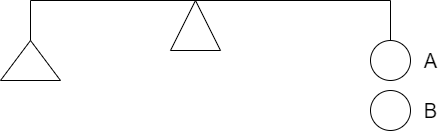
Step II: If the two poles are small then they can be represented as point magnetic charges. The force between two magnetic poles is given by the formula
$F = \dfrac{{\mu {q_1}{q_2}}}{{4\pi {r^2}}}$
Where $F$ is the force
${q_1},{q_2}$are magnitude of charges, in this case it is ${P_1},{P_2}$
$\mu$ is the permeability
$r$ is the distance
Step III:
${F_1} = \dfrac{{\mu {P_1}{P_2}}}{{4\pi {d^2}}}$
Since the pole strengths are equal, so
${F_1} = \dfrac{{\mu {P^2}}}{{4\pi {d^2}}}$---(i)
Step IV: When the weight $500gm$ is added, then another force will act.
${F_2} = mg$
$m = 0.5kg;g = 10m/{s^2}$
${F_2} = 0.5 \times 10$---(ii)
Step V: Since the forces are balanced, so
${F_1} = {F_2}$
$\dfrac{{\mu {P^2}}}{{4\pi {d^2}}} = 0.5 \times 10$
Since the term $4\pi $, so substituting all the other values and solving
$\dfrac{{{{10}^{ - 7}}{P^2}}}{{{{(0.01)}^2}}} = 0.5 \times 10$
${P^2} = \dfrac{{0.5 \times 10 \times 0.0001}}{{{{10}^{ - 7}}}}$
${P^2} = 4998.49$
$P = 70.7Am$
Step VI: The pole strength of each sphere is $70.7Am.$
Therefore, Option (D) is the right answer.
Note: It is important to note that the magnetic field strength is similar around the two poles of a magnet. But it is comparatively weaker in the center of the magnet. The pole strength varies inversely with the distance between the poles of the magnet. If the distance between two points is very large then the pole strength of the magnet will decrease.
Complete step by step solution:
Step I: Since the spheres are placed close to each other, so let their pole strengths be ${P_1}$ and ${P_2}$. Since their pole strengths are equal so
${P_1} = {P_2} = P$
Also the distance between the two spheres is $d = 1cm = 0.01m$
Step II: If the two poles are small then they can be represented as point magnetic charges. The force between two magnetic poles is given by the formula
$F = \dfrac{{\mu {q_1}{q_2}}}{{4\pi {r^2}}}$
Where $F$ is the force
${q_1},{q_2}$are magnitude of charges, in this case it is ${P_1},{P_2}$
$\mu$ is the permeability
$r$ is the distance
Step III:
${F_1} = \dfrac{{\mu {P_1}{P_2}}}{{4\pi {d^2}}}$
Since the pole strengths are equal, so
${F_1} = \dfrac{{\mu {P^2}}}{{4\pi {d^2}}}$---(i)
Step IV: When the weight $500gm$ is added, then another force will act.
${F_2} = mg$
$m = 0.5kg;g = 10m/{s^2}$
${F_2} = 0.5 \times 10$---(ii)
Step V: Since the forces are balanced, so
${F_1} = {F_2}$
$\dfrac{{\mu {P^2}}}{{4\pi {d^2}}} = 0.5 \times 10$
Since the term $4\pi $, so substituting all the other values and solving
$\dfrac{{{{10}^{ - 7}}{P^2}}}{{{{(0.01)}^2}}} = 0.5 \times 10$
${P^2} = \dfrac{{0.5 \times 10 \times 0.0001}}{{{{10}^{ - 7}}}}$
${P^2} = 4998.49$
$P = 70.7Am$
Step VI: The pole strength of each sphere is $70.7Am.$
Therefore, Option (D) is the right answer.
Note: It is important to note that the magnetic field strength is similar around the two poles of a magnet. But it is comparatively weaker in the center of the magnet. The pole strength varies inversely with the distance between the poles of the magnet. If the distance between two points is very large then the pole strength of the magnet will decrease.
Recently Updated Pages
JEE Main 2023 April 6 Shift 1 Question Paper with Answer Key

JEE Main 2023 April 6 Shift 2 Question Paper with Answer Key
JEE Main 2023 (January 31 Evening Shift) Question Paper with Solutions [PDF]
JEE Main 2023 January 30 Shift 2 Question Paper with Answer Key
JEE Main 2023 January 25 Shift 1 Question Paper with Answer Key
JEE Main 2023 January 24 Shift 2 Question Paper with Answer Key
Trending doubts
JEE Main 2026: Session 2 Registration Open, City Intimation Slip, Exam Dates, Syllabus & Eligibility
JEE Main 2026 Application Login: Direct Link, Registration, Form Fill, and Steps
JEE Main Marking Scheme 2026- Paper-Wise Marks Distribution and Negative Marking Details
Understanding the Angle of Deviation in a Prism
Hybridisation in Chemistry – Concept, Types & Applications
How to Convert a Galvanometer into an Ammeter or Voltmeter
Other Pages
JEE Advanced Marks vs Ranks 2025: Understanding Category-wise Qualifying Marks and Previous Year Cut-offs
Understanding Uniform Acceleration in Physics
Dual Nature of Radiation and Matter Class 12 Physics Chapter 11 CBSE Notes - 2025-26
Understanding Electromagnetic Waves and Their Importance
Understanding the Electric Field of a Uniformly Charged Ring
JEE Advanced Weightage 2025 Chapter-Wise for Physics, Maths and Chemistry