




A virtual, erect and diminished image is formed by a concave lens, when the object is:
(A) Beyond 2F
(B) At 2F
(C) Between F and 2F
(D) All the above
Answer
 Verified
232.8k+ views
Hint We know that a concave lens is defined as a lens that possesses at least one surface that curves inwards. It is considered to be a diverging lens, which means that it spreads out light rays that have been refracted through it. The concave lens is thinner at its centre than at its edges, and is used to correct short-sightedness. Based on this concept we have to solve this question.
Complete step by step answer
We know that a concave lens always gives a virtual, erect and diminished image whatever may be the position of the object.
There are some properties which define the concave lens which include negative focal length and the incident rays always diverge away from the principal axis.
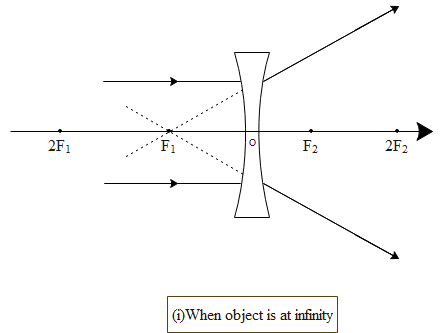
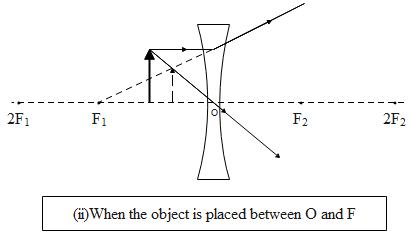
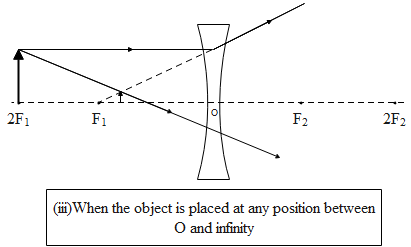
The position of the images when the object is placed at infinity, between O and F and any position between infinity and O are given below in the diagrammatic representation.
In the first diagram we have the object in the infinity position:
In the second diagram we have the object in the place that is between the O and F:
In the third diagram we have the object in the position that is placed between O and infinity:
Note We know that the principal axis is defined as the line that passes through the centre of curvature of a lens so that the light is either reflected or refracted. In the normal eye the optic axis is the direction in which objects are seen mostly distinctly optic axis.
We know that concave mirrors can produce both real and virtual images, they can be upright, in case the image is virtual or it is inverted if it is real. They can be behind the mirror (if it is virtual) or in front of the mirror (if it is real). The properties of the image are also enlarged, reduced or the same size as the object.
Complete step by step answer
We know that a concave lens always gives a virtual, erect and diminished image whatever may be the position of the object.
There are some properties which define the concave lens which include negative focal length and the incident rays always diverge away from the principal axis.
The position of the images when the object is placed at infinity, between O and F and any position between infinity and O are given below in the diagrammatic representation.
In the first diagram we have the object in the infinity position:
In the second diagram we have the object in the place that is between the O and F:
In the third diagram we have the object in the position that is placed between O and infinity:
Note We know that the principal axis is defined as the line that passes through the centre of curvature of a lens so that the light is either reflected or refracted. In the normal eye the optic axis is the direction in which objects are seen mostly distinctly optic axis.
We know that concave mirrors can produce both real and virtual images, they can be upright, in case the image is virtual or it is inverted if it is real. They can be behind the mirror (if it is virtual) or in front of the mirror (if it is real). The properties of the image are also enlarged, reduced or the same size as the object.
Recently Updated Pages
JEE Main 2023 April 6 Shift 1 Question Paper with Answer Key

JEE Main 2023 April 6 Shift 2 Question Paper with Answer Key
JEE Main 2023 (January 31 Evening Shift) Question Paper with Solutions [PDF]
JEE Main 2023 January 30 Shift 2 Question Paper with Answer Key
JEE Main 2023 January 25 Shift 1 Question Paper with Answer Key
JEE Main 2023 January 24 Shift 2 Question Paper with Answer Key
Trending doubts
JEE Main 2026: Session 2 Registration Open, City Intimation Slip, Exam Dates, Syllabus & Eligibility
JEE Main 2026 Application Login: Direct Link, Registration, Form Fill, and Steps
JEE Main Marking Scheme 2026- Paper-Wise Marks Distribution and Negative Marking Details
Understanding the Angle of Deviation in a Prism
Hybridisation in Chemistry – Concept, Types & Applications
How to Convert a Galvanometer into an Ammeter or Voltmeter
Other Pages
JEE Advanced Marks vs Ranks 2025: Understanding Category-wise Qualifying Marks and Previous Year Cut-offs
Dual Nature of Radiation and Matter Class 12 Physics Chapter 11 CBSE Notes - 2025-26
Understanding Uniform Acceleration in Physics
Understanding the Electric Field of a Uniformly Charged Ring
JEE Advanced Weightage 2025 Chapter-Wise for Physics, Maths and Chemistry
Derivation of Equation of Trajectory Explained for Students