




When you are standing still in rain, you have to hold your umbrella vertically to protect yourself.
(a) When you walk with velocity $90cm/s$ , you have to hold your umbrella at $53^\circ $ above the horizontal. What is the velocity of the raindrops relative to the ground and relative to you?
(b) If we walk with speed $160cm/s$ , how should you hold your umbrella?
Answer
 Verified
232.8k+ views
Hint If the actual downward velocity of rain be $\overrightarrow v $ and the horizontal velocity of the man be $\overrightarrow u $ , the relative velocity of rain with respect to the man is $w = \sqrt {{v^2} + {u^2}} $ . If the relative velocity makes an angle $\theta $ with the vertical, then, $\tan \theta = \dfrac{u}{v}$ . The relative velocity of raindrops with respect to the person and the speed of the person from the second question will be used to get the angle of the umbrella.
Formula used If the actual downward velocity of rain be $\overrightarrow v $ and the horizontal velocity of the man be $\overrightarrow u $ , the relative velocity of rain with respect to the man is $w = \sqrt {{v^2} + {u^2}} $ .
If the relative velocity makes an angle $\theta $ with the vertical, then, $\tan \theta = \dfrac{u}{v}$ .
Complete step by step answer In the absence of wind, rain falls vertically. But when a man moves forward during a rainfall, he has to hold his umbrella slantingly in front of him. This is due to the fact that the relative velocity of the falling rain with respect to the man makes an angle with the vertical.
Let the actual downward velocity of rain be $\overrightarrow v $ and the horizontal velocity of the man be $\overrightarrow u $ .
Hence, the relative velocity of rain with respect to the man is $\overrightarrow w = \overrightarrow v - \overrightarrow u $ .
$\therefore w = \sqrt {{v^2} + {u^2}} $
If the relative velocity makes an angle $\theta $ with the vertical, then, $\tan \theta = \dfrac{u}{v}$ .
(A) Now, it is given that the velocity of the man, $u = 90cm/s$ and let the actual velocity of rain be $v$ .
Also, the man has to hold his umbrella at $53^\circ $ .
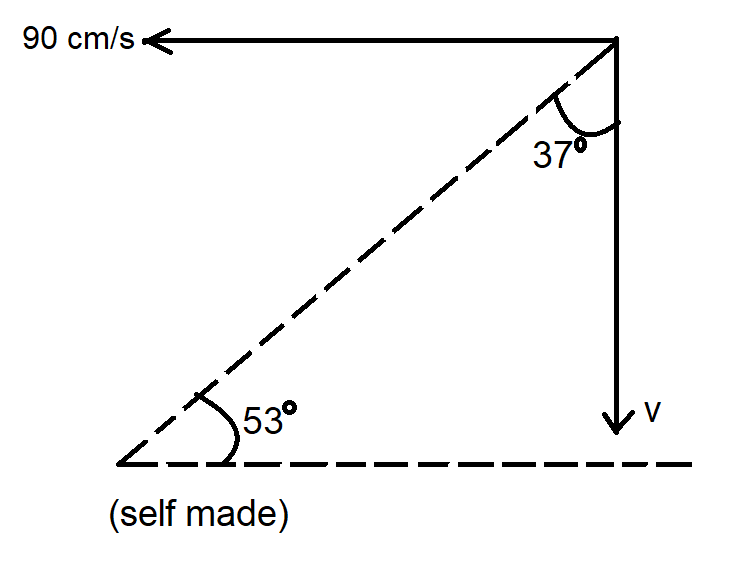
So, according to the formula, we get, $\tan 37^\circ = \dfrac{{90}}{v}$
or, $\dfrac{3}{4} = \dfrac{{90}}{v}$
or, $v = \dfrac{{90 \times 4}}{3} = 120cm/s$
So, the velocity of the raindrops relative to the ground $120cm/s$ .
Now, according to the formula, the relative velocity of rain with respect to the man is
$w = \sqrt {{{\left( {90} \right)}^2} + {{\left( {120} \right)}^2}} = 150cm/s$ .
(B) Now, the velocity of man becomes $160cm/s$ .
Also, we calculated that the relative velocity of rain with respect to the man is $120cm/s$ .
So, $u = 160cm/s$ and $v = 120cm/s$
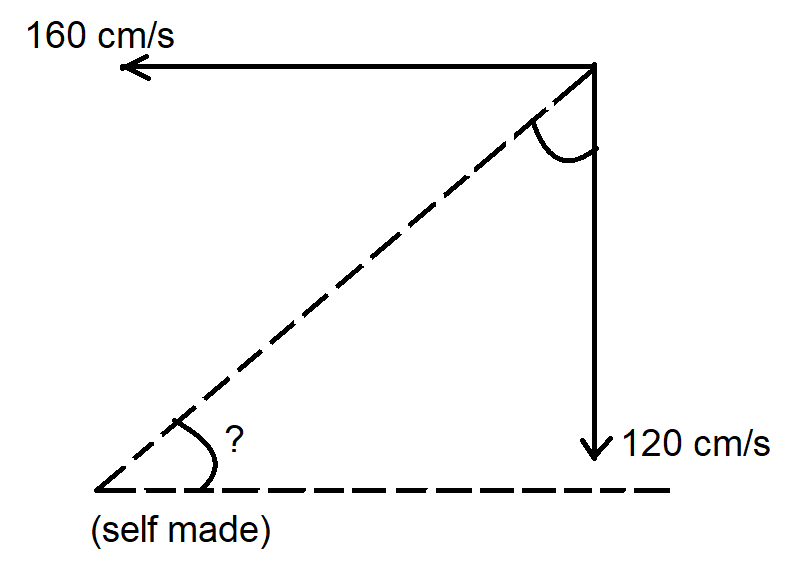
Let, the angle made by the umbrella is $\theta $ .
So, according to the formula, $\tan \theta = \dfrac{u}{v} = \dfrac{{160}}{{120}} = \dfrac{4}{3}$
or, ${\tan ^{ - 1}}\left( {\dfrac{4}{3}} \right) = \theta $
or, $\theta = 53^\circ $
So, the umbrella should be held at $53^\circ $ .
Note As the relative velocity of rain makes an angle with the vertical, it seems that rain comes down at an angle when we move. For the same reason, a speeding vehicle receives more rain on the front wind-screen than on the rear one. Similarly, a person sitting inside a moving train feels that the raindrops follow a slanted path.
Formula used If the actual downward velocity of rain be $\overrightarrow v $ and the horizontal velocity of the man be $\overrightarrow u $ , the relative velocity of rain with respect to the man is $w = \sqrt {{v^2} + {u^2}} $ .
If the relative velocity makes an angle $\theta $ with the vertical, then, $\tan \theta = \dfrac{u}{v}$ .
Complete step by step answer In the absence of wind, rain falls vertically. But when a man moves forward during a rainfall, he has to hold his umbrella slantingly in front of him. This is due to the fact that the relative velocity of the falling rain with respect to the man makes an angle with the vertical.
Let the actual downward velocity of rain be $\overrightarrow v $ and the horizontal velocity of the man be $\overrightarrow u $ .
Hence, the relative velocity of rain with respect to the man is $\overrightarrow w = \overrightarrow v - \overrightarrow u $ .
$\therefore w = \sqrt {{v^2} + {u^2}} $
If the relative velocity makes an angle $\theta $ with the vertical, then, $\tan \theta = \dfrac{u}{v}$ .
(A) Now, it is given that the velocity of the man, $u = 90cm/s$ and let the actual velocity of rain be $v$ .
Also, the man has to hold his umbrella at $53^\circ $ .
So, according to the formula, we get, $\tan 37^\circ = \dfrac{{90}}{v}$
or, $\dfrac{3}{4} = \dfrac{{90}}{v}$
or, $v = \dfrac{{90 \times 4}}{3} = 120cm/s$
So, the velocity of the raindrops relative to the ground $120cm/s$ .
Now, according to the formula, the relative velocity of rain with respect to the man is
$w = \sqrt {{{\left( {90} \right)}^2} + {{\left( {120} \right)}^2}} = 150cm/s$ .
(B) Now, the velocity of man becomes $160cm/s$ .
Also, we calculated that the relative velocity of rain with respect to the man is $120cm/s$ .
So, $u = 160cm/s$ and $v = 120cm/s$
Let, the angle made by the umbrella is $\theta $ .
So, according to the formula, $\tan \theta = \dfrac{u}{v} = \dfrac{{160}}{{120}} = \dfrac{4}{3}$
or, ${\tan ^{ - 1}}\left( {\dfrac{4}{3}} \right) = \theta $
or, $\theta = 53^\circ $
So, the umbrella should be held at $53^\circ $ .
Note As the relative velocity of rain makes an angle with the vertical, it seems that rain comes down at an angle when we move. For the same reason, a speeding vehicle receives more rain on the front wind-screen than on the rear one. Similarly, a person sitting inside a moving train feels that the raindrops follow a slanted path.
Recently Updated Pages
JEE Main 2023 April 6 Shift 1 Question Paper with Answer Key

JEE Main 2023 April 6 Shift 2 Question Paper with Answer Key
JEE Main 2023 (January 31 Evening Shift) Question Paper with Solutions [PDF]
JEE Main 2023 January 30 Shift 2 Question Paper with Answer Key
JEE Main 2023 January 25 Shift 1 Question Paper with Answer Key
JEE Main 2023 January 24 Shift 2 Question Paper with Answer Key
Trending doubts
JEE Main 2026: Session 2 Registration Open, City Intimation Slip, Exam Dates, Syllabus & Eligibility
JEE Main 2026 Application Login: Direct Link, Registration, Form Fill, and Steps
JEE Main Marking Scheme 2026- Paper-Wise Marks Distribution and Negative Marking Details
Understanding the Angle of Deviation in a Prism
Hybridisation in Chemistry – Concept, Types & Applications
How to Convert a Galvanometer into an Ammeter or Voltmeter
Other Pages
JEE Advanced Marks vs Ranks 2025: Understanding Category-wise Qualifying Marks and Previous Year Cut-offs
Laws of Motion Class 11 Physics Chapter 4 CBSE Notes - 2025-26
Waves Class 11 Physics Chapter 14 CBSE Notes - 2025-26
Mechanical Properties of Fluids Class 11 Physics Chapter 9 CBSE Notes - 2025-26
Thermodynamics Class 11 Physics Chapter 11 CBSE Notes - 2025-26
Units And Measurements Class 11 Physics Chapter 1 CBSE Notes - 2025-26