




At which place earth’s magnetism becomes horizontal?
A) Magnetic Pole
B) Geographic Pole
C) Magnetic Meridian
D) Magnetic Equator
Answer
 Verified
232.8k+ views
Hint: As we know that the Geographical pole of earth is that point on earth through which its axis of rotation passes through. There are two geographical poles of earth, north and the south geographical poles.
Complete step by step solution:
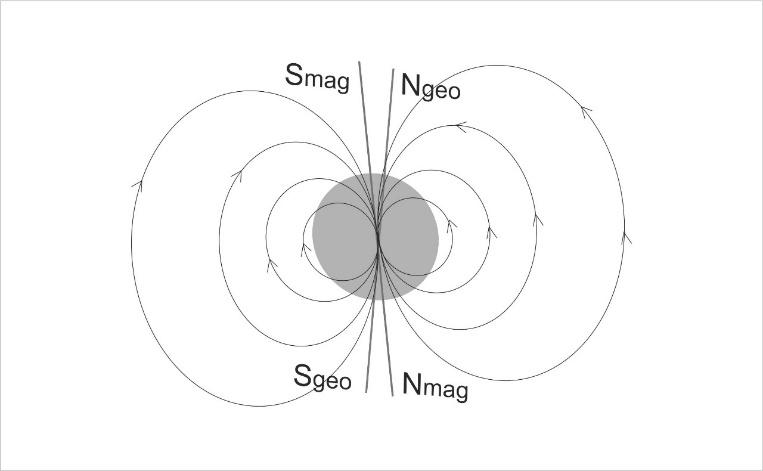
Figure 1: Magnetic field lines of Earth
In the above diagram if we see, there are two straight lines which pass through the earth. The green line is the one which depicts the geographic poles of the earth, i.e. the points through which it passes. The red line shown is the one which shows the magnetic poles of the earth. The magnetic pole line is basically tilted at a very small angle of \[11.3^\circ \]. The axis of rotation of earth is along the geographic pole line itself.
Now if we see that natural magnetic lines rise from the magnetic north pole and end up at the magnetic South Pole. The intensity of these lines is more towards the core of the earth. These magnetic field lines occur because of the movement of the molten metal inside the earth’s crust. Now when these magnetic field lines originate from the magnetic north pole and terminate at the magnetic South Pole, the direction of the field lines is changing every moment with respect to the earth. So, the field lines are vertical at the magnetic poles hence they cannot be horizontal at the magnetic poles. Again, if we see figure 2, there is a horizontal dotted line shown which is the geographic equator and there occurs a point in the field lines which becomes parallel to the magnetic equator of the earth. At this particular point, say at P as shown in figure 2, the earth’s magnetism becomes horizontal.
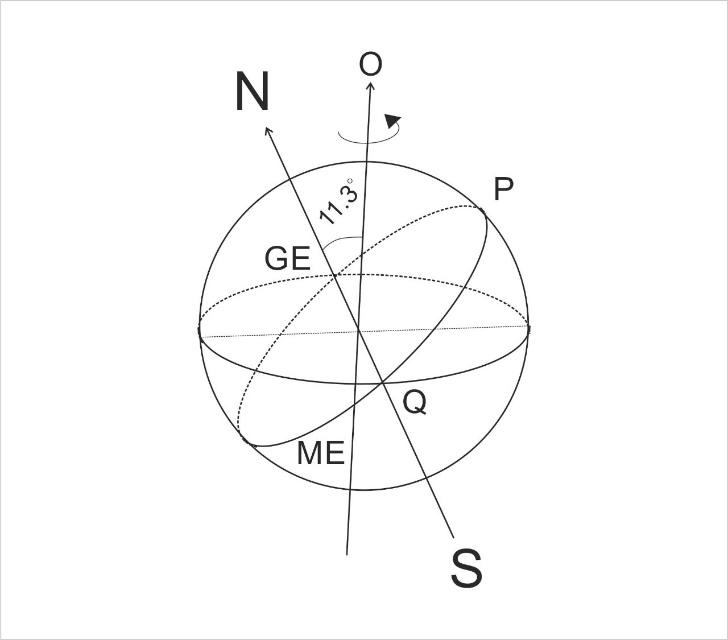
Figure 2: magnetic and geographic equator
Thus, the correct option is D.
Note: As we know that the magnetic equator is that imaginary ellipse on which the magnetic field lines become parallel to the earth’s surface and the magnetic field lines originate from magnetic north pole and terminate at magnetic South Pole, the direction of the field lines is changing every moment with respect to the earth.
Complete step by step solution:
Figure 1: Magnetic field lines of Earth
In the above diagram if we see, there are two straight lines which pass through the earth. The green line is the one which depicts the geographic poles of the earth, i.e. the points through which it passes. The red line shown is the one which shows the magnetic poles of the earth. The magnetic pole line is basically tilted at a very small angle of \[11.3^\circ \]. The axis of rotation of earth is along the geographic pole line itself.
Now if we see that natural magnetic lines rise from the magnetic north pole and end up at the magnetic South Pole. The intensity of these lines is more towards the core of the earth. These magnetic field lines occur because of the movement of the molten metal inside the earth’s crust. Now when these magnetic field lines originate from the magnetic north pole and terminate at the magnetic South Pole, the direction of the field lines is changing every moment with respect to the earth. So, the field lines are vertical at the magnetic poles hence they cannot be horizontal at the magnetic poles. Again, if we see figure 2, there is a horizontal dotted line shown which is the geographic equator and there occurs a point in the field lines which becomes parallel to the magnetic equator of the earth. At this particular point, say at P as shown in figure 2, the earth’s magnetism becomes horizontal.
Figure 2: magnetic and geographic equator
Thus, the correct option is D.
Note: As we know that the magnetic equator is that imaginary ellipse on which the magnetic field lines become parallel to the earth’s surface and the magnetic field lines originate from magnetic north pole and terminate at magnetic South Pole, the direction of the field lines is changing every moment with respect to the earth.
Recently Updated Pages
JEE Main 2023 April 6 Shift 1 Question Paper with Answer Key

JEE Main 2023 April 6 Shift 2 Question Paper with Answer Key
JEE Main 2023 (January 31 Evening Shift) Question Paper with Solutions [PDF]
JEE Main 2023 January 30 Shift 2 Question Paper with Answer Key
JEE Main 2023 January 25 Shift 1 Question Paper with Answer Key
JEE Main 2023 January 24 Shift 2 Question Paper with Answer Key
Trending doubts
JEE Main 2026: Session 2 Registration Open, City Intimation Slip, Exam Dates, Syllabus & Eligibility
JEE Main 2026 Application Login: Direct Link, Registration, Form Fill, and Steps
Understanding the Angle of Deviation in a Prism
Hybridisation in Chemistry – Concept, Types & Applications
How to Convert a Galvanometer into an Ammeter or Voltmeter
Understanding Uniform Acceleration in Physics
Other Pages
JEE Advanced Marks vs Ranks 2025: Understanding Category-wise Qualifying Marks and Previous Year Cut-offs
Dual Nature of Radiation and Matter Class 12 Physics Chapter 11 CBSE Notes - 2025-26
Understanding the Electric Field of a Uniformly Charged Ring
JEE Advanced Weightage 2025 Chapter-Wise for Physics, Maths and Chemistry
Derivation of Equation of Trajectory Explained for Students
Understanding Electromagnetic Waves and Their Importance