




What color of light deviates the maximum in dispersion of white light by the prism?
A) Violet
B) Blue
C) Green
D) Red
Answer
 Verified
232.8k+ views
Hint: The white light is a combination of several lights but can only be seen when refracted through a prism. The VIBGYOR or the seven lights lies within the spectrum of IR and UV region and the position of the light above each other is dependent on their wavelength and frequency.
Complete step by step solution:
As given in the question, the lights when passing through a prism at a certain angle refracts the light with the white light divided into seven main color with red at the top and violet at the bottom, now the dispersion of the white light depends upon the wavelength and frequency and the relationship between the wavelength and frequency are inversely proportional to each other meaning higher the frequency lower the wavelength and vice versa.
The diagram below shows the position of color based on their wavelength and frequency in upright order.
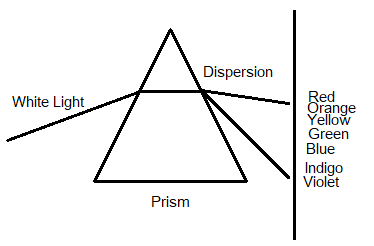
Hence, by looking at the diagram we can say that the color violet's angle of deviation is higher and that of the red is lower with violet having the lower wavelength and red having the higher wavelength and the frequency is reversed for both the color due to inverse proportionality with wavelength.
Note: The color gained from the dispersion of the white light after passing through the prism is from bottom to top as violet, indigo, blue, green, yellow, orange and red and termed as VIBGYOR now the actual order is ROYGBIV but to memorize the name of the colors the reverse form is used.
Complete step by step solution:
As given in the question, the lights when passing through a prism at a certain angle refracts the light with the white light divided into seven main color with red at the top and violet at the bottom, now the dispersion of the white light depends upon the wavelength and frequency and the relationship between the wavelength and frequency are inversely proportional to each other meaning higher the frequency lower the wavelength and vice versa.
The diagram below shows the position of color based on their wavelength and frequency in upright order.
Hence, by looking at the diagram we can say that the color violet's angle of deviation is higher and that of the red is lower with violet having the lower wavelength and red having the higher wavelength and the frequency is reversed for both the color due to inverse proportionality with wavelength.
Note: The color gained from the dispersion of the white light after passing through the prism is from bottom to top as violet, indigo, blue, green, yellow, orange and red and termed as VIBGYOR now the actual order is ROYGBIV but to memorize the name of the colors the reverse form is used.
Recently Updated Pages
JEE Main 2023 April 6 Shift 1 Question Paper with Answer Key

JEE Main 2023 April 6 Shift 2 Question Paper with Answer Key
JEE Main 2023 (January 31 Evening Shift) Question Paper with Solutions [PDF]
JEE Main 2023 January 30 Shift 2 Question Paper with Answer Key
JEE Main 2023 January 25 Shift 1 Question Paper with Answer Key
JEE Main 2023 January 24 Shift 2 Question Paper with Answer Key
Trending doubts
JEE Main 2026: Session 2 Registration Open, City Intimation Slip, Exam Dates, Syllabus & Eligibility
JEE Main 2026 Application Login: Direct Link, Registration, Form Fill, and Steps
Understanding the Angle of Deviation in a Prism
Hybridisation in Chemistry – Concept, Types & Applications
How to Convert a Galvanometer into an Ammeter or Voltmeter
Understanding Uniform Acceleration in Physics
Other Pages
JEE Advanced Marks vs Ranks 2025: Understanding Category-wise Qualifying Marks and Previous Year Cut-offs
Dual Nature of Radiation and Matter Class 12 Physics Chapter 11 CBSE Notes - 2025-26
Understanding the Electric Field of a Uniformly Charged Ring
JEE Advanced Weightage 2025 Chapter-Wise for Physics, Maths and Chemistry
Derivation of Equation of Trajectory Explained for Students
Understanding Electromagnetic Waves and Their Importance