




What is electromagnet? Draw a circuit diagram to show how a soft iron piece can be transformed into an electromagnet.
Answer
 Verified
233.1k+ views
Hint: An electromagnet is a non-permanent magnet formed when the current passes through a solenoid and a material like the soft iron core gets magnetized. The magnetic properties are present only when the current passes through the insulated copper wire surrounding the solenoid.
Complete step by step solution:
Electromagnet is a magnet where the magnetic field is produced by electric current. It is known that when a current passes through a coil, it generates a magnetic field around it. This property of electromagnetism is applied in electromagnetics.
To create an solenoid, an insulated copper wire is used, this wire is wound around a soft iron core and both the ends of this wire are connected to a battery, and the switch is closed. When the current flows through the wire loop, it generates a small magnetic field around it. Many such loops are formed when the wire is wound around the metal core. Thus the intensity of the magnetic field is increased .All the magnetic field lines created by the wire loops pass through the soft iron core. Thus it gets magnetized as well, this results in formation of an electromagnet, or a solenoid.
This diagram shows how a soft iron piece can be transformed into an electromagnet-
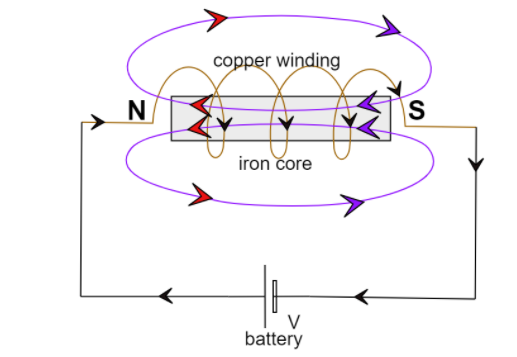
The iron core behaves like a bar magnet, and has a North pole where the magnetic field lines come out and a south pole where the field lines go back into the core.
Note: The direction of winding of the insulated copper wire is given by the right hand thumb rule. The polarity of the magnet can be reversed by reversing the direction of current. This is either done by changing the polarity of the magnet or by changing the direction of winding, from clockwise to anticlockwise.
Complete step by step solution:
Electromagnet is a magnet where the magnetic field is produced by electric current. It is known that when a current passes through a coil, it generates a magnetic field around it. This property of electromagnetism is applied in electromagnetics.
To create an solenoid, an insulated copper wire is used, this wire is wound around a soft iron core and both the ends of this wire are connected to a battery, and the switch is closed. When the current flows through the wire loop, it generates a small magnetic field around it. Many such loops are formed when the wire is wound around the metal core. Thus the intensity of the magnetic field is increased .All the magnetic field lines created by the wire loops pass through the soft iron core. Thus it gets magnetized as well, this results in formation of an electromagnet, or a solenoid.
This diagram shows how a soft iron piece can be transformed into an electromagnet-
The iron core behaves like a bar magnet, and has a North pole where the magnetic field lines come out and a south pole where the field lines go back into the core.
Note: The direction of winding of the insulated copper wire is given by the right hand thumb rule. The polarity of the magnet can be reversed by reversing the direction of current. This is either done by changing the polarity of the magnet or by changing the direction of winding, from clockwise to anticlockwise.
Recently Updated Pages
JEE Main 2023 April 6 Shift 1 Question Paper with Answer Key

JEE Main 2023 April 6 Shift 2 Question Paper with Answer Key
JEE Main 2023 (January 31 Evening Shift) Question Paper with Solutions [PDF]
JEE Main 2023 January 30 Shift 2 Question Paper with Answer Key
JEE Main 2023 January 25 Shift 1 Question Paper with Answer Key
JEE Main 2023 January 24 Shift 2 Question Paper with Answer Key
Trending doubts
JEE Main 2026: Session 2 Registration Open, City Intimation Slip, Exam Dates, Syllabus & Eligibility
JEE Main 2026 Application Login: Direct Link, Registration, Form Fill, and Steps
Understanding the Angle of Deviation in a Prism
Hybridisation in Chemistry – Concept, Types & Applications
How to Convert a Galvanometer into an Ammeter or Voltmeter
Understanding Uniform Acceleration in Physics
Other Pages
JEE Advanced Marks vs Ranks 2025: Understanding Category-wise Qualifying Marks and Previous Year Cut-offs
Dual Nature of Radiation and Matter Class 12 Physics Chapter 11 CBSE Notes - 2025-26
Understanding the Electric Field of a Uniformly Charged Ring
JEE Advanced Weightage 2025 Chapter-Wise for Physics, Maths and Chemistry
Derivation of Equation of Trajectory Explained for Students
Understanding Electromagnetic Waves and Their Importance