




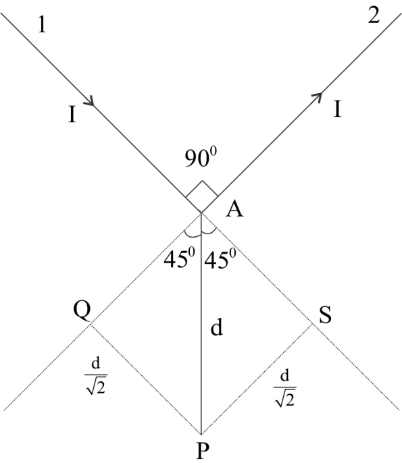
Find the magnetic field at P due to arrangement as shown.
Answer
 Verified
232.8k+ views
Hint: In this question the bended wire arrangement can be considered as a system of two wires which are of semi-infinite length and aligned perpendicular to each other. So, the net magnetic field at Point ${{P}}$ can be found by superposition Principle i.e. by sum of magnetic fields due to two wires.
Formula used:
(i) ${{B}}\;{{ = }}\dfrac{{{{{\mu }}_{{0}}}}}{{{{4\pi }}}}\dfrac{{{I}}}{{{r}}}\left( {{{Sin}}{{{\theta }}_{{1}}}{{ - Sin}}{{{\theta }}_{{2}}}} \right)$
Where ${{B}}$ is magnetic field, ${{{\mu }}_{{0}}}$ is absolute permeability of free space, ${{I}}$ is amount of current flowing in the conductor, ${{r}}$ is perpendicular distance from the wire to the observation Point P, ${{{\theta }}_{{2}}}$ is the angle which the line joining Point P to lower end of wire makes with perpendicular line with the conductor/wire and ${{{\theta }}_{{1}}}$ is the angle which same perpendicular distance line makes with the line from point P to upper end of wire.
Complete step by step solution:
(i) Magnetic field due to wire $1$ As it is clear from the diagram the wire $1$ carries a current ${{I}}$ a point ${{P}}$ which is at ${{d}}$distance away from its lower end. And to point ${{P}}$ is given ${{PS}}\;{{ = }}\;{{dSin4}}{{{5}}^{{o}}}$
So,
${{PS}}\;{{ = }}\;\dfrac{{{d}}}{{\sqrt {{2}} }}{{\_\_\_}}\left( {{1}} \right)$
So, by right hand rule the direction of magnetic field at point ${{P}}$ due to wire $1$ is inward. If ${{B,}}$ in magnetic field at point ${{P}}$ due to wire $1$ end ${{PS}}$ is normal distance of wire from observation point then,
${{{B}}_{{1}}}\;{{ = }}\;\dfrac{{{{{\mu }}_{{0}}}}}{{{{4\pi }}}}\dfrac{{{I}}}{{{{PS}}}}\left( {{{Sin}}{{{\theta }}_{{1}}}{{ - Sin}}{{{\theta }}_{{2}}}} \right)\;{{\_\_\_}}\left( {{2}} \right)$
Also, from fig it is clear that ${{{\theta }}_{{1}}}{{ = }}\;{{9}}{{{0}}^{{o}}}{{,}}\;{{{\theta }}_{{2}}}{{ = }}\;{{4}}{{{5}}^{{o}}}$
By substituting the values of angles and ${{PS}}$ in equation $\left( 2 \right)$
We get
${{{B}}_{{1}}}{{ = }}\;\dfrac{{{{{\mu }}_{{0}}}}}{{{{4\pi }}}}\dfrac{{\sqrt {{2}} {{I}}}}{{{d}}}\left( {{{Sin9}}{{{0}}^{{o}}}{{ - Sin4}}{{{5}}^{{o}}}} \right)$
${{{B}}_{{1}}}\;{{ = }}\;\dfrac{{{{{\mu }}_{{0}}}}}{{{{4\pi }}}}\dfrac{{\sqrt {{2}} {{I}}}}{{{d}}}\left[ {{{1 - }}\dfrac{{{1}}}{{\sqrt {{2}} }}} \right]\;{{Inward}}\;{{\_\_\_}}\left( 3 \right)$
(ii) Magnetic field due to wire $2$ :
In the diagram ${{PQ}}$ is perpendicular distance of Point ${{P}}$ from:
Direction of current
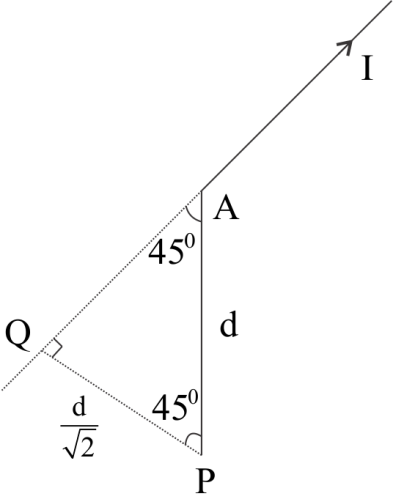
${{PQ}}\;{{ = }}\;{{dSin4}}{{{5}}^{{o}}}$
Here ${{{\theta }}_{{1}}}$ is ${90^ \circ }$ and
So, if ${{{B}}_{{2}}}$ is magnetic field at ${{P}}$ due to wire $2$ directing inwards by right hand rule is given by
${{{B}}_{{2}}}\;{{ = }}\dfrac{{{{{\mu }}_{{0}}}}}{{{{4\pi }}}}\dfrac{{{I}}}{{{{PQ}}}}\left( {{{Sin}}{{{\theta }}_{{1}}}{{ - Sin}}{{{\theta }}_{{2}}}} \right)\;{{\_\_\_}}\left( {{5}} \right)$
By substituting values of ${{PQ}}$ and ${{{\theta }}_{{1}}}{{,}}{{{\theta }}_{{2}}}$ in$\left( 5 \right)$ we get
${{{B}}_{{2}}}\;{{ = }}\dfrac{{{{{\mu }}_{{0}}}}}{{{{4\pi }}}}\dfrac{{\sqrt {{2}} {{I}}}}{{{d}}}\left( {{{Sin9}}{{{0}}^{{o}}}{{ - Sin4}}{{{5}}^{{o}}}} \right)$
${{{B}}_{{2}}}\;{{ = }}\;\dfrac{{{{{\mu }}_{{0}}}}}{{{{4\pi }}}}\dfrac{{\sqrt {{2}} {{I}}}}{{{d}}}\left( {{{1 - }}\dfrac{{{1}}}{{\sqrt {{2}} }}} \right)\;{{inwards}}\;{{\_\_\_}}\left( {{6}} \right)$
By equation $\left( 5 \right)$ and $\left( 6 \right),$ net magnetic field at ${{P}}$ is given by
${{B}}\;{{ = }}\;{{{B}}_{{1}}}{{ + }}{{{B}}_{{2}}}$
${{B}}\;{{ = }}\;\dfrac{{{{{\mu }}_{{0}}}}}{{{{4\pi }}}}{{.}}\dfrac{{\sqrt {{2}} {{I}}}}{{{d}}}\left( {{{1 - }}\dfrac{{{1}}}{{\sqrt {{2}} }}} \right){{ + }}\;\dfrac{{{{{\mu }}_{{0}}}}}{{{{4\pi }}}}\dfrac{{\sqrt {{2}} {{I}}}}{{{d}}}\left( {{{1 - }}\dfrac{{{1}}}{{\sqrt {{2}} }}} \right)$
${{B}}\;{{ = }}\;\dfrac{{{{{\mu }}_{{0}}}}}{{\sqrt {{2}} {{\pi }}}}\dfrac{{{I}}}{{{d}}}\left( {{{1 - }}\dfrac{{{1}}}{{\sqrt {{2}} }}} \right)$
Note: The distance ${{'r'}}$ which is used in the formula is perpendicular distance. So if it is not given then first find perpendicular distance by means of resolution of vectors and then substitute in the relation. The superposition principle is also known as superposition property. It states that, for all linear systems, the net response caused by two or more fields/forces is the sum of the responses that would have been caused by each stimulus individually.
Formula used:
(i) ${{B}}\;{{ = }}\dfrac{{{{{\mu }}_{{0}}}}}{{{{4\pi }}}}\dfrac{{{I}}}{{{r}}}\left( {{{Sin}}{{{\theta }}_{{1}}}{{ - Sin}}{{{\theta }}_{{2}}}} \right)$
Where ${{B}}$ is magnetic field, ${{{\mu }}_{{0}}}$ is absolute permeability of free space, ${{I}}$ is amount of current flowing in the conductor, ${{r}}$ is perpendicular distance from the wire to the observation Point P, ${{{\theta }}_{{2}}}$ is the angle which the line joining Point P to lower end of wire makes with perpendicular line with the conductor/wire and ${{{\theta }}_{{1}}}$ is the angle which same perpendicular distance line makes with the line from point P to upper end of wire.
Complete step by step solution:
(i) Magnetic field due to wire $1$ As it is clear from the diagram the wire $1$ carries a current ${{I}}$ a point ${{P}}$ which is at ${{d}}$distance away from its lower end. And to point ${{P}}$ is given ${{PS}}\;{{ = }}\;{{dSin4}}{{{5}}^{{o}}}$
So,
${{PS}}\;{{ = }}\;\dfrac{{{d}}}{{\sqrt {{2}} }}{{\_\_\_}}\left( {{1}} \right)$
So, by right hand rule the direction of magnetic field at point ${{P}}$ due to wire $1$ is inward. If ${{B,}}$ in magnetic field at point ${{P}}$ due to wire $1$ end ${{PS}}$ is normal distance of wire from observation point then,
${{{B}}_{{1}}}\;{{ = }}\;\dfrac{{{{{\mu }}_{{0}}}}}{{{{4\pi }}}}\dfrac{{{I}}}{{{{PS}}}}\left( {{{Sin}}{{{\theta }}_{{1}}}{{ - Sin}}{{{\theta }}_{{2}}}} \right)\;{{\_\_\_}}\left( {{2}} \right)$
Also, from fig it is clear that ${{{\theta }}_{{1}}}{{ = }}\;{{9}}{{{0}}^{{o}}}{{,}}\;{{{\theta }}_{{2}}}{{ = }}\;{{4}}{{{5}}^{{o}}}$
By substituting the values of angles and ${{PS}}$ in equation $\left( 2 \right)$
We get
${{{B}}_{{1}}}{{ = }}\;\dfrac{{{{{\mu }}_{{0}}}}}{{{{4\pi }}}}\dfrac{{\sqrt {{2}} {{I}}}}{{{d}}}\left( {{{Sin9}}{{{0}}^{{o}}}{{ - Sin4}}{{{5}}^{{o}}}} \right)$
${{{B}}_{{1}}}\;{{ = }}\;\dfrac{{{{{\mu }}_{{0}}}}}{{{{4\pi }}}}\dfrac{{\sqrt {{2}} {{I}}}}{{{d}}}\left[ {{{1 - }}\dfrac{{{1}}}{{\sqrt {{2}} }}} \right]\;{{Inward}}\;{{\_\_\_}}\left( 3 \right)$
(ii) Magnetic field due to wire $2$ :
In the diagram ${{PQ}}$ is perpendicular distance of Point ${{P}}$ from:
Direction of current
${{PQ}}\;{{ = }}\;{{dSin4}}{{{5}}^{{o}}}$
Here ${{{\theta }}_{{1}}}$ is ${90^ \circ }$ and
So, if ${{{B}}_{{2}}}$ is magnetic field at ${{P}}$ due to wire $2$ directing inwards by right hand rule is given by
${{{B}}_{{2}}}\;{{ = }}\dfrac{{{{{\mu }}_{{0}}}}}{{{{4\pi }}}}\dfrac{{{I}}}{{{{PQ}}}}\left( {{{Sin}}{{{\theta }}_{{1}}}{{ - Sin}}{{{\theta }}_{{2}}}} \right)\;{{\_\_\_}}\left( {{5}} \right)$
By substituting values of ${{PQ}}$ and ${{{\theta }}_{{1}}}{{,}}{{{\theta }}_{{2}}}$ in$\left( 5 \right)$ we get
${{{B}}_{{2}}}\;{{ = }}\dfrac{{{{{\mu }}_{{0}}}}}{{{{4\pi }}}}\dfrac{{\sqrt {{2}} {{I}}}}{{{d}}}\left( {{{Sin9}}{{{0}}^{{o}}}{{ - Sin4}}{{{5}}^{{o}}}} \right)$
${{{B}}_{{2}}}\;{{ = }}\;\dfrac{{{{{\mu }}_{{0}}}}}{{{{4\pi }}}}\dfrac{{\sqrt {{2}} {{I}}}}{{{d}}}\left( {{{1 - }}\dfrac{{{1}}}{{\sqrt {{2}} }}} \right)\;{{inwards}}\;{{\_\_\_}}\left( {{6}} \right)$
By equation $\left( 5 \right)$ and $\left( 6 \right),$ net magnetic field at ${{P}}$ is given by
${{B}}\;{{ = }}\;{{{B}}_{{1}}}{{ + }}{{{B}}_{{2}}}$
${{B}}\;{{ = }}\;\dfrac{{{{{\mu }}_{{0}}}}}{{{{4\pi }}}}{{.}}\dfrac{{\sqrt {{2}} {{I}}}}{{{d}}}\left( {{{1 - }}\dfrac{{{1}}}{{\sqrt {{2}} }}} \right){{ + }}\;\dfrac{{{{{\mu }}_{{0}}}}}{{{{4\pi }}}}\dfrac{{\sqrt {{2}} {{I}}}}{{{d}}}\left( {{{1 - }}\dfrac{{{1}}}{{\sqrt {{2}} }}} \right)$
${{B}}\;{{ = }}\;\dfrac{{{{{\mu }}_{{0}}}}}{{\sqrt {{2}} {{\pi }}}}\dfrac{{{I}}}{{{d}}}\left( {{{1 - }}\dfrac{{{1}}}{{\sqrt {{2}} }}} \right)$
Note: The distance ${{'r'}}$ which is used in the formula is perpendicular distance. So if it is not given then first find perpendicular distance by means of resolution of vectors and then substitute in the relation. The superposition principle is also known as superposition property. It states that, for all linear systems, the net response caused by two or more fields/forces is the sum of the responses that would have been caused by each stimulus individually.
Recently Updated Pages
JEE Main 2023 April 6 Shift 1 Question Paper with Answer Key

JEE Main 2023 April 6 Shift 2 Question Paper with Answer Key
JEE Main 2023 (January 31 Evening Shift) Question Paper with Solutions [PDF]
JEE Main 2023 January 30 Shift 2 Question Paper with Answer Key
JEE Main 2023 January 25 Shift 1 Question Paper with Answer Key
JEE Main 2023 January 24 Shift 2 Question Paper with Answer Key
Trending doubts
JEE Main 2026: Session 2 Registration Open, City Intimation Slip, Exam Dates, Syllabus & Eligibility
JEE Main 2026 Application Login: Direct Link, Registration, Form Fill, and Steps
Understanding the Angle of Deviation in a Prism
Hybridisation in Chemistry – Concept, Types & Applications
How to Convert a Galvanometer into an Ammeter or Voltmeter
Understanding Uniform Acceleration in Physics
Other Pages
JEE Advanced Marks vs Ranks 2025: Understanding Category-wise Qualifying Marks and Previous Year Cut-offs
Dual Nature of Radiation and Matter Class 12 Physics Chapter 11 CBSE Notes - 2025-26
Understanding the Electric Field of a Uniformly Charged Ring
JEE Advanced Weightage 2025 Chapter-Wise for Physics, Maths and Chemistry
Derivation of Equation of Trajectory Explained for Students
Understanding Electromagnetic Waves and Their Importance