




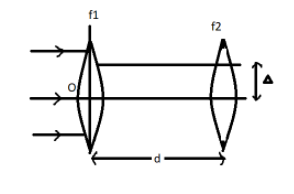
Find the $y$ coordinate of the focal of this lens system.
A) $\dfrac{{({f_1} + d)\Delta }}{{({f_1} + {f_2} - d)}}$
B) $\dfrac{{2({f_1} + d)\Delta }}{{({f_1} + {f_2} + d)}}$
C) $\dfrac{{2({f_1} - d)\Delta }}{{({f_1} + {f_2} + d)}}$
D) $\dfrac{{({f_1} - d)\Delta }}{{({f_1} + {f_2} - d)}}$
Answer
 Verified
233.1k+ views
Hint: A lens is a Transmissive optical instrument that focuses or distributes a beam of light by refraction. A single piece of transparent material consists of a simple lens whereas a compound lens consists of multiple simple lenses (elements), typically arranged around a common axis. Objectives consist of glass or plastic materials and are soiled and polished or designed to a desired form. The lens, unlike a prism, can transform light into a picture and refract light. Often called lenses, such as microwaves, electron lenses, acoustic lenses or explosive lenses, are instruments that concentrate or scatter waves and radiation other than visible light.
Complete step by step solution:
The picture will form at the centre of the second lens after the refraction of parallel rays from the first lens. The first picture is created from the first lens at a distance of ${f_1}$ .
This picture is an object for second-lens refraction, for positioning the object
$u = {f_1} - d$
$u$ is the distance of object from first mirror
$d$ is the distance between two lens
Therefore,
$\dfrac{1}{v} - \dfrac{1}{{{f_1} - d}} = \dfrac{1}{{{f_2}}}$
$ \Rightarrow v = \dfrac {{({f_1} - d) {f_2}}} {{{f_1} + {f_2} - d}} $
The magnification can be written as,
$\dfrac {v} {u} = \dfrac{{{f_2}}}{{{f_1} + {f_2} - d}} $
The picture was created on the $x$ -axis after the refraction from the first lens, but the second lens is focused on the $x$ - axis at a distance of $\Delta $.
$m = \dfrac{y} {{- \Delta}}$
Hence,
$y = \dfrac {{- \Delta {f_2}}} {{{f_1} + {f_2} - d}} $
$y$ Coordinate with respect to the centre of first lens,
$\Delta + y = \Delta + \dfrac {{- \Delta {f_2}}} {{{f_1} + {f_2} - d}} $
$ \Rightarrow \dfrac {{({f_1} - d)\Delta}} {{{f_1} + {f_2} - d}} $
Hence correct option is (D).
Note: The curvatures in the two optical surfaces are labelled for the lenses. If the two sides are convex, a lens is biconvex (or double convex or just convex). The lens is equiconvex because all surfaces have the same curvature radius. Biconcave (or concave) is a lens with two concave surfaces. The lens is Plano-convex or Plano-concave while one of the surfaces is smooth, depending on the curvature in the other. Convex-concave or meniscus is a lens with one convex and one concave side. This is the most widely used type of lens in correction lenses.
Complete step by step solution:
The picture will form at the centre of the second lens after the refraction of parallel rays from the first lens. The first picture is created from the first lens at a distance of ${f_1}$ .
This picture is an object for second-lens refraction, for positioning the object
$u = {f_1} - d$
$u$ is the distance of object from first mirror
$d$ is the distance between two lens
Therefore,
$\dfrac{1}{v} - \dfrac{1}{{{f_1} - d}} = \dfrac{1}{{{f_2}}}$
$ \Rightarrow v = \dfrac {{({f_1} - d) {f_2}}} {{{f_1} + {f_2} - d}} $
The magnification can be written as,
$\dfrac {v} {u} = \dfrac{{{f_2}}}{{{f_1} + {f_2} - d}} $
The picture was created on the $x$ -axis after the refraction from the first lens, but the second lens is focused on the $x$ - axis at a distance of $\Delta $.
$m = \dfrac{y} {{- \Delta}}$
Hence,
$y = \dfrac {{- \Delta {f_2}}} {{{f_1} + {f_2} - d}} $
$y$ Coordinate with respect to the centre of first lens,
$\Delta + y = \Delta + \dfrac {{- \Delta {f_2}}} {{{f_1} + {f_2} - d}} $
$ \Rightarrow \dfrac {{({f_1} - d)\Delta}} {{{f_1} + {f_2} - d}} $
Hence correct option is (D).
Note: The curvatures in the two optical surfaces are labelled for the lenses. If the two sides are convex, a lens is biconvex (or double convex or just convex). The lens is equiconvex because all surfaces have the same curvature radius. Biconcave (or concave) is a lens with two concave surfaces. The lens is Plano-convex or Plano-concave while one of the surfaces is smooth, depending on the curvature in the other. Convex-concave or meniscus is a lens with one convex and one concave side. This is the most widely used type of lens in correction lenses.
Recently Updated Pages
JEE Main 2023 April 6 Shift 1 Question Paper with Answer Key

JEE Main 2023 April 6 Shift 2 Question Paper with Answer Key
JEE Main 2023 (January 31 Evening Shift) Question Paper with Solutions [PDF]
JEE Main 2023 January 30 Shift 2 Question Paper with Answer Key
JEE Main 2023 January 25 Shift 1 Question Paper with Answer Key
JEE Main 2023 January 24 Shift 2 Question Paper with Answer Key
Trending doubts
JEE Main 2026: Session 2 Registration Open, City Intimation Slip, Exam Dates, Syllabus & Eligibility
JEE Main 2026 Application Login: Direct Link, Registration, Form Fill, and Steps
JEE Main Marking Scheme 2026- Paper-Wise Marks Distribution and Negative Marking Details
Understanding the Angle of Deviation in a Prism
Hybridisation in Chemistry – Concept, Types & Applications
How to Convert a Galvanometer into an Ammeter or Voltmeter
Other Pages
JEE Advanced Marks vs Ranks 2025: Understanding Category-wise Qualifying Marks and Previous Year Cut-offs
Understanding Uniform Acceleration in Physics
Dual Nature of Radiation and Matter Class 12 Physics Chapter 11 CBSE Notes - 2025-26
Understanding Electromagnetic Waves and Their Importance
Understanding the Electric Field of a Uniformly Charged Ring
JEE Advanced Weightage 2025 Chapter-Wise for Physics, Maths and Chemistry