




What is the flux through a cube of side ‘a’ if a point charge q is at one of its corners ?
A) \[\dfrac{q}{{{\varepsilon _\circ }}}\]
B) \[\dfrac{q}{{2{\varepsilon _\circ }}}\]
C) \[\dfrac{{2q}}{{{\varepsilon _\circ }}}\]
D) \[\dfrac{q}{{8{\varepsilon _\circ }}}\]
Answer
 Verified
526.8k+ views
Hint: Electric flux is the rate of flow of the electric field through a given area. According to gauss law, the electric flux through a closed surface is equal to \[\dfrac{q}{{{\varepsilon _\circ }}}\], if q is the charge enclosed in it.
In case if a charge is placed at one of the corners of the cube then the amount of charge enclosed in it is eighth part of the charge so the flux is also the eighth part of \[\dfrac{q}{{{\varepsilon _\circ }}}\].
Formula used:
Gauss law: According to gauss law :- If a charge “q ” is enclosed in a closed surface then the net flux emerging out of the closed surface is \[\dfrac{q}{{{\varepsilon _\circ }}}\]. Gauss law is only applicable for closed bodies.
Complete step by step solution:
According to gauss law, the electric flux through a closed surface is equal to \[\dfrac{q}{{{\varepsilon _\circ }}}\], if q is the charge enclosed in it.
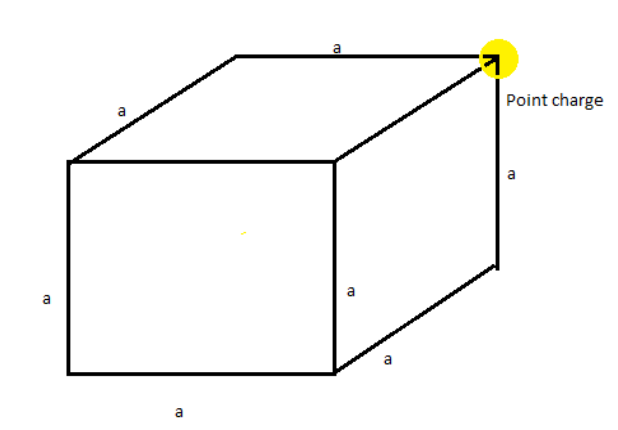
If the charge ‘q ’is placed at one of the corners of the cube, it will be divided into 8 such cubes. Therefore, electric flux through the one cube is the eighth part of \[\dfrac{q}{{{\varepsilon _\circ }}}\].
So electric flux (\[\varphi \]) is equal to \[\dfrac{q}{{8{\varepsilon _\circ }}}\].
Hence option (D) is the correct answer.
Gauss law is one of the four Maxwell’s equations which form the basis of classical electrodynamics.
Note: Electric flux has SI units of volt metres ( V m).
Electric flux is the rate of flow of electric field through a given area. Electric flux is proportional to the number of electric field lines going through a virtual surface. Gauss law can be used to derive the coulomb’s law and vice-versa.
In case if a charge is placed at one of the corners of the cube then the amount of charge enclosed in it is eighth part of the charge so the flux is also the eighth part of \[\dfrac{q}{{{\varepsilon _\circ }}}\].
Formula used:
Gauss law: According to gauss law :- If a charge “q ” is enclosed in a closed surface then the net flux emerging out of the closed surface is \[\dfrac{q}{{{\varepsilon _\circ }}}\]. Gauss law is only applicable for closed bodies.
Complete step by step solution:
According to gauss law, the electric flux through a closed surface is equal to \[\dfrac{q}{{{\varepsilon _\circ }}}\], if q is the charge enclosed in it.
If the charge ‘q ’is placed at one of the corners of the cube, it will be divided into 8 such cubes. Therefore, electric flux through the one cube is the eighth part of \[\dfrac{q}{{{\varepsilon _\circ }}}\].
So electric flux (\[\varphi \]) is equal to \[\dfrac{q}{{8{\varepsilon _\circ }}}\].
Hence option (D) is the correct answer.
Gauss law is one of the four Maxwell’s equations which form the basis of classical electrodynamics.
Note: Electric flux has SI units of volt metres ( V m).
Electric flux is the rate of flow of electric field through a given area. Electric flux is proportional to the number of electric field lines going through a virtual surface. Gauss law can be used to derive the coulomb’s law and vice-versa.
Recently Updated Pages
JEE Main 2023 April 6 Shift 1 Question Paper with Answer Key

JEE Main 2023 April 6 Shift 2 Question Paper with Answer Key
JEE Main 2023 (January 31 Evening Shift) Question Paper with Solutions [PDF]
JEE Main 2023 January 30 Shift 2 Question Paper with Answer Key
JEE Main 2023 January 25 Shift 1 Question Paper with Answer Key
JEE Main 2023 January 24 Shift 2 Question Paper with Answer Key
Trending doubts
JEE Main 2026: Session 2 Registration Open, City Intimation Slip, Exam Dates, Syllabus & Eligibility
JEE Main 2026 Application Login: Direct Link, Registration, Form Fill, and Steps
JEE Main Marking Scheme 2026- Paper-Wise Marks Distribution and Negative Marking Details
Understanding the Angle of Deviation in a Prism
Hybridisation in Chemistry – Concept, Types & Applications
How to Convert a Galvanometer into an Ammeter or Voltmeter
Other Pages
JEE Advanced Marks vs Ranks 2025: Understanding Category-wise Qualifying Marks and Previous Year Cut-offs
Dual Nature of Radiation and Matter Class 12 Physics Chapter 11 CBSE Notes - 2025-26
Understanding Uniform Acceleration in Physics
Understanding the Electric Field of a Uniformly Charged Ring
JEE Advanced Weightage 2025 Chapter-Wise for Physics, Maths and Chemistry
Derivation of Equation of Trajectory Explained for Students