




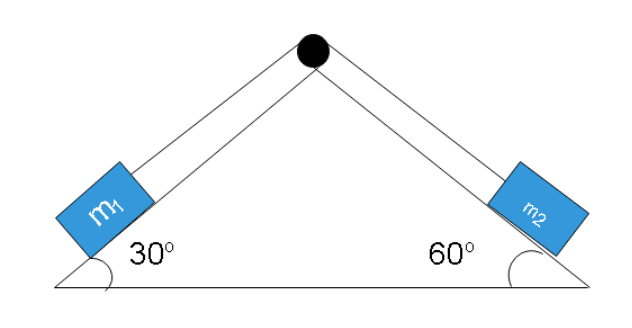
Given that ${m_1} = \,10\,kg$ and ${m_2} = 12\,kg$ connected as shown in the figure given below. Find tension in the string and acceleration of the two blocks.
Answer
 Verified
232.8k+ views
Hint: In this solution, we will find the components of the blocks that will exert tension on the string i.e. parallel to the slope of the inclined plane. Both the blocks will have the same acceleration since they are connected with a string which will be under constant tension.
Complete step by step answer:
Looking at the figure, the block of mass 12 kg will be heavier and as a result, it will move downwards and at the same time, pull the block of mass 10 kg upwards. Both the block will have the same acceleration since they are tied by the same string under acceleration and hence the same tension in the string as well.
Since the block of mass 10 kg will be moving upwards, the pseudo acceleration force and the tension in the string will both be towards the pulley, parallel to the surface of the power and the component of the weight for the block will be downwards. So, we can write
\[{m_1}a = T - {m_1}g\sin {\theta _1}\]
\[ \Rightarrow T = {m_1}g\sin {\theta _1} + {m_1}a\]
Similarly, for the second block, we can write, the weight and the acceleration will be downwards
\[{m_2}a = {m_2}g\sin {\theta _2} - T\]
\[ \Rightarrow T = {m_2}g\sin {\theta _2} - {m_2}a\]
So comparing tension in both these equations, we can write
$\dfrac{1}{2}{m_1}g + {m_1}a = \dfrac{{\sqrt 3 }}{2}{m_2}g - {m_2}a$
Solving for $a$, we get
$22a = \dfrac{{\sqrt 3 }}{2}(12)g - \dfrac{1}{2}(10)g$
On substituting $g = 10\,m/{s^2}$, we get
$22a = 54$
Hence $a = 2.45\,m/{s^2}$
Then the tension in the string can be calculated as
\[T = {m_1}g\sin {\theta _1} + {m_1}a\]
\[ \Rightarrow T = 50 + 24.5\]
Hence the tension in the string will be
$T = 74.5\,N$
Note: Here we have assumed that there is no friction acting on the blocks and the ramps which can hinder the motion of the blocks. Since the second block is heavier and also at a more inclined plane, we can assume that it will be pulling the first block.
Complete step by step answer:
Looking at the figure, the block of mass 12 kg will be heavier and as a result, it will move downwards and at the same time, pull the block of mass 10 kg upwards. Both the block will have the same acceleration since they are tied by the same string under acceleration and hence the same tension in the string as well.
Since the block of mass 10 kg will be moving upwards, the pseudo acceleration force and the tension in the string will both be towards the pulley, parallel to the surface of the power and the component of the weight for the block will be downwards. So, we can write
\[{m_1}a = T - {m_1}g\sin {\theta _1}\]
\[ \Rightarrow T = {m_1}g\sin {\theta _1} + {m_1}a\]
Similarly, for the second block, we can write, the weight and the acceleration will be downwards
\[{m_2}a = {m_2}g\sin {\theta _2} - T\]
\[ \Rightarrow T = {m_2}g\sin {\theta _2} - {m_2}a\]
So comparing tension in both these equations, we can write
$\dfrac{1}{2}{m_1}g + {m_1}a = \dfrac{{\sqrt 3 }}{2}{m_2}g - {m_2}a$
Solving for $a$, we get
$22a = \dfrac{{\sqrt 3 }}{2}(12)g - \dfrac{1}{2}(10)g$
On substituting $g = 10\,m/{s^2}$, we get
$22a = 54$
Hence $a = 2.45\,m/{s^2}$
Then the tension in the string can be calculated as
\[T = {m_1}g\sin {\theta _1} + {m_1}a\]
\[ \Rightarrow T = 50 + 24.5\]
Hence the tension in the string will be
$T = 74.5\,N$
Note: Here we have assumed that there is no friction acting on the blocks and the ramps which can hinder the motion of the blocks. Since the second block is heavier and also at a more inclined plane, we can assume that it will be pulling the first block.
Recently Updated Pages
JEE Main 2023 April 6 Shift 1 Question Paper with Answer Key

JEE Main 2023 April 6 Shift 2 Question Paper with Answer Key
JEE Main 2023 (January 31 Evening Shift) Question Paper with Solutions [PDF]
JEE Main 2023 January 30 Shift 2 Question Paper with Answer Key
JEE Main 2023 January 25 Shift 1 Question Paper with Answer Key
JEE Main 2023 January 24 Shift 2 Question Paper with Answer Key
Trending doubts
JEE Main 2026: Session 2 Registration Open, City Intimation Slip, Exam Dates, Syllabus & Eligibility
JEE Main 2026 Application Login: Direct Link, Registration, Form Fill, and Steps
Understanding the Angle of Deviation in a Prism
Hybridisation in Chemistry – Concept, Types & Applications
How to Convert a Galvanometer into an Ammeter or Voltmeter
Understanding Uniform Acceleration in Physics
Other Pages
JEE Advanced Marks vs Ranks 2025: Understanding Category-wise Qualifying Marks and Previous Year Cut-offs
Laws of Motion Class 11 Physics Chapter 4 CBSE Notes - 2025-26
Waves Class 11 Physics Chapter 14 CBSE Notes - 2025-26
Mechanical Properties of Fluids Class 11 Physics Chapter 9 CBSE Notes - 2025-26
Thermodynamics Class 11 Physics Chapter 11 CBSE Notes - 2025-26
Units And Measurements Class 11 Physics Chapter 1 CBSE Notes - 2025-26