




In a nuclear reactor the function of the moderator is to decrease:
A) Number of neutrons
B) Speed of neutrons
C) Escape of the neutrons
D) Temperature of the reactor.
Answer
 Verified
233.1k+ views
Hint: Nuclear reactors work on the principle of nuclear fission in which a heavy nucleus splits into small fragments. It is an important tool to produce radioactive isotopes and the most prominent source of energy which initiates control of nuclear chain reaction by moderator and control rods. Moderator is a material which is used to slow down the speed of neutrons produced during nuclear fission. The most commonly used moderator materials are Heavy water and Graphite in nuclear plants.
Complete answer:
Definition: A nuclear reactor is a giant device that initiates and controls a self-sustained nuclear chain reaction.They are widely used in power nuclear power plants for generating huge amounts of electricity by maintaining all the safety measures.
Explanation:
Nuclear reactors work on the principle of nuclear fission in which the nuclear reaction is initiated by bombarding nuclei of a radioactive element Uranium with nuclear particle neutrons. This leads to the release of disintegration energy in fission and by-product neutrons with an ample amount of kinetic energy. The initial stage of nuclear reaction in the reactor is:-

The average energy of these induced neutrons from the nuclear reaction is about 2 MeV which is huge. This may result in these neutrons can escape out from the reactor without interacting with uranium nuclei which will decrease the efficiency of producing power with the reactors. So to tackle this problem we need some device that can slow the speed of these fast-moving neutrons. So from here, the role of the moderator comes into the picture.
The moderators which are nothing but the light compound of nuclei are used for slowing down the fast-moving neutrons. The moderators commonly used in nuclear reactors in India are heavy water ${D_2}O$ and graphite.
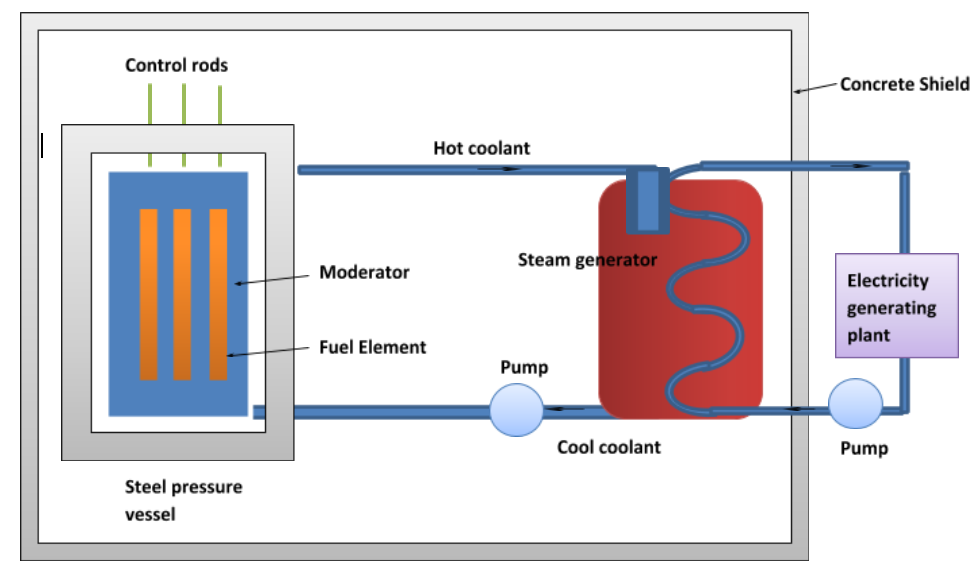
Schematic showing different components of a nuclear reactor
Hence, option (B) is the correct answer.
Note: In order to tackle these kinds of theoretical questions the key is one should have to read the articles on nuclear reactors and its working from basic textbooks and write down the important points regarding different components and its working. Students should note down the important nuclear reaction that occurs at the core compartment of the reactor.
Complete answer:
Definition: A nuclear reactor is a giant device that initiates and controls a self-sustained nuclear chain reaction.They are widely used in power nuclear power plants for generating huge amounts of electricity by maintaining all the safety measures.
Explanation:
Nuclear reactors work on the principle of nuclear fission in which the nuclear reaction is initiated by bombarding nuclei of a radioactive element Uranium with nuclear particle neutrons. This leads to the release of disintegration energy in fission and by-product neutrons with an ample amount of kinetic energy. The initial stage of nuclear reaction in the reactor is:-
The average energy of these induced neutrons from the nuclear reaction is about 2 MeV which is huge. This may result in these neutrons can escape out from the reactor without interacting with uranium nuclei which will decrease the efficiency of producing power with the reactors. So to tackle this problem we need some device that can slow the speed of these fast-moving neutrons. So from here, the role of the moderator comes into the picture.
The moderators which are nothing but the light compound of nuclei are used for slowing down the fast-moving neutrons. The moderators commonly used in nuclear reactors in India are heavy water ${D_2}O$ and graphite.
Schematic showing different components of a nuclear reactor
Hence, option (B) is the correct answer.
Note: In order to tackle these kinds of theoretical questions the key is one should have to read the articles on nuclear reactors and its working from basic textbooks and write down the important points regarding different components and its working. Students should note down the important nuclear reaction that occurs at the core compartment of the reactor.
Recently Updated Pages
JEE Main 2023 April 6 Shift 1 Question Paper with Answer Key

JEE Main 2023 April 6 Shift 2 Question Paper with Answer Key
JEE Main 2023 (January 31 Evening Shift) Question Paper with Solutions [PDF]
JEE Main 2023 January 30 Shift 2 Question Paper with Answer Key
JEE Main 2023 January 25 Shift 1 Question Paper with Answer Key
JEE Main 2023 January 24 Shift 2 Question Paper with Answer Key
Trending doubts
JEE Main 2026: Session 2 Registration Open, City Intimation Slip, Exam Dates, Syllabus & Eligibility
JEE Main 2026 Application Login: Direct Link, Registration, Form Fill, and Steps
Understanding the Angle of Deviation in a Prism
Hybridisation in Chemistry – Concept, Types & Applications
How to Convert a Galvanometer into an Ammeter or Voltmeter
Understanding Uniform Acceleration in Physics
Other Pages
JEE Advanced Marks vs Ranks 2025: Understanding Category-wise Qualifying Marks and Previous Year Cut-offs
Dual Nature of Radiation and Matter Class 12 Physics Chapter 11 CBSE Notes - 2025-26
Understanding the Electric Field of a Uniformly Charged Ring
JEE Advanced Weightage 2025 Chapter-Wise for Physics, Maths and Chemistry
Derivation of Equation of Trajectory Explained for Students
Understanding Electromagnetic Waves and Their Importance