




Obtain a mirror equation for a spherical mirror.
Answer
 Verified
233.1k+ views
Hint: The equation for the spherical mirror can be derived by drawing the ray diagram of the spherical mirror. Spherical mirror has two reflecting surfaces concave and convex.
Distance is measured from the pole and according to sign convention, the distance measured on the right side from the pole is negative and the distance measured on the left side is positive.
Complete step by step solution:
We will use a concave mirror for obtaining the equation for a spherical mirror.
Diagram: Ray diagram for a concave mirror.
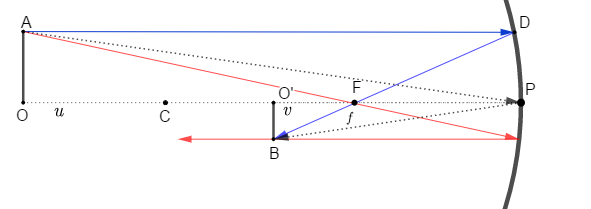
Here, in this diagram C is the center of curvature of the spherical mirror, P is the pole of the spherical mirror, F is the focal point of the spherical mirror at a distance of $f$ from the pole, OA is the object at a distance of $u$ from pole and O’B is the image at a distance of $v$ from the pole P.
Consider the $\Delta OAP$ and $\Delta O'BP$ which can be proven similar by using the angle-angle test.
In $\Delta OAP$ and $\Delta O'BP$,
$ \Rightarrow $ $\angle AOP \cong \angle BO'P$ (both are right angles)
$ \Rightarrow $ $\angle APO \cong \angle BPO'$ (law of reflection)
$\therefore $ $\Delta OAP \sim \Delta O'BP$ (By AA test of similarity of the triangle)
$\therefore $ $\dfrac{{OA}}{{O'B}} = \dfrac{{OP}}{{O'P}}$ (by properties of the similar triangle)
Substitute $ - u$ for $OP$ and $ - v$ for $O'P$ in the above equation. (According to sign convention distance on the left side of the pole is taken negative)
$\therefore $ $\dfrac{{OA}}{{O'B}} = \dfrac{{ - u}}{{ - v}}$
$ \Rightarrow $ $\dfrac{{OA}}{{O'B}} = \dfrac{u}{v}$……… (1)
Consider the $\Delta PDF$ and $\Delta O'BF$ which can be proven similar by using angle-angle tests.
In $\Delta PDF$ and $\Delta O'BF$,
$ \Rightarrow $ $\angle DPF \cong \angle BO'F$ (both are right angles)
$ \Rightarrow $ $\angle DFP \cong \angle BFO'$ (vertically opposite angles)
$\therefore $ $\Delta PDF \sim \Delta O'BF$ (By AA test of similarity of the triangle)
$\therefore $ $\dfrac{{PD}}{{O'B}} = \dfrac{{PF}}{{O'F}}$ (by properties of similar triangle)
Substitute $ - f$ for $PF$ and $ - v + f$ for \[O'F\] in the above equation.
$\therefore $ $\dfrac{{PD}}{{O'B}} = \dfrac{f}{{v - f}}$
From the diagram $OA$ is equal to $PD$. Substitute $OA$ for PD in the above equation.
$\therefore $ $\dfrac{{OA}}{{O'B}} = \dfrac{f}{{v - f}}$……… (2)
Equate the expressions (1) and (2).
$\therefore $ $\dfrac{u}{v} = \dfrac{{ - f}}{{ - v + f}}$
$ \Rightarrow $ $\dfrac{u}{v} = \dfrac{f}{{v - f}}$
$ \Rightarrow $ $\dfrac{v}{u} = \dfrac{{v - f}}{f}$(by invertendo)
$ \Rightarrow $ $\dfrac{v}{u} = \dfrac{v}{f} - 1$
Divide the above expression by $v$ on both sides.
$ \Rightarrow $ $\dfrac{1}{u} = \dfrac{1}{f} - \dfrac{1}{v}$
$ \Rightarrow $ $\dfrac{1}{u} + \dfrac{1}{v} = \dfrac{1}{f}$
Thus, the expression $\dfrac{1}{u} + \dfrac{1}{v} = \dfrac{1}{f}$ is the required equation for a spherical mirror.
Note: Ray diagrams are based on laws of reflection which are as follows.
1. The angle of the incident ray and reflected ray with respect to the normal to the surface are congruent.
2. The incident ray, reflected ray, and the normal lie in the same plane.
Normal to the spherical surface can be drawn by drawing the tangent to the spherical surface at a point where the incident ray meets the surface.
The equation for spherical mirrors remains the same for both the concave and convex mirrors.
Distance is measured from the pole and according to sign convention, the distance measured on the right side from the pole is negative and the distance measured on the left side is positive.
Complete step by step solution:
We will use a concave mirror for obtaining the equation for a spherical mirror.
Diagram: Ray diagram for a concave mirror.
Here, in this diagram C is the center of curvature of the spherical mirror, P is the pole of the spherical mirror, F is the focal point of the spherical mirror at a distance of $f$ from the pole, OA is the object at a distance of $u$ from pole and O’B is the image at a distance of $v$ from the pole P.
Consider the $\Delta OAP$ and $\Delta O'BP$ which can be proven similar by using the angle-angle test.
In $\Delta OAP$ and $\Delta O'BP$,
$ \Rightarrow $ $\angle AOP \cong \angle BO'P$ (both are right angles)
$ \Rightarrow $ $\angle APO \cong \angle BPO'$ (law of reflection)
$\therefore $ $\Delta OAP \sim \Delta O'BP$ (By AA test of similarity of the triangle)
$\therefore $ $\dfrac{{OA}}{{O'B}} = \dfrac{{OP}}{{O'P}}$ (by properties of the similar triangle)
Substitute $ - u$ for $OP$ and $ - v$ for $O'P$ in the above equation. (According to sign convention distance on the left side of the pole is taken negative)
$\therefore $ $\dfrac{{OA}}{{O'B}} = \dfrac{{ - u}}{{ - v}}$
$ \Rightarrow $ $\dfrac{{OA}}{{O'B}} = \dfrac{u}{v}$……… (1)
Consider the $\Delta PDF$ and $\Delta O'BF$ which can be proven similar by using angle-angle tests.
In $\Delta PDF$ and $\Delta O'BF$,
$ \Rightarrow $ $\angle DPF \cong \angle BO'F$ (both are right angles)
$ \Rightarrow $ $\angle DFP \cong \angle BFO'$ (vertically opposite angles)
$\therefore $ $\Delta PDF \sim \Delta O'BF$ (By AA test of similarity of the triangle)
$\therefore $ $\dfrac{{PD}}{{O'B}} = \dfrac{{PF}}{{O'F}}$ (by properties of similar triangle)
Substitute $ - f$ for $PF$ and $ - v + f$ for \[O'F\] in the above equation.
$\therefore $ $\dfrac{{PD}}{{O'B}} = \dfrac{f}{{v - f}}$
From the diagram $OA$ is equal to $PD$. Substitute $OA$ for PD in the above equation.
$\therefore $ $\dfrac{{OA}}{{O'B}} = \dfrac{f}{{v - f}}$……… (2)
Equate the expressions (1) and (2).
$\therefore $ $\dfrac{u}{v} = \dfrac{{ - f}}{{ - v + f}}$
$ \Rightarrow $ $\dfrac{u}{v} = \dfrac{f}{{v - f}}$
$ \Rightarrow $ $\dfrac{v}{u} = \dfrac{{v - f}}{f}$(by invertendo)
$ \Rightarrow $ $\dfrac{v}{u} = \dfrac{v}{f} - 1$
Divide the above expression by $v$ on both sides.
$ \Rightarrow $ $\dfrac{1}{u} = \dfrac{1}{f} - \dfrac{1}{v}$
$ \Rightarrow $ $\dfrac{1}{u} + \dfrac{1}{v} = \dfrac{1}{f}$
Thus, the expression $\dfrac{1}{u} + \dfrac{1}{v} = \dfrac{1}{f}$ is the required equation for a spherical mirror.
Note: Ray diagrams are based on laws of reflection which are as follows.
1. The angle of the incident ray and reflected ray with respect to the normal to the surface are congruent.
2. The incident ray, reflected ray, and the normal lie in the same plane.
Normal to the spherical surface can be drawn by drawing the tangent to the spherical surface at a point where the incident ray meets the surface.
The equation for spherical mirrors remains the same for both the concave and convex mirrors.
Recently Updated Pages
JEE Main 2023 April 6 Shift 1 Question Paper with Answer Key

JEE Main 2023 April 6 Shift 2 Question Paper with Answer Key
JEE Main 2023 (January 31 Evening Shift) Question Paper with Solutions [PDF]
JEE Main 2023 January 30 Shift 2 Question Paper with Answer Key
JEE Main 2023 January 25 Shift 1 Question Paper with Answer Key
JEE Main 2023 January 24 Shift 2 Question Paper with Answer Key
Trending doubts
JEE Main 2026: Session 2 Registration Open, City Intimation Slip, Exam Dates, Syllabus & Eligibility
JEE Main 2026 Application Login: Direct Link, Registration, Form Fill, and Steps
Understanding the Angle of Deviation in a Prism
Hybridisation in Chemistry – Concept, Types & Applications
How to Convert a Galvanometer into an Ammeter or Voltmeter
Understanding Uniform Acceleration in Physics
Other Pages
JEE Advanced Marks vs Ranks 2025: Understanding Category-wise Qualifying Marks and Previous Year Cut-offs
Dual Nature of Radiation and Matter Class 12 Physics Chapter 11 CBSE Notes - 2025-26
Understanding the Electric Field of a Uniformly Charged Ring
JEE Advanced Weightage 2025 Chapter-Wise for Physics, Maths and Chemistry
Derivation of Equation of Trajectory Explained for Students
Understanding Electromagnetic Waves and Their Importance