








How Does Centrifugal Force Work in Everyday Life?
Centrifugal force is a fundamental concept in circular motion, describing an outward force experienced by objects in a rotating reference frame. This force, often termed as "centre-fleeing," is important for understanding the dynamics of bodies moving along curved paths in physics.
Definition and Basic Principle of Centrifugal Force
Centrifugal force refers to the apparent force that acts outward on a mass when it is rotated about a fixed axis. It is not an actual force but a pseudo or fictitious force, observed only in non-inertial (rotating) frames of reference.
Origin of Centrifugal Force
The cause of centrifugal force is the inertia of the object moving in a circular path. In a rotating frame, the object’s tendency to move in a straight line results in an observed force directed away from the center of rotation.
Centrifugal Force vs Centripetal Force
Centripetal force is the real force directed towards the center of the circular path, necessary for maintaining circular motion. In contrast, centrifugal force acts outward from the center in a rotating reference frame and is considered fictitious.
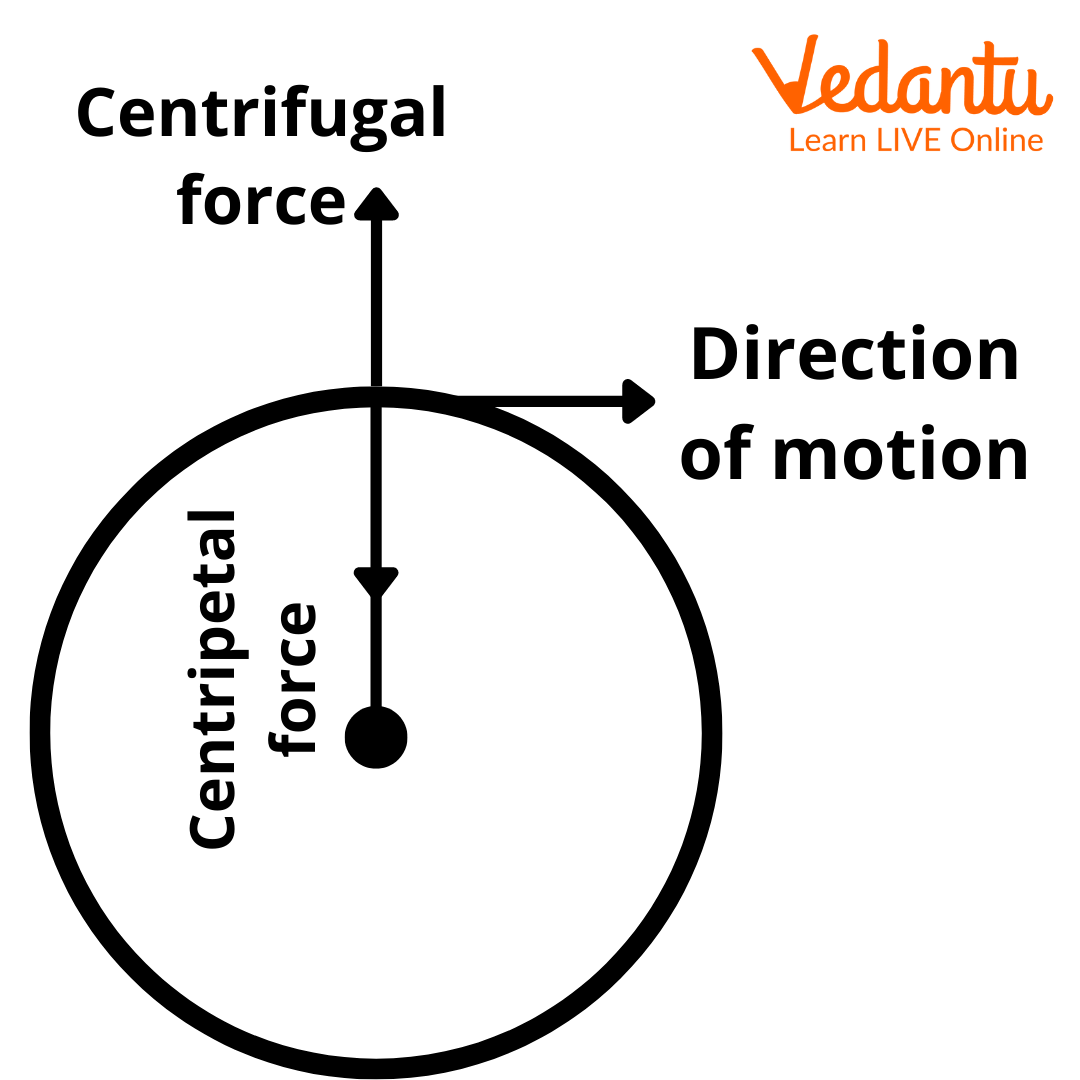
Mathematical Expression of Centrifugal Force
Centrifugal force can be calculated using the relationship between mass, velocity, and the radius of the circular path. The basic formula is given by:
$F = m \times \dfrac{v^2}{r}$
Here, $F$ is the centrifugal force, $m$ is mass, $v$ is linear velocity, and $r$ is the radius from the axis of rotation.
When angular velocity ($\omega$) is known, the formula becomes:
$F = m \times \omega^2 r$
This equation is widely used in problems involving rotational motion.
Units and Dimensional Formula
Centrifugal force is measured in the SI unit of newton (N). Its dimensional formula is $[M^1 L^1 T^{-2}]$, which is the same as that for force.
| Quantity | Value |
|---|---|
| SI Unit | Newton (N) |
| Dimensional Formula | $M^1L^1T^{-2}$ |
Physical Interpretation in Circular Motion
In a rotating system, centrifugal force appears to push objects away from the axis of rotation. It arises in non-inertial frames to account for the inertia of a mass following a curved path. The necessity of this pseudo force emerges for the correct application of Newtonian mechanics in rotating frames.
Relative Centrifugal Force (RCF) and RPM Connection
The relative centrifugal force (RCF) is often used to compare the acceleration due to centrifugal force with Earth’s gravity, especially in centrifuge applications. The relation to revolutions per minute (RPM) is given by:
$RCF = RPM^2 \times 1.118 \times 10^{-5} \times r$
Here, $r$ is the rotational radius in centimeters, and RCF is measured relative to $g$.
Centrifugal Force as a Pseudo Force
Centrifugal force does not result from any physical interaction but is introduced in a rotating frame to explain outward acceleration. Newton’s laws apply only in inertial frames; thus, for non-inertial (rotating) frames, centrifugal force serves as a necessary correction.
More details on forces in non-inertial frames can be found in the Forces in Motion 404 article.
Examples of Centrifugal Force
Several practical situations illustrate the effects of centrifugal force. Some of the most common examples are listed below.
- Water moving outward in a spinning washing machine
- Passengers experiencing outward force in a turning vehicle
- Banked curves on highways for vehicle stability
- Operation of centrifugal pumps and centrifuges
- Apparent outward pull for planets revolving around the Sun
Additional practical scenarios using centrifugal force are explained on the Centrifugal Force topic page.
Solved Example: Centrifugal Force Calculation
Consider a 2 kg object rotating at a constant speed of 4 m/s in a circle with a radius of 0.5 m. The centrifugal force can be calculated as:
$F = m \times \dfrac{v^2}{r} = 2 \times \dfrac{(4)^2}{0.5} = 2 \times \dfrac{16}{0.5} = 2 \times 32 = 64\ \text{N}$
Thus, the centrifugal force experienced by the object is 64 newtons.
Applications of Centrifugal Force
Centrifugal force is used in mechanical devices and natural phenomena, such as centrifugal pumps, separator devices, and planetary motion. It is significant for understanding the physical stability of rotating systems.
Geographical and Human Geography Contexts
In geography and AP Human Geography contexts, centrifugal force explains the forces that push entities or populations away from a central area or leadership, as opposed to centripetal forces which unify.
Summary Table: Centrifugal and Centripetal Forces
| Aspect | Centrifugal Force |
|---|---|
| Direction | Outward from center |
| Type | Pseudo force |
| Observing frame | Non-inertial |
| Formula | $m \dfrac{v^2}{r}$ or $m\omega^2 r$ |
Key Points on Centrifugal Force for JEE
- Centrifugal force is apparent only in rotating frames
- The direction is always away from the axis of rotation
- It counteracts the centripetal force in non-inertial analyses
- The concept is critical for rotational dynamics questions
Further details on acceleration in circular motion are available in the Acceleration Due to Gravity section.


FAQs on Understanding Centrifugal Force in Physics
1. What is centrifugal force?
Centrifugal force is the apparent outward force experienced by an object moving in a circular path. It occurs due to the object's inertia, which makes it appear to push away from the center.
- Centrifugal force is a pseudo-force or fictitious force.
- It acts on objects in a rotating frame of reference.
- It works opposite to centripetal force, which acts towards the center.
- Its magnitude: F = mv2/r, where m = mass, v = velocity, r = radius.
- It's essential in understanding circular motion in physics (CBSE/NCERT syllabus).
2. What is the difference between centripetal force and centrifugal force?
Centrifugal force and centripetal force are opposite in direction but related to circular motion.
- Centripetal force: Acts towards the center of the circle; real force.
- Centrifugal force: Acts away from the center; pseudo-force observed in rotating frames.
- Centripetal is required for any circular motion, while centrifugal is perceived due to inertia.
- Example: When taking a sharp turn, centripetal force keeps you on the turn, while you feel pushed outward due to centrifugal force.
3. Is centrifugal force a real force?
Centrifugal force is not a real force; it's a pseudo-force seen in rotating frames.
- It does not originate from any physical interaction.
- Experienced only by an observer inside the rotating frame.
- Used for analysis in non-inertial reference frames (like merry-go-rounds).
- Not present in an inertial (non-accelerating) frame of reference.
4. What are the applications of centrifugal force?
Centrifugal force is widely used in technology and daily life.
- Washing machines: Spin cycle uses centrifugal force to expel water.
- Centrifuges: Separate mixtures based on density.
- Roller coasters and vehicles turning: Passengers feel thrown outward.
- Drying of clothes, cream separator, playground merry-go-round.
- Important in mechanical engineering and space research.
5. Explain with an example how centrifugal force is experienced in daily life.
You experience centrifugal force when taking a sharp turn in a car.
- As the car turns, you feel pushed outward, away from the center of the curve.
- This sensation is due to your body's inertia resisting the change in direction.
- Centrifugal force is not acting on your body; instead, you try to continue in a straight line as the car turns under you.
- This everyday example helps students relate physics concepts to real-life situations.
6. Write the formula for centrifugal force and explain its terms.
The formula for centrifugal force is F = mv2/r.
- F = Centrifugal force (in Newtons, N)
- m = Mass of the object (kg)
- v = Velocity of rotation (m/s)
- r = Radius of the circular path (m)
- The formula is identical to the expression for centripetal force in magnitude but points in the opposite direction.
7. Why is centrifugal force called a fictitious or pseudo-force?
Centrifugal force is a pseudo-force because it appears due to the rotation of the reference frame, not a real physical interaction.
- Exists only in non-inertial (accelerated) frames, not in an inertial frame.
- It helps to explain motion as seen by observers inside a rotating system.
8. What role does centrifugal force play in a washing machine?
Centrifugal force helps remove water from clothes during the spin cycle of a washing machine.
- As the drum spins, water is forced outwards through the holes by centrifugal force.
- Clothes remain pressed to the drum due to the force.
- This process efficiently removes excess water, drying clothes faster.
9. Can centrifugal force exist in an inertial frame of reference?
No, centrifugal force does not exist in an inertial frame of reference.
- It is observed only in rotating (non-inertial) frames.
- In an inertial frame, only real forces like centripetal force act on the object.
- The concept of centrifugal force is useful for analyzing motion from within rotating systems.
10. Name some machines or devices that use centrifugal force.
Several machines and devices use centrifugal force in their operation.
- Washing machines (for water extraction)
- Centrifuges (for separating components based on density)
- Cream separators in dairy industry
- Spin dryers, amusement rides, salad spinners
- Many more industrial and laboratory applications
