








How to Calculate Compressibility Factor and Its Importance in Real Gases
The compressibility factor is an important thermodynamic parameter used to understand the deviation of real gases from ideal gas behaviour. It provides a quantitative measure of how closely a real gas follows the ideal gas law under various temperature and pressure conditions. This topic is essential for JEE Main preparation as it links fundamental gas laws to real-world physical behaviour, enabling accurate analysis and solving of advanced gas-related problems.
Definition of Compressibility Factor
The compressibility factor, denoted as $Z$, is a dimensionless quantity that compares the actual behaviour of a real gas to that predicted by the ideal gas law. This factor is defined as the ratio of the product of pressure and molar volume to the product of universal gas constant and temperature at the same conditions.
For an ideal gas, the value of $Z$ is always equal to $1$. For real gases, $Z$ may be greater than or less than $1$, depending on the nature of intermolecular interactions and external conditions. This correction allows more accurate predictions in practical and competitive exam scenarios.
Compressibility Factor Formula
The mathematical expression for the compressibility factor $Z$ is given by:
$Z = \dfrac{pV_m}{RT}$
where $p$ is the pressure of the gas (in Pascal), $V_m$ is the molar volume (in m$^3$/mol), $R$ is the universal gas constant ($8.314$ J·mol$^{-1}$·K$^{-1}$), and $T$ is the absolute temperature (in Kelvin). This relationship is central to the analysis of gaseous states and is widely used in numerical problems in exams like JEE Main. For more detailed discussions on thermodynamic properties, see Thermodynamics.
Interpretation and Physical Meaning of Compressibility Factor
The value of $Z$ provides insights into the nature of molecular interactions within the gas. When $Z = 1$, the real gas behaves like an ideal gas under those specific conditions. If $Z < 1$, attractive intermolecular forces dominate, making the gas more compressible than predicted by the ideal gas law. When $Z > 1$, repulsive forces are significant, and the gas becomes less compressible.
| Condition | Physical Meaning |
|---|---|
| $Z = 1$ | Ideal gas behaviour |
| $Z < 1$ | More compressible, attraction dominates |
| $Z > 1$ | Less compressible, repulsion dominates |
Understanding whether $Z$ is greater than, less than, or equal to $1$ helps in identifying the dominant forces acting within the gas sample. This interpretation is widely applicable in advanced questions relating to physical chemistry and kinetic theory of gases. For comparison between real and ideal gases, visit Real Gas and Ideal Gas.
Derivation of Compressibility Factor for Real Gases
Starting with the ideal gas law, $pV_m = RT$, the compressibility factor introduces real gas behaviour as $pV_m = ZRT$. For real gases, interactions between particles require corrections, often described by equations such as the Van der Waals equation.
At high pressure, the volume occupied by gas molecules and intermolecular forces significantly affect the properties of the gas. These factors lead to deviation from $Z = 1$, which is characteristic of ideal gases. For practical illustration, refer to Properties of Solids and Liquids.
Compressibility Factor and Molar Volume Relationship
The compressibility factor can also be expressed in terms of molar volumes to compare real and ideal gases under identical conditions. The formula can be written as:
$Z = \dfrac{V_{\text{actual}}}{V_{\text{ideal}}}$
Here, $V_{\text{actual}}$ is the molar volume observed experimentally for the real gas, while $V_{\text{ideal}}$ is the theoretical molar volume predicted by the ideal gas law at the same pressure and temperature. This approach is particularly useful in laboratory analysis and calculation-based questions. Explore detailed examples in the Compressibility Factor resource.
Impact of Pressure and Temperature on Compressibility Factor
The value of $Z$ varies with changes in pressure and temperature. At low pressures, most gases exhibit near-ideal behaviour, so $Z$ approaches $1$. At high pressures, repulsive forces increase, leading to $Z > 1$. At moderate pressures and lower temperatures, attractive forces dominate and $Z$ may become less than $1$.
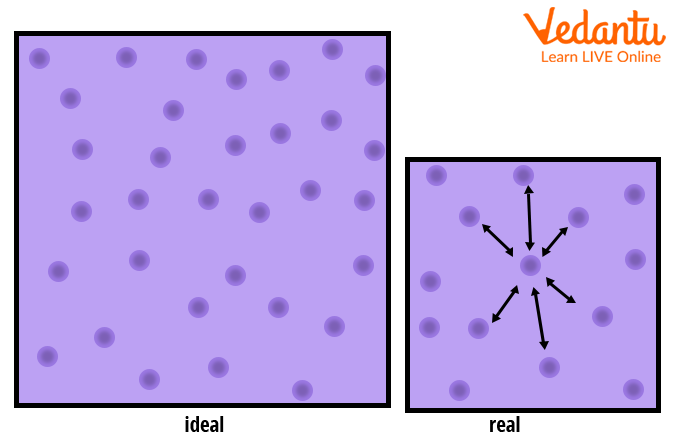
Increasing temperature generally causes $Z$ to move towards unity by overcoming intermolecular attractions or repulsions. These trends are essential while interpreting graphs or addressing conceptual MCQs in JEE Main Physics.
Example Calculation Using Compressibility Factor
To illustrate the use of compressibility factor in calculations, consider a sample where the number of moles $n = 2$, pressure $p = 5 \times 10^5$ Pa, volume $V = 0.05$ m$^3$, and temperature $T = 300$ K. Using $R = 8.314$ J·mol$^{-1}$·K$^{-1}$, the value of $Z$ is calculated as follows:
First, calculate the denominator: $nRT = 2 \times 8.314 \times 300 = 4988.4$.
Next, evaluate the numerator: $pV = 5 \times 10^5 \times 0.05 = 25000$.
So, $Z = \dfrac{25000}{4988.4} \approx 5.01$. This value ($Z > 1$) indicates strong repulsive forces, making the real gas less compressible than the ideal gas under these conditions.
Variation of Compressibility Factor for Common Gases
The compressibility factor varies for different gases such as air, nitrogen, and natural gas, depending on temperature and pressure conditions. Standard compressibility factor charts and calculators are used in industry to obtain accurate values for specific gases. The units of $Z$ are always dimensionless, allowing for easy comparison between different systems and gases.
Key Points and Common Errors in Application
- Always use absolute temperature in Kelvin in calculations
- Convert all quantities to SI units before applying formulas
- $Z = 1$ is valid only under ideal conditions
- $Z < 1$ implies dominant attraction; $Z > 1$ implies repulsion
- Link the value of $Z$ to physical meaning in graphical problems
Mastering the compressibility factor helps prevent mistakes especially in examination settings, such as confusing the correct sign of deviation or substituting incorrect units. Comprehensive practice of numerical and conceptual questions improves analytical skills for competitive exams. Study additional quantitative relationships in Dimensions of Density.


FAQs on What Is Compressibility Factor in Chemistry and Physics?
1. What is the compressibility factor (Z) in thermodynamics?
The compressibility factor (Z) is a dimensionless number that indicates how much a real gas deviates from ideal gas behavior. It is defined as the ratio of the actual molar volume of a gas to its molar volume if it behaved ideally at the same temperature and pressure.
- Z = PV/nRT, where P is pressure, V is volume, n is the number of moles, R is the gas constant, and T is temperature.
- If Z = 1, the gas behaves ideally.
- If Z > 1, the gas is less compressible than an ideal gas (repulsive forces dominate).
- If Z < 1, the gas is more compressible than an ideal gas (attractive forces dominate).
2. How do you calculate the compressibility factor for a real gas?
The compressibility factor (Z) can be calculated for a real gas using the formula Z = PV/nRT.
- Measure the pressure (P), volume (V), and temperature (T) of the gas.
- Determine n, the number of moles present.
- Use the gas constant R (typically 0.0821 L·atm/mol·K).
- Substitute all values into the equation Z = PV/nRT.
3. Why is compressibility factor important in chemistry?
The compressibility factor is important as it helps chemists and engineers understand how real gases deviate from ideal gas laws.
- It allows for accurate calculation of real gas behavior under various conditions.
- Helps in designing chemical processes and equipment.
- Improves predictions regarding gas storage and transport.
4. What does it mean if the compressibility factor Z is less than 1?
If Z < 1, it implies that the gas is more compressible than predicted by the ideal gas law due to significant attractive forces between molecules.
- Indicates the presence of intermolecular attractions.
- Common at moderate pressures and lower temperatures for most gases.
5. For which gases does the compressibility factor approach 1?
The compressibility factor (Z) approaches 1 for gases that closely follow the ideal gas law, especially at low pressures and high temperatures.
- Hydrogen and helium are examples that often exhibit Z ≈ 1 under standard conditions.
- At very low pressures, most gases behave ideally, so Z nears 1.
6. How does the compressibility factor vary with pressure?
The compressibility factor (Z) generally decreases below 1 as pressure increases at first, then increases and can exceed 1 at higher pressures.
- At low pressures: Z ≈ 1 (ideal behavior).
- At moderate pressures: Z < 1 due to attractive forces.
- At very high pressures: Z > 1 as repulsive forces become significant.
7. What is the physical significance of the compressibility factor?
The compressibility factor quantifies the deviation of a real gas from ideal behavior, guiding corrections in calculations involving gas mixtures and reactions.
- Enables more precise determination of real gas volumes under different conditions.
- Helps in industrial processes where accurate gas data is crucial.
8. What are the typical values of the compressibility factor for real gases?
For real gases, the compressibility factor (Z) typically ranges:
- Z ≈ 1 at low pressure (ideal behavior).
- Z < 1 at moderate pressure (attractive forces).
- Z > 1 at high pressure (repulsive forces).
Actual values depend on the gas and conditions.
9. What happens to the value of compressibility factor at extremely high pressure?
At extremely high pressure, the compressibility factor (Z) increases above 1, indicating that the gas is less compressible than an ideal gas due to strong repulsive molecular forces.
- This is observed because molecules are forced very close together.
- Observed in all gases at sufficiently high pressures.
10. What is meant by deviation from ideal behavior in the context of compressibility factor?
Deviation from ideal behavior refers to the difference between the actual behavior of a real gas and the predictions of the ideal gas law, as measured by the compressibility factor (Z).
- Z ≠ 1 signals deviation due to intermolecular attractions or repulsions.
- The extent of deviation helps assess when corrections to the ideal gas law are necessary.
