




The basicity of acetic acid is:
A.1
B.2
C.3
D.4
Answer
 Verified
276.6k+ views
Hint: We know that the basicity of an acid is the number of replaceable hydrogen atoms that are present in a molecule of that acid. Hence an acid that contains only one replaceable hydrogen atom in its molecule is known as a monobasic acid and its basicity is 1. Similarly, the acid which contains two replaceable hydrogen atoms in its molecule is called a dibasic acid and its basicity is 2. With this concept in mind, we will be solving the given question where we have to first know about the molecular structure of Acetic Acid and then find how many hydrogen atoms it replaces to find its basicity.
Step by step answer: Acetic Acid has a total of 4 hydrogen atoms and 2 carbon atoms with functional group oxygen present in its molecular structure as we can see below. The dissociation formula of acetic acid is also given as follows:
$\text{C}{{\text{H}}_{3}}-\text{COOH }\xrightarrow{{}}\text{ C}{{\text{H}}_{\text{3}}}\text{CO}{{\text{O}}^{-}}\text{ }+\text{ }{{\text{H}}^{+}}$
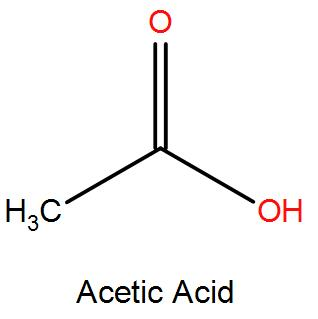
4 hydrogen atoms being present in the molecule of Acetic Acid, it only has one replaceable hydrogen ion present in it. Hence giving only one ionizable ${{\text{H}}^{+}}$ ion, hence its basicity is 1.
So we can determine that the basicity of Acetic acid is 1 because it releases one hydrogen ion in an aqueous solution.
Therefore, the correct option is Option A.
Note: The less electronegative the element, the less stable the lone pair will be and therefore the higher will be the basicity. Even though it’s a weak acid, at high concentrations it will be corrosive on skin. The household vinegar consists of Acetic acid as a primary ingredient.
Step by step answer: Acetic Acid has a total of 4 hydrogen atoms and 2 carbon atoms with functional group oxygen present in its molecular structure as we can see below. The dissociation formula of acetic acid is also given as follows:
$\text{C}{{\text{H}}_{3}}-\text{COOH }\xrightarrow{{}}\text{ C}{{\text{H}}_{\text{3}}}\text{CO}{{\text{O}}^{-}}\text{ }+\text{ }{{\text{H}}^{+}}$
4 hydrogen atoms being present in the molecule of Acetic Acid, it only has one replaceable hydrogen ion present in it. Hence giving only one ionizable ${{\text{H}}^{+}}$ ion, hence its basicity is 1.
So we can determine that the basicity of Acetic acid is 1 because it releases one hydrogen ion in an aqueous solution.
Therefore, the correct option is Option A.
Note: The less electronegative the element, the less stable the lone pair will be and therefore the higher will be the basicity. Even though it’s a weak acid, at high concentrations it will be corrosive on skin. The household vinegar consists of Acetic acid as a primary ingredient.
Recently Updated Pages
With which part the mRNA should be bound to initiate class 12 biology JEE_Main

Which one of the following is an example of a biofertiliser class 12 biology JEE_Main
A straight line goes through the points pq and rs -class-11-mathematics-JEE_Main
Which of the following protein destroys the antigen class 12 biology JEE_Main
Which of the following scientists discovered the Pasteurization class 11 biology JEE_Main
Explain the experiment of Julius von Sachs class 11 biology JEE_Main
Trending doubts
JEE Main 2026: Exam Dates, Session 2 Updates, City Slip, Admit Card & Latest News
Understanding the Electric Field of a Uniformly Charged Ring
Derivation of Equation of Trajectory Explained for Students
Understanding the Different Types of Solutions in Chemistry
How to Convert a Galvanometer into an Ammeter or Voltmeter
Understanding Combined Translation and Rotational Motion
Other Pages
JEE Advanced 2026 Notification Out with Exam Date, Registration (Extended), Syllabus and More
JEE Advanced Percentile vs Marks 2026: JEE Main Cutoff, AIR & IIT Admission Guide
JEE Advanced Weightage Chapter Wise 2026 for Physics, Chemistry, and Mathematics
NCERT Solutions For Class 11 Chemistry In Hindi Chapter 1 Some Basic Concepts Of Chemistry - 2026-27
Understanding Instantaneous Velocity
Ideal and Non-Ideal Solutions Explained for Class 12 Chemistry