




The magnet is strongest near the:
(A) Poles of the magnet
(B) Ends of the magnet
(C) Centre of the magnet
(D) One- quarter point from the poles of the magnet
Answer
 Verified
233.1k+ views
Hint When a magnet is placed, the magnetic field is produced around it. This magnetic field can be represented through magnetic field lines. The magnet is strongest at the point where these magnetic field lines are most dense.
Complete Step by step solution
The area around a magnet where the magnetic force exists is called the magnetic field.
A visual tool used to represent magnetic fields is magnetic field lines. They explain the direction of the magnetic field. Magnetic field lines will never cross, meaning that at every point in space the field is unique. Magnetic field lines are continuous, with no beginning or end, creating closed loops. They go to the south pole from the north pole.
In regions where the magnetic field is the greatest, magnetic field lines naturally bunch together. This implies that the density of field lines indicates the strength of the field.
Magnetic field lines of a magnet can be represented by the following diagram:
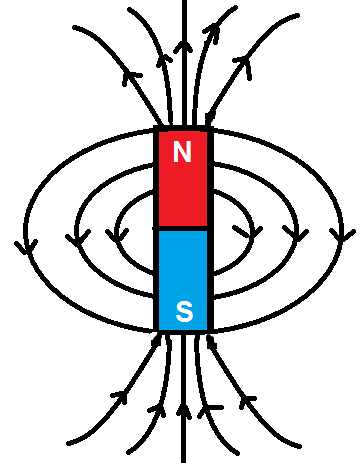
The closer the magnetic field lines are, the stronger the magnetic field at that point.
As we can see in the diagram, the magnetic field lines are closer or denser at the poles. So, the magnetic field is strongest around the poles of the magnet.
Hence, the correct answer is option (A) Poles of the magnet.
Note Magnets have two poles, a north pole, and a south pole. It does not separate its north pole from its south pole by splitting a magnet in two. Each half is found to have north and south poles of its own. Also, like poles repel each other and unlike poles attract each other.
Complete Step by step solution
The area around a magnet where the magnetic force exists is called the magnetic field.
A visual tool used to represent magnetic fields is magnetic field lines. They explain the direction of the magnetic field. Magnetic field lines will never cross, meaning that at every point in space the field is unique. Magnetic field lines are continuous, with no beginning or end, creating closed loops. They go to the south pole from the north pole.
In regions where the magnetic field is the greatest, magnetic field lines naturally bunch together. This implies that the density of field lines indicates the strength of the field.
Magnetic field lines of a magnet can be represented by the following diagram:
The closer the magnetic field lines are, the stronger the magnetic field at that point.
As we can see in the diagram, the magnetic field lines are closer or denser at the poles. So, the magnetic field is strongest around the poles of the magnet.
Hence, the correct answer is option (A) Poles of the magnet.
Note Magnets have two poles, a north pole, and a south pole. It does not separate its north pole from its south pole by splitting a magnet in two. Each half is found to have north and south poles of its own. Also, like poles repel each other and unlike poles attract each other.
Recently Updated Pages
JEE Main 2023 April 6 Shift 1 Question Paper with Answer Key

JEE Main 2023 April 6 Shift 2 Question Paper with Answer Key
JEE Main 2023 (January 31 Evening Shift) Question Paper with Solutions [PDF]
JEE Main 2023 January 30 Shift 2 Question Paper with Answer Key
JEE Main 2023 January 25 Shift 1 Question Paper with Answer Key
JEE Main 2023 January 24 Shift 2 Question Paper with Answer Key
Trending doubts
JEE Main 2026: Session 2 Registration Open, City Intimation Slip, Exam Dates, Syllabus & Eligibility
JEE Main 2026 Application Login: Direct Link, Registration, Form Fill, and Steps
JEE Main Marking Scheme 2026- Paper-Wise Marks Distribution and Negative Marking Details
Understanding the Angle of Deviation in a Prism
Hybridisation in Chemistry – Concept, Types & Applications
How to Convert a Galvanometer into an Ammeter or Voltmeter
Other Pages
JEE Advanced Marks vs Ranks 2025: Understanding Category-wise Qualifying Marks and Previous Year Cut-offs
Understanding Uniform Acceleration in Physics
Dual Nature of Radiation and Matter Class 12 Physics Chapter 11 CBSE Notes - 2025-26
Understanding Electromagnetic Waves and Their Importance
Understanding the Electric Field of a Uniformly Charged Ring
JEE Advanced Weightage 2025 Chapter-Wise for Physics, Maths and Chemistry