




There is a metal cube inside a block of ice which is floating on the surface of water. The ice melts completely and metal falls in the water. Water level in the container:
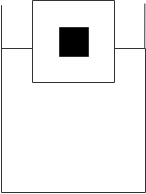
(A) Rises
(B) Falls
(C) Remains same
(D) Nothing can be concluded
Answer
 Verified
233.1k+ views
Hint We know that density is a measure of the mass per volume. The average density of an object equals to the total mass divided by its total volume. An object made from a comparatively dense material, such as the iron, will have less volume than an object of equal mass from some less dense substance, such as water. Based on this concept we have to solve this question.
Complete step by step answer
We know that when ice with piece of metal floats, the volume V of water displaced is given by:
$V=\dfrac{M+m}{{{\rho }_{w}}}$.
In the above expression, the M and m are the masses of ice and metal respectively and $\rho$is the density of water.
When the ice melts completely then,
Volume of water displaced by metal ${{V}_{1}}=\dfrac{m}{{{\rho }_{w}}}$
Volume of water due to conversion of ice into water = ${{V}_{2}}=\dfrac{M}{{{\rho }_{w}}}$
Therefore, we can say that the total volume of water displayed as:
${{V}_{total}}={{V}_{1}}+{{V}_{2}}$
So now we have to put the expression in the following form:
$\dfrac{m}{{{\rho }_{w}}}+\dfrac{M}{{{\rho }_{w}}}$
After evaluating the above expression, we get that:
$\dfrac{m+M}{\rho -w}$
Now, we can say that ${{V}_{total}}=V$.
Therefore, there is no change in the level of water. Hence the correct answer is ‘remains the same’.
So, the correct answer is option C.
Note The density gives us an idea how much space an object or substance takes up, in this case the volume, in relation to the amount of the matter in that object or the substance, by which we mean its mass.
Another way to put it is that density is the amount which gives us an idea about the volume that is to be considered per unit of the substance.
If we know that an object is heavy and compact, it has a high density, and if the object is light then the density will always be low.
Complete step by step answer
We know that when ice with piece of metal floats, the volume V of water displaced is given by:
$V=\dfrac{M+m}{{{\rho }_{w}}}$.
In the above expression, the M and m are the masses of ice and metal respectively and $\rho$is the density of water.
When the ice melts completely then,
Volume of water displaced by metal ${{V}_{1}}=\dfrac{m}{{{\rho }_{w}}}$
Volume of water due to conversion of ice into water = ${{V}_{2}}=\dfrac{M}{{{\rho }_{w}}}$
Therefore, we can say that the total volume of water displayed as:
${{V}_{total}}={{V}_{1}}+{{V}_{2}}$
So now we have to put the expression in the following form:
$\dfrac{m}{{{\rho }_{w}}}+\dfrac{M}{{{\rho }_{w}}}$
After evaluating the above expression, we get that:
$\dfrac{m+M}{\rho -w}$
Now, we can say that ${{V}_{total}}=V$.
Therefore, there is no change in the level of water. Hence the correct answer is ‘remains the same’.
So, the correct answer is option C.
Note The density gives us an idea how much space an object or substance takes up, in this case the volume, in relation to the amount of the matter in that object or the substance, by which we mean its mass.
Another way to put it is that density is the amount which gives us an idea about the volume that is to be considered per unit of the substance.
If we know that an object is heavy and compact, it has a high density, and if the object is light then the density will always be low.
Recently Updated Pages
JEE Main 2026 Session 2 Registration Open, Exam Dates, Syllabus & Eligibility

JEE Main 2023 April 6 Shift 1 Question Paper with Answer Key
JEE Main 2023 April 6 Shift 2 Question Paper with Answer Key
JEE Main 2023 (January 31 Evening Shift) Question Paper with Solutions [PDF]
JEE Main 2023 January 30 Shift 2 Question Paper with Answer Key
JEE Main 2023 January 25 Shift 1 Question Paper with Answer Key
Trending doubts
JEE Main Marking Scheme 2026- Paper-Wise Marks Distribution and Negative Marking Details
Understanding Average and RMS Value in Electrical Circuits
Understanding Collisions: Types and Examples for Students
Ideal and Non-Ideal Solutions Explained for Class 12 Chemistry
Understanding Atomic Structure for Beginners
Derive an expression for maximum speed of a car on class 11 physics JEE_Main
Other Pages
JEE Advanced Weightage 2025 Chapter-Wise for Physics, Maths and Chemistry
NCERT Solutions For Class 11 Physics Chapter 9 Mechanical Properties of Fluids (2025-26)
NCERT Solutions For Class 11 Physics Chapter 12 Kinetic Theory (2025-26)
NCERT Solutions For Class 11 Physics Chapter 4 Law of Motion (2025-26)
Class 11 JEE Main Physics Mock Test 2025
Inductive Effect and Its Role in Acidic Strength