




A barometer reads $76 cm$ of mercury. If the tube is gradually inclined at an angle of $ 60^\circ $ with vertical, keeping the open end immersed in the reservoir, the length of the mercury column will be
(A) 152 cm
(B) 72 cm
(C) 32 cm
(D) 38 cm
Answer
 Verified
497.7k+ views
Hint: In order to solve the question, we will first resolve the vertical and horizontal components of the length of mercury occupies when it is tilt at an angle after then we will equate the vertical component angled mercury test tube with the height of straight test tube occupying the space.
Complete step by step answer:
In the question we are given a barometer which reads mercury in the test tube. If the tube is gradually inclined at an angle with vertical, keeping the open end immersed in the reservoir and we have to find the length of the mercury column
Original length which mercury column maintain = 76 cm
Tube is inclined at an angle = $ 60^\circ $
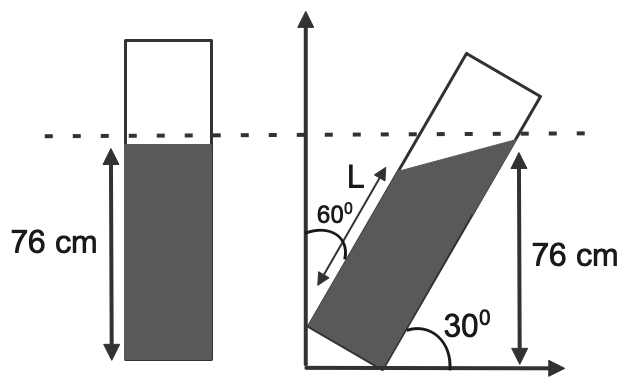
Let us assume the length of mercury occupied space at the angle be “L”
In the figure as we can see original vertical length which mercury occupies is 76 cm and when we tilt the test it laterally occupies the length “L”
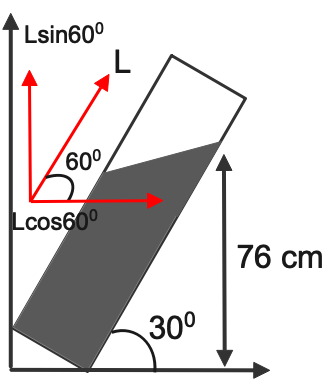
In the above figure we can see that “L” is resolved in the component now we will equate the vertical component of “L” with the height of straight test tube occupying the space
$ L\sin 30^\circ = 76cm $
Value of $ \sin 30^\circ = \dfrac{1}{2} $
Now we will equate the value of $ \sin 30^\circ $ in the equation
$ L \times \dfrac{1}{2} = 76cm $
Now we will take half on the other side which gives us the value of “L”
$ L = 152cm $
Hence, the correct option is option (A) 152 cm .
Note:
There might be a chance of making mistakes by using the pressure equation in the question as it contains the physical quantity height but the height remains constant so the equation will be useless as the question involves basic trigonometry and the component resolving of angled segments.
Complete step by step answer:
In the question we are given a barometer which reads mercury in the test tube. If the tube is gradually inclined at an angle with vertical, keeping the open end immersed in the reservoir and we have to find the length of the mercury column
Original length which mercury column maintain = 76 cm
Tube is inclined at an angle = $ 60^\circ $
Let us assume the length of mercury occupied space at the angle be “L”
In the figure as we can see original vertical length which mercury occupies is 76 cm and when we tilt the test it laterally occupies the length “L”
In the above figure we can see that “L” is resolved in the component now we will equate the vertical component of “L” with the height of straight test tube occupying the space
$ L\sin 30^\circ = 76cm $
Value of $ \sin 30^\circ = \dfrac{1}{2} $
Now we will equate the value of $ \sin 30^\circ $ in the equation
$ L \times \dfrac{1}{2} = 76cm $
Now we will take half on the other side which gives us the value of “L”
$ L = 152cm $
Hence, the correct option is option (A) 152 cm .
Note:
There might be a chance of making mistakes by using the pressure equation in the question as it contains the physical quantity height but the height remains constant so the equation will be useless as the question involves basic trigonometry and the component resolving of angled segments.
Recently Updated Pages
Master Class 11 Computer Science: Engaging Questions & Answers for Success

Master Class 11 Business Studies: Engaging Questions & Answers for Success
Master Class 11 Economics: Engaging Questions & Answers for Success
Master Class 11 English: Engaging Questions & Answers for Success
Master Class 11 Maths: Engaging Questions & Answers for Success
Master Class 11 Biology: Engaging Questions & Answers for Success
Trending doubts
One Metric ton is equal to kg A 10000 B 1000 C 100 class 11 physics CBSE
There are 720 permutations of the digits 1 2 3 4 5 class 11 maths CBSE
Discuss the various forms of bacteria class 11 biology CBSE
Draw a diagram of a plant cell and label at least eight class 11 biology CBSE
State the laws of reflection of light
10 examples of friction in our daily life