




A body at rest is acted upon by a constant force. What is the nature of the displacement-time graph?
A. Straight line
B. Symmetric parabola
C. Asymmetric parabola
D. Rectangular hyperbola
Answer
 Verified
579.3k+ views
Hint: When a constant force is acting on a body it corresponds to constant acceleration. The nature of the displacement time curve can be determined using the equation of motion.
Complete answer:
A force due to which the body moves at a constant velocity with time and has constant non-zero acceleration is a constant force.
The force acting on a body of mass m is given by,
$F=ma$
$F\propto a$
If force is constant, acceleration will be constant.
To determine the nature of displacement time graph let us consider the equation of motion,
$s=ut+\dfrac{1}{2}a{{t}^{2}}$
$F\propto a$
Since the body is initially at rest $u=0$
And acceleration is constant
$\Rightarrow s=\dfrac{1}{2}a{{t}^{2}}$
$\Rightarrow s\propto {{t}^{2}}$
This equation is analogous to the equation of parabola i.e. $y=4a{{x}^{2}}$
Therefore, the displacement time graph is a parabola
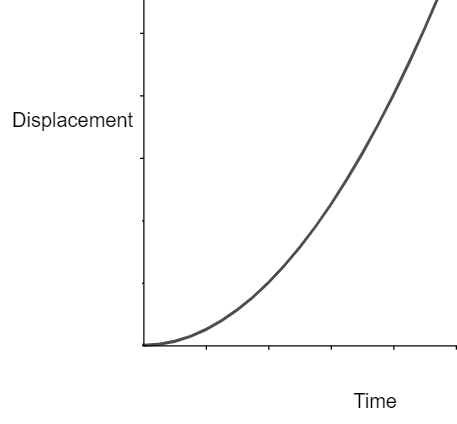
So, the correct answer is “Option B”.
Additional Information:
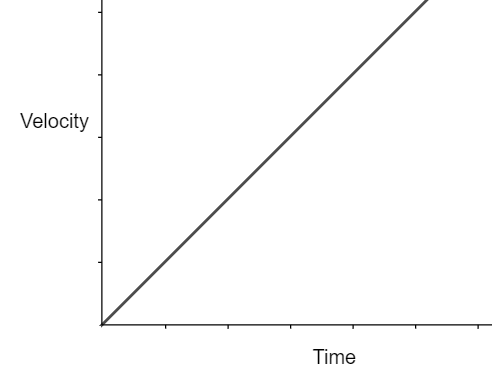
The nature of the velocity time graph would be a straight line if a constant force is applied. Using the first equation of motion i.e.
$v=u+at$
We get
$v\propto t$
Hence the velocity-time graph is a straight line.
An example of constant force is force of gravitation and the acceleration due to gravity is given by gravitational constant $g=9.8m{{s}^{-2}}$ for Earth.
Note:
Students should not confuse constant force with constant velocity. If the force acting on a body is constant it means it will have a constant non-zero acceleration and therefore an increasing velocity.
Complete answer:
A force due to which the body moves at a constant velocity with time and has constant non-zero acceleration is a constant force.
The force acting on a body of mass m is given by,
$F=ma$
$F\propto a$
If force is constant, acceleration will be constant.
To determine the nature of displacement time graph let us consider the equation of motion,
$s=ut+\dfrac{1}{2}a{{t}^{2}}$
$F\propto a$
Since the body is initially at rest $u=0$
And acceleration is constant
$\Rightarrow s=\dfrac{1}{2}a{{t}^{2}}$
$\Rightarrow s\propto {{t}^{2}}$
This equation is analogous to the equation of parabola i.e. $y=4a{{x}^{2}}$
Therefore, the displacement time graph is a parabola
So, the correct answer is “Option B”.
Additional Information:
The nature of the velocity time graph would be a straight line if a constant force is applied. Using the first equation of motion i.e.
$v=u+at$
We get
$v\propto t$
Hence the velocity-time graph is a straight line.
An example of constant force is force of gravitation and the acceleration due to gravity is given by gravitational constant $g=9.8m{{s}^{-2}}$ for Earth.
Note:
Students should not confuse constant force with constant velocity. If the force acting on a body is constant it means it will have a constant non-zero acceleration and therefore an increasing velocity.
Recently Updated Pages
Master Class 11 Computer Science: Engaging Questions & Answers for Success

Master Class 11 Business Studies: Engaging Questions & Answers for Success
Master Class 11 Economics: Engaging Questions & Answers for Success
Master Class 11 English: Engaging Questions & Answers for Success
Master Class 11 Maths: Engaging Questions & Answers for Success
Master Class 11 Biology: Engaging Questions & Answers for Success
Trending doubts
There are 720 permutations of the digits 1 2 3 4 5 class 11 maths CBSE
Discuss the various forms of bacteria class 11 biology CBSE
Explain zero factorial class 11 maths CBSE
What organs are located on the left side of your body class 11 biology CBSE
Draw a diagram of nephron and explain its structur class 11 biology CBSE
How do I convert ms to kmh Give an example class 11 physics CBSE