




When can a body move with zero acceleration? Represent the condition with a velocity time graph.
Answer
 Verified
516.9k+ views
Hint: This question is based on the concept of acceleration and velocity graphs. Velocity of a body is the rate of change of displacement and the acceleration of a body is the rate of change of velocity. Velocity time graphs are very important components of physics and are used in solving various problems related to mechanics.
Complete answer:
Any phase in which the velocity increases is referred to as acceleration. Since velocity has both a speed and a direction, you can only accelerate in one of two ways: change your speed or change your direction—or both. If you're not shifting your pace or course, you can't really accelerate—no matter how fast you're going.
In a vehicle, you can accelerate by pressing the gas pedal or braking, which both result in a shift in speed. However, you could adjust your direction of motion by turning the steering wheel. Since they shift velocity, each of these will be called an acceleration.
$a = \dfrac{{dv}}{{dt}}$
Acceleration of an object can be zero when it is moving with a constant velocity. Since velocity is constant, there will be no change in velocity and so there will be no acceleration.
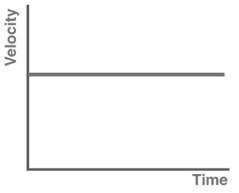
The above graph represents zero acceleration.
Note: An object will accelerate if acceleration is in the same direction as velocity. The object will slow down if the acceleration is in the opposite direction of the velocity. For example, for a body thrown upwards, acceleration due to gravity slows down the body, and for an object falling freely, acceleration due to gravity increases the velocity of the body.
Complete answer:
Any phase in which the velocity increases is referred to as acceleration. Since velocity has both a speed and a direction, you can only accelerate in one of two ways: change your speed or change your direction—or both. If you're not shifting your pace or course, you can't really accelerate—no matter how fast you're going.
In a vehicle, you can accelerate by pressing the gas pedal or braking, which both result in a shift in speed. However, you could adjust your direction of motion by turning the steering wheel. Since they shift velocity, each of these will be called an acceleration.
$a = \dfrac{{dv}}{{dt}}$
Acceleration of an object can be zero when it is moving with a constant velocity. Since velocity is constant, there will be no change in velocity and so there will be no acceleration.
The above graph represents zero acceleration.
Note: An object will accelerate if acceleration is in the same direction as velocity. The object will slow down if the acceleration is in the opposite direction of the velocity. For example, for a body thrown upwards, acceleration due to gravity slows down the body, and for an object falling freely, acceleration due to gravity increases the velocity of the body.
Recently Updated Pages
Master Class 11 Computer Science: Engaging Questions & Answers for Success

Master Class 11 Business Studies: Engaging Questions & Answers for Success
Master Class 11 Economics: Engaging Questions & Answers for Success
Master Class 11 English: Engaging Questions & Answers for Success
Master Class 11 Maths: Engaging Questions & Answers for Success
Master Class 11 Biology: Engaging Questions & Answers for Success
Trending doubts
One Metric ton is equal to kg A 10000 B 1000 C 100 class 11 physics CBSE
There are 720 permutations of the digits 1 2 3 4 5 class 11 maths CBSE
Discuss the various forms of bacteria class 11 biology CBSE
Draw a diagram of a plant cell and label at least eight class 11 biology CBSE
State the laws of reflection of light
Explain zero factorial class 11 maths CBSE