




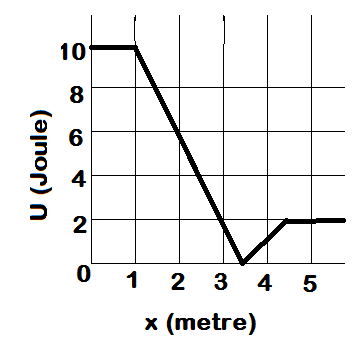
A body with mass 1kg moves in one direction in the presence of a force which is described by the potential energy graph. If the body is released from rest at x = 2m, then its speed when it crosses x = 5m is: (neglect dissipative forces)
A. Zero
B. $1m{s^{ - 1}}$
C. $2m{s^{ - 1}}$
D. $3m{s^{ - 1}}$
Answer
 Verified
584.7k+ views
Hint:According to the law of conservation of energy in all physical processes taking place in closed systems, the amount of change in kinetic energy is equal to the amount of change in potential energy that is $\Delta U = \Delta K$. If the kinetic energy increases, the potential energy decreases, and vice-versa.
The other key concept required for this question is the Work-Energy Theorem. According to the work-energy theorem the work done by all forces acting on a particle equals the change in the particle’s kinetic energy.
$\therefore W = \Delta KE = \dfrac{1}{2}(mfv{f^2} - miv{i^2})$
Complete step by step solution:
According to the question:
At x =2m, Potential energy (U) = 6 J
And at x = 5m, Potential energy (U) = 2 J
Therefore according to conservation of energy we can say that change in kinetic energy is equal to change in Potential energy $\Delta U = \Delta K$.
$\begin{gathered}
\therefore \Delta U = \Delta KE \\
\Rightarrow (6 - 2) = \Delta KE \\
\Rightarrow 4 = \Delta KE \\
\Rightarrow \Delta KE = 4J \\
\end{gathered} $
Therefore change in kinetic energy = 4 J
And according to work energy theorem we can say that work done by all forces acting on a particle equals the change in the particle’s kinetic energy.
$\begin{gathered}
\therefore W = \Delta KE = \dfrac{1}{2}(mfv{f^2} - miv{i^2}) \\
\therefore \Rightarrow 4 = \dfrac{1}{2}(mfv{f^2} - miv{i^2}) \\
\end{gathered} $
$\because $The body is released from rest therefore initial velocity will $(vi)$ be 0.
$\begin{gathered}
\therefore \Rightarrow 4 = \dfrac{1}{2}(mv{f^2}) \\
\Rightarrow 8 = mv{f^2} \\
\Rightarrow 8 = 1 \times v{f^2} \\
\Rightarrow 8 = v{f^2} \\
\Rightarrow v{f^2} = 8 \\
\Rightarrow vf = 2\sqrt 2 \\
\\
\end{gathered} $
On approximation the final velocity $vf \approx 3m{s^{ - 1}}$
Note: Be clear with the concepts of the work-energy theorem as it helps to reduce many long calculations and sometimes with the use of work-energy theorem we can solve the question without using the integration part as it provides an alternative option to get the answer without using integration.
The other key concept required for this question is the Work-Energy Theorem. According to the work-energy theorem the work done by all forces acting on a particle equals the change in the particle’s kinetic energy.
$\therefore W = \Delta KE = \dfrac{1}{2}(mfv{f^2} - miv{i^2})$
Complete step by step solution:
According to the question:
At x =2m, Potential energy (U) = 6 J
And at x = 5m, Potential energy (U) = 2 J
Therefore according to conservation of energy we can say that change in kinetic energy is equal to change in Potential energy $\Delta U = \Delta K$.
$\begin{gathered}
\therefore \Delta U = \Delta KE \\
\Rightarrow (6 - 2) = \Delta KE \\
\Rightarrow 4 = \Delta KE \\
\Rightarrow \Delta KE = 4J \\
\end{gathered} $
Therefore change in kinetic energy = 4 J
And according to work energy theorem we can say that work done by all forces acting on a particle equals the change in the particle’s kinetic energy.
$\begin{gathered}
\therefore W = \Delta KE = \dfrac{1}{2}(mfv{f^2} - miv{i^2}) \\
\therefore \Rightarrow 4 = \dfrac{1}{2}(mfv{f^2} - miv{i^2}) \\
\end{gathered} $
$\because $The body is released from rest therefore initial velocity will $(vi)$ be 0.
$\begin{gathered}
\therefore \Rightarrow 4 = \dfrac{1}{2}(mv{f^2}) \\
\Rightarrow 8 = mv{f^2} \\
\Rightarrow 8 = 1 \times v{f^2} \\
\Rightarrow 8 = v{f^2} \\
\Rightarrow v{f^2} = 8 \\
\Rightarrow vf = 2\sqrt 2 \\
\\
\end{gathered} $
On approximation the final velocity $vf \approx 3m{s^{ - 1}}$
Note: Be clear with the concepts of the work-energy theorem as it helps to reduce many long calculations and sometimes with the use of work-energy theorem we can solve the question without using the integration part as it provides an alternative option to get the answer without using integration.
Recently Updated Pages
Master Class 11 Computer Science: Engaging Questions & Answers for Success

Master Class 11 Business Studies: Engaging Questions & Answers for Success
Master Class 11 Economics: Engaging Questions & Answers for Success
Master Class 11 English: Engaging Questions & Answers for Success
Master Class 11 Maths: Engaging Questions & Answers for Success
Master Class 11 Biology: Engaging Questions & Answers for Success
Trending doubts
One Metric ton is equal to kg A 10000 B 1000 C 100 class 11 physics CBSE
There are 720 permutations of the digits 1 2 3 4 5 class 11 maths CBSE
Discuss the various forms of bacteria class 11 biology CBSE
Draw a diagram of a plant cell and label at least eight class 11 biology CBSE
State the laws of reflection of light
Explain zero factorial class 11 maths CBSE