




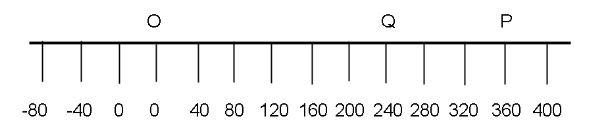
A car is moving along a straight line, say OP in the figure. It moves from O to P in 18 sec and returns from P and Q in 6 sec. What is the average velocity of the car in going from
(a) O to P? (b) from O to P and back to Q?
(A) $ 10m{s^{ - 1}},20m{s^{ - 1}} $
(B) $ 20m{s^{ - 1}},10m{s^{ - 1}} $
(C) $ 10m{s^{ - 1}},10m{s^{ - 1}} $
(D) $ 20m{s^{ - 1}},20m{s^{ - 1}} $
Answer
 Verified
561k+ views
Hint: In this solution, we will use the formula of average velocity which is the ratio of the total displacement travelled by the car in a given amount of time to the amount of time. We will determine the displacement travelled in all the 3 questions and determine their average velocity individually.
Formula used: In this solution, we will use the following formula:
-Average velocity= $ \dfrac{{{\text{total displacement}}}}{{{\text{time}}\,{\text{taken}}}} $
Complete step by step answer:
We’ve been given that the car is moving along a straight line from O to P in 18 sec and returns from P and Q in 6 sec. Then the average velocity of the car will depend on the displacement travelled by the car and the time it takes to cover this displacement.
For question (a), when the car travels from O to P in 18 seconds, the displacement travelled by the car will be $ (360 - 0)m = 360m $ . Since it takes 18 seconds to cover this displacement, the average velocity will be
$ {v_{avg}} = \dfrac{{360}}{{18}} = 20\,m/s $
For question (b), when the car travels from O to P and back to Q, the total displacement it will cover will be the distance between the initial point O and the final point Q which is 240 m. The time it will take to cover this distance is $ 18 + 6 = 24 $ seconds.
Hence the average velocity will be
$ {v_{avg}} = \dfrac{{240}}{{24}} = 10\,m/s $
Hence the correct answer is option B.
Note:
We should not be confused between average speed and average velocity. For average speed, we calculate the distance travelled by the car while for average velocity, we calculate the displacement of the car which is the distance between the initial and the final point of the car. The average velocity of the car will also have a direction which will be towards the positive x-axis for both the cases.
Formula used: In this solution, we will use the following formula:
-Average velocity= $ \dfrac{{{\text{total displacement}}}}{{{\text{time}}\,{\text{taken}}}} $
Complete step by step answer:
We’ve been given that the car is moving along a straight line from O to P in 18 sec and returns from P and Q in 6 sec. Then the average velocity of the car will depend on the displacement travelled by the car and the time it takes to cover this displacement.
For question (a), when the car travels from O to P in 18 seconds, the displacement travelled by the car will be $ (360 - 0)m = 360m $ . Since it takes 18 seconds to cover this displacement, the average velocity will be
$ {v_{avg}} = \dfrac{{360}}{{18}} = 20\,m/s $
For question (b), when the car travels from O to P and back to Q, the total displacement it will cover will be the distance between the initial point O and the final point Q which is 240 m. The time it will take to cover this distance is $ 18 + 6 = 24 $ seconds.
Hence the average velocity will be
$ {v_{avg}} = \dfrac{{240}}{{24}} = 10\,m/s $
Hence the correct answer is option B.
Note:
We should not be confused between average speed and average velocity. For average speed, we calculate the distance travelled by the car while for average velocity, we calculate the displacement of the car which is the distance between the initial and the final point of the car. The average velocity of the car will also have a direction which will be towards the positive x-axis for both the cases.
Recently Updated Pages
Master Class 11 Computer Science: Engaging Questions & Answers for Success

Master Class 11 Business Studies: Engaging Questions & Answers for Success
Master Class 11 Economics: Engaging Questions & Answers for Success
Master Class 11 English: Engaging Questions & Answers for Success
Master Class 11 Maths: Engaging Questions & Answers for Success
Master Class 11 Biology: Engaging Questions & Answers for Success
Trending doubts
One Metric ton is equal to kg A 10000 B 1000 C 100 class 11 physics CBSE
There are 720 permutations of the digits 1 2 3 4 5 class 11 maths CBSE
Discuss the various forms of bacteria class 11 biology CBSE
Draw a diagram of a plant cell and label at least eight class 11 biology CBSE
State the laws of reflection of light
Explain zero factorial class 11 maths CBSE