




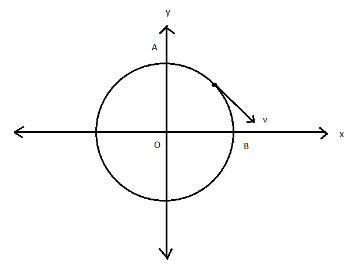
A car moves in a single track of radius \[4\,{\text{m}}\] at a constant speed of \[2\,{\text{m}}{{\text{s}}^{ - 1}}\] from \[A\] and \[B\] as shown in figure. The acceleration of car at the position halfway between \[A\] and \[B\] is:
(A) \[ - \dfrac{1}{{\sqrt 2 }}\left( {\hat i + \hat j} \right)\]
(B) \[\dfrac{1}{{\sqrt 2 }}\left( {\hat i + \hat j} \right)\]
(C) \[ - \left( {\hat i + \hat j} \right)\]
(D) Zero
Answer
 Verified
584.4k+ views
Hint: First of all, we will draw the diagram which relates the question, then we will calculate the acceleration by the formula. After that we will write the acceleration in vector form by taking one component along the vertical axis and the other along the horizontal axis.
Complete step by step answer:
In the given problem, we are supplied with the following data:
The radius of the track in which the car is moving is \[4\,{\text{m}}\] .
The speed of the car is \[2\,{\text{m}}{{\text{s}}^{ - 1}}\] .
We are asked to find the acceleration of the car at the position which is halfway between \[A\] and \[B\].
To solve this problem, we will draw a diagram for better understanding.
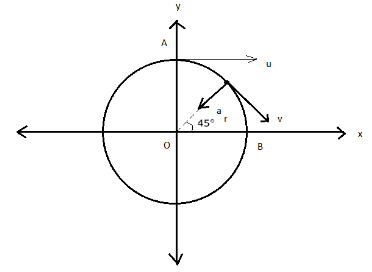
In the question we are asked to find out the acceleration at halfway, so the angle subtended by the car at the centre of the circular track will definitely be \[45^\circ \] . We have added initial velocity to be \[u\] . The acceleration that we require is directed inside symbolised as \[{a_{\text{r}}}\] .
Now, we find the magnitude of the acceleration, which is given by the formula:
\[{a_{\text{r}}} = \dfrac{{{v^2}}}{R}\] …… (1)
Where,
\[{a_{\text{r}}}\] indicates the acceleration at the halfway point.
\[v\] indicates the velocity at which the car is moving.
\[R\] indicates the radius of the circular track.
Substituting the required values in the equation (1), we get:
\[
{a_{\text{r}}} = \dfrac{{{v^2}}}{R} \\
{a_{\text{r}}} = \dfrac{{{2^2}}}{4} \\
{a_{\text{r}}} = 1\,{\text{m}}{{\text{s}}^{ - 2}} \\
\]
We add up another diagram which consists only the required acceleration and its components, as given below:
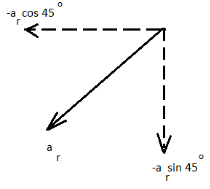
Now, we write the acceleration in the vector form.
As we can see in the diagram that if the direction of acceleration is counted then both its horizontal component and vertical component will be along the negative axes.
\[
{a_{\text{r}}} = - 1\cos 45^\circ \hat i - 1\sin 45^\circ \hat j \\
{a_{\text{r}}} = -\dfrac{1}{{\sqrt 2 }}\hat i - \dfrac{1}{{\sqrt 2 }}\hat j \\
{a_{\text{r}}} = -\dfrac{1}{{\sqrt 2 }}\left( {\hat i + \hat j} \right) \\
\]
Hence, the vector form of the acceleration is found to be \[ - \dfrac{1}{{\sqrt 2 }}\left( {\hat i + \hat j} \right)\] .
The correct option is A.
Note: While solving this problem, you should have a good knowledge of vectors and its respective components. The acceleration is directed inside and for this reason the components will be along the negative axes. Writing the vector form with positive components will definitely affect the result obtained.
Complete step by step answer:
In the given problem, we are supplied with the following data:
The radius of the track in which the car is moving is \[4\,{\text{m}}\] .
The speed of the car is \[2\,{\text{m}}{{\text{s}}^{ - 1}}\] .
We are asked to find the acceleration of the car at the position which is halfway between \[A\] and \[B\].
To solve this problem, we will draw a diagram for better understanding.
In the question we are asked to find out the acceleration at halfway, so the angle subtended by the car at the centre of the circular track will definitely be \[45^\circ \] . We have added initial velocity to be \[u\] . The acceleration that we require is directed inside symbolised as \[{a_{\text{r}}}\] .
Now, we find the magnitude of the acceleration, which is given by the formula:
\[{a_{\text{r}}} = \dfrac{{{v^2}}}{R}\] …… (1)
Where,
\[{a_{\text{r}}}\] indicates the acceleration at the halfway point.
\[v\] indicates the velocity at which the car is moving.
\[R\] indicates the radius of the circular track.
Substituting the required values in the equation (1), we get:
\[
{a_{\text{r}}} = \dfrac{{{v^2}}}{R} \\
{a_{\text{r}}} = \dfrac{{{2^2}}}{4} \\
{a_{\text{r}}} = 1\,{\text{m}}{{\text{s}}^{ - 2}} \\
\]
We add up another diagram which consists only the required acceleration and its components, as given below:
Now, we write the acceleration in the vector form.
As we can see in the diagram that if the direction of acceleration is counted then both its horizontal component and vertical component will be along the negative axes.
\[
{a_{\text{r}}} = - 1\cos 45^\circ \hat i - 1\sin 45^\circ \hat j \\
{a_{\text{r}}} = -\dfrac{1}{{\sqrt 2 }}\hat i - \dfrac{1}{{\sqrt 2 }}\hat j \\
{a_{\text{r}}} = -\dfrac{1}{{\sqrt 2 }}\left( {\hat i + \hat j} \right) \\
\]
Hence, the vector form of the acceleration is found to be \[ - \dfrac{1}{{\sqrt 2 }}\left( {\hat i + \hat j} \right)\] .
The correct option is A.
Note: While solving this problem, you should have a good knowledge of vectors and its respective components. The acceleration is directed inside and for this reason the components will be along the negative axes. Writing the vector form with positive components will definitely affect the result obtained.
Recently Updated Pages
Master Class 11 Computer Science: Engaging Questions & Answers for Success

Master Class 11 Business Studies: Engaging Questions & Answers for Success
Master Class 11 Economics: Engaging Questions & Answers for Success
Master Class 11 English: Engaging Questions & Answers for Success
Master Class 11 Maths: Engaging Questions & Answers for Success
Master Class 11 Biology: Engaging Questions & Answers for Success
Trending doubts
One Metric ton is equal to kg A 10000 B 1000 C 100 class 11 physics CBSE
There are 720 permutations of the digits 1 2 3 4 5 class 11 maths CBSE
Discuss the various forms of bacteria class 11 biology CBSE
Draw a diagram of a plant cell and label at least eight class 11 biology CBSE
State the laws of reflection of light
Explain zero factorial class 11 maths CBSE