




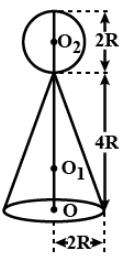
A carpenter has constructed a toy as shown in the figure If the density of the material of the sphere is 12 times that of cone, the position of the centre of mass the toy is given by
A. At a distance of 2 R from O
B. At a distance of 3 R from O
C. At a distance of 4 R from O
D. At a distance of 5 R from O
Answer
 Verified
517.2k+ views
Hint: The term "density" refers to the amount of mass per unit of volume. An object's average density is proportional to its total mass divided by its total volume. An object composed of a more dense material (such as iron) would have less volume than one made of a less dense substance of comparable mass (such as water).
Complete step by step answer:
The centre of mass of a mass distribution in space (also known as the equilibrium point) is the special point in physics where the weighted relative location of the distributed mass amounts to zero. A force may be applied to this point to induce a linear acceleration without causing an angular acceleration.
We know that
$\text{Mass} = \dfrac{\text{Density}}{\text{Volume}}$
If the density of cone is$\rho $, then mass of cone = $ = {\text{ density }} \times {\text{ volume }} = \dfrac{{\rho 1}}{{3\pi {{(2{\text{R}})}^2}}}$
i.e, ${m_1} = \dfrac{{16}}{{3\pi {{({\text{R}})}^3}\rho }}$
Hence, This mass is concentrated at a height from
${\text{O}} = \dfrac{h}{4} = \dfrac{{4R}}{h}$
From the above calculations
$\text{Mass of sphere} = {m_2} \\
\Rightarrow \text{Mass of sphere} = {\text{ density }} \times {\text{ volume }} \\
\Rightarrow \text{Mass of sphere} = \dfrac{{12\rho 4}}{{3\pi {{({\text{R}})}^3}}} \\
\Rightarrow \text{Mass of sphere} = 16\pi {{\text{R}}^3}\rho $
This mass is actually concentrated at ${O_2}$, i.e. at a distance of \[4R + R = 5R\] from O.Hence centre of mass of whole system will be
${{\text{Y}}_{{\text{cm}}}} = \dfrac{{{{\text{m}}_1}{{\text{y}}_1} + {{\text{m}}_2}{{\text{y}}_2}}}{{\;{{\text{m}}_1} + {{\text{m}}_2}}} \\$
Here ${y_1} = R{\text{ and }}{y_2} = 5R$
${Y_{cm}} = \dfrac{{mR + 3m(5R)}}{{m + 3m}} \\$
$\Rightarrow {Y_{cm}} = \dfrac{{16{\text{mR}}}}{{4\;{\text{m}}}} \\ $
$\therefore {Y_{cm}} = 4R$
Hence option C is correct.
Note: When formulated with respect to the centre of mass, physics calculations are sometimes simplified. It is a fictional point at which an object's entire mass can be believed to be condensed in order to visualise its motion. To put it another way, the centre of mass is the particle counterpart to a given object when Newton's laws of motion are applied.
Complete step by step answer:
The centre of mass of a mass distribution in space (also known as the equilibrium point) is the special point in physics where the weighted relative location of the distributed mass amounts to zero. A force may be applied to this point to induce a linear acceleration without causing an angular acceleration.
We know that
$\text{Mass} = \dfrac{\text{Density}}{\text{Volume}}$
If the density of cone is$\rho $, then mass of cone = $ = {\text{ density }} \times {\text{ volume }} = \dfrac{{\rho 1}}{{3\pi {{(2{\text{R}})}^2}}}$
i.e, ${m_1} = \dfrac{{16}}{{3\pi {{({\text{R}})}^3}\rho }}$
Hence, This mass is concentrated at a height from
${\text{O}} = \dfrac{h}{4} = \dfrac{{4R}}{h}$
From the above calculations
$\text{Mass of sphere} = {m_2} \\
\Rightarrow \text{Mass of sphere} = {\text{ density }} \times {\text{ volume }} \\
\Rightarrow \text{Mass of sphere} = \dfrac{{12\rho 4}}{{3\pi {{({\text{R}})}^3}}} \\
\Rightarrow \text{Mass of sphere} = 16\pi {{\text{R}}^3}\rho $
This mass is actually concentrated at ${O_2}$, i.e. at a distance of \[4R + R = 5R\] from O.Hence centre of mass of whole system will be
${{\text{Y}}_{{\text{cm}}}} = \dfrac{{{{\text{m}}_1}{{\text{y}}_1} + {{\text{m}}_2}{{\text{y}}_2}}}{{\;{{\text{m}}_1} + {{\text{m}}_2}}} \\$
Here ${y_1} = R{\text{ and }}{y_2} = 5R$
${Y_{cm}} = \dfrac{{mR + 3m(5R)}}{{m + 3m}} \\$
$\Rightarrow {Y_{cm}} = \dfrac{{16{\text{mR}}}}{{4\;{\text{m}}}} \\ $
$\therefore {Y_{cm}} = 4R$
Hence option C is correct.
Note: When formulated with respect to the centre of mass, physics calculations are sometimes simplified. It is a fictional point at which an object's entire mass can be believed to be condensed in order to visualise its motion. To put it another way, the centre of mass is the particle counterpart to a given object when Newton's laws of motion are applied.
Recently Updated Pages
Master Class 11 Computer Science: Engaging Questions & Answers for Success

Master Class 11 Business Studies: Engaging Questions & Answers for Success
Master Class 11 Economics: Engaging Questions & Answers for Success
Master Class 11 English: Engaging Questions & Answers for Success
Master Class 11 Maths: Engaging Questions & Answers for Success
Master Class 11 Biology: Engaging Questions & Answers for Success
Trending doubts
One Metric ton is equal to kg A 10000 B 1000 C 100 class 11 physics CBSE
There are 720 permutations of the digits 1 2 3 4 5 class 11 maths CBSE
Discuss the various forms of bacteria class 11 biology CBSE
Draw a diagram of a plant cell and label at least eight class 11 biology CBSE
State the laws of reflection of light
Explain zero factorial class 11 maths CBSE