




A circle is inscribed in a triangle whose sides are 8 cm, 15 cm, and 17 cm, then the radius of the circle is
(a) 3 cm
(b) 4 cm
(c) 5 cm
(d) None of these
Answer
 Verified
614.7k+ views
Hint: In this question, first we will prove that the triangle is a right angled triangle. Then, find the area of the right-angled triangle. After that, we will draw the line segments with the centre of the circle and all corners of the triangle. Now, we have to evaluate the area of all 3 triangles. Now, on comparing both the areas, we will get the radius of the circle.
Complete step-by-step answer:
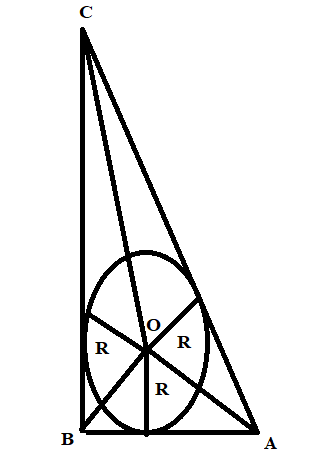
Let, the \[\Delta ABC\] have the dimensions AB = 8cm, BC = 15cm and AC = 17cm.
Now, we have to prove that ABC is a right-angled triangle. So, by using Pythagoras theorem $\left( {{a}^{2}}+{{b}^{2}}={{c}^{2}} \right)$ :
$\begin{align}
& A{{B}^{2}}+B{{C}^{2}}={{8}^{2}}+{{15}^{2}}=64+225=289 \\
& A{{C}^{2}}={{17}^{2}}=289 \\
\end{align}$
Hence, it satisfies Pythagoras theorem. So, the ABC is a right-angled triangle.
Area of $\Delta ABC=\dfrac{1}{2}\times Base\times Height$
Base = 8 cm and height = 15 cm.
Area of $\Delta ABC=\dfrac{1}{2}\times 8\times 15=60c{{m}^{2}}...(1)$
Let, R be the radius of the circle, whose centre is O.
Now, calculate area of all 3 triangles in the figure in terms of radius of the circle R,
= area of $\Delta AOB$+ area of $\Delta BOC$+ area of $\Delta COA$
$\begin{align}
& =\left[ \dfrac{1}{2}\times AB\times R \right]+\left[ \dfrac{1}{2}\times BC\times R \right]+\left[ \dfrac{1}{2}\times AC\times R \right] \\
& =\dfrac{1}{2}\times R\times \left[ 8+15+17 \right]=\dfrac{1}{2}\times R\times 40 \\
& =20R...(2) \\
\end{align}$
The area obtained in equation (2) is also the area of the right-angled triangle because the sum of the area of all 3 triangles is the area of the right-angled triangle.
From equation (1) and equation (2), we get
$\begin{align}
& 20\times R=60 \\
& R=3cm \\
\end{align}$
Hence, the radius of the circle is 3 cm.
Therefore, option (a) is correct.
Note: The key concept for solving this problem is the segregation of the whole area into three parts. By separating the area into three triangles we easily evaluated the radius of the circle. This concept is very useful in solving complex problems.
Complete step-by-step answer:
Let, the \[\Delta ABC\] have the dimensions AB = 8cm, BC = 15cm and AC = 17cm.
Now, we have to prove that ABC is a right-angled triangle. So, by using Pythagoras theorem $\left( {{a}^{2}}+{{b}^{2}}={{c}^{2}} \right)$ :
$\begin{align}
& A{{B}^{2}}+B{{C}^{2}}={{8}^{2}}+{{15}^{2}}=64+225=289 \\
& A{{C}^{2}}={{17}^{2}}=289 \\
\end{align}$
Hence, it satisfies Pythagoras theorem. So, the ABC is a right-angled triangle.
Area of $\Delta ABC=\dfrac{1}{2}\times Base\times Height$
Base = 8 cm and height = 15 cm.
Area of $\Delta ABC=\dfrac{1}{2}\times 8\times 15=60c{{m}^{2}}...(1)$
Let, R be the radius of the circle, whose centre is O.
Now, calculate area of all 3 triangles in the figure in terms of radius of the circle R,
= area of $\Delta AOB$+ area of $\Delta BOC$+ area of $\Delta COA$
$\begin{align}
& =\left[ \dfrac{1}{2}\times AB\times R \right]+\left[ \dfrac{1}{2}\times BC\times R \right]+\left[ \dfrac{1}{2}\times AC\times R \right] \\
& =\dfrac{1}{2}\times R\times \left[ 8+15+17 \right]=\dfrac{1}{2}\times R\times 40 \\
& =20R...(2) \\
\end{align}$
The area obtained in equation (2) is also the area of the right-angled triangle because the sum of the area of all 3 triangles is the area of the right-angled triangle.
From equation (1) and equation (2), we get
$\begin{align}
& 20\times R=60 \\
& R=3cm \\
\end{align}$
Hence, the radius of the circle is 3 cm.
Therefore, option (a) is correct.
Note: The key concept for solving this problem is the segregation of the whole area into three parts. By separating the area into three triangles we easily evaluated the radius of the circle. This concept is very useful in solving complex problems.
Recently Updated Pages
Master Class 10 Computer Science: Engaging Questions & Answers for Success

Master Class 10 General Knowledge: Engaging Questions & Answers for Success
Master Class 10 English: Engaging Questions & Answers for Success
Master Class 10 Social Science: Engaging Questions & Answers for Success
Master Class 10 Maths: Engaging Questions & Answers for Success
Master Class 10 Science: Engaging Questions & Answers for Success
Trending doubts
What is the median of the first 10 natural numbers class 10 maths CBSE
Which women's tennis player has 24 Grand Slam singles titles?
Who is the Brand Ambassador of Incredible India?
Why is there a time difference of about 5 hours between class 10 social science CBSE
Write a letter to the principal requesting him to grant class 10 english CBSE
A moving boat is observed from the top of a 150 m high class 10 maths CBSE