




(a) How has the development of bioreactors helped in biotechnology?
(b) Name the most commonly used bioreactor and describe its working.
Answer
 Verified
392.4k+ views
Hint: A bioreactor is a big vessel, which is used to cultivate culture on a huge scale under optimal conditions to generate large amounts of the desired product, e.g., vaccines, enzymes, antibodies, etc.
Complete step-by-step answer:
(a) The bioreactor has assisted in biotechnology in many different ways like controlling the pressure and temperature of the system. Bioreactors are chambers where microorganisms are grown in a liquid medium. A large volume of culture or larger biomass can be treated which leads to higher yields of desired products specifically (enzymes/proteins), under controlled circumstances. Therefore, the evolution of bioreactors helped tremendously in creating the desired products widely. Aerators are used if oxygen should be pumped into the system. Biotechnological methods can be performed without adulteration/ leakage of internal material into the surroundings.
(b) The most used bioreactor is the simple stirred tank bioreactor. It consists of a reactor and a mixer like a propeller, a turbine wing, or a stirrer. Stirred tank reactors perform functions such as exchanges of heat, liquid aeration, dispersion of gas-liquid mixtures, suspension of solids, and homogenization. These features form the functioning of the bioreactor. The variables are size, type, location and number of impellers, location, and sparger size. These functions have an impact on the hydrodynamic characteristics of the reactor. Conventional fermentation is performed in batch mode. This kind of bioreactor is useful for immobilised enzymes with relatively low activity and for substrate solutions of high-level viscosity. The drawback of this bioreactor is that the immobilised enzyme is inclined to degrade during stirring.
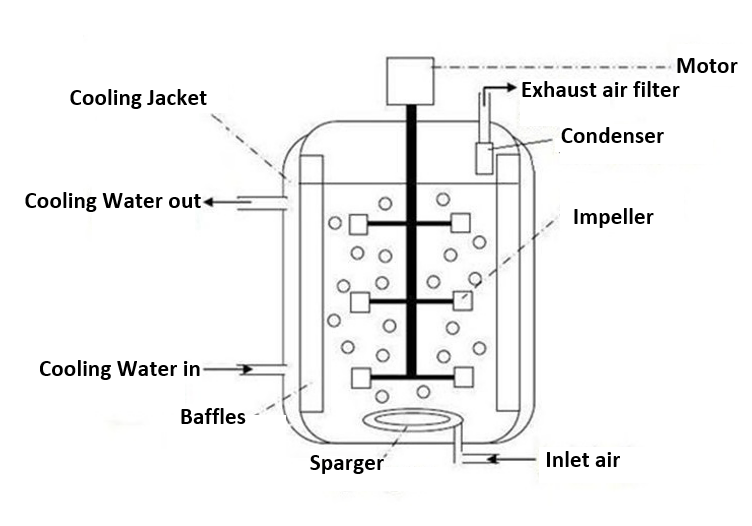
Image: Stirred tank bioreactors
Note: A bioreactor helps to generate a huge volume of culture. The bioreactor is a huge vessel in which different cells like plant, human, or animal cells are utilised to culture new biological products.
Complete step-by-step answer:
(a) The bioreactor has assisted in biotechnology in many different ways like controlling the pressure and temperature of the system. Bioreactors are chambers where microorganisms are grown in a liquid medium. A large volume of culture or larger biomass can be treated which leads to higher yields of desired products specifically (enzymes/proteins), under controlled circumstances. Therefore, the evolution of bioreactors helped tremendously in creating the desired products widely. Aerators are used if oxygen should be pumped into the system. Biotechnological methods can be performed without adulteration/ leakage of internal material into the surroundings.
(b) The most used bioreactor is the simple stirred tank bioreactor. It consists of a reactor and a mixer like a propeller, a turbine wing, or a stirrer. Stirred tank reactors perform functions such as exchanges of heat, liquid aeration, dispersion of gas-liquid mixtures, suspension of solids, and homogenization. These features form the functioning of the bioreactor. The variables are size, type, location and number of impellers, location, and sparger size. These functions have an impact on the hydrodynamic characteristics of the reactor. Conventional fermentation is performed in batch mode. This kind of bioreactor is useful for immobilised enzymes with relatively low activity and for substrate solutions of high-level viscosity. The drawback of this bioreactor is that the immobilised enzyme is inclined to degrade during stirring.
Image: Stirred tank bioreactors
Note: A bioreactor helps to generate a huge volume of culture. The bioreactor is a huge vessel in which different cells like plant, human, or animal cells are utilised to culture new biological products.
Recently Updated Pages
Choose the incorrect statement regarding the HardyWeinberg class 12 biology NEET_UG

Explain in brief the separation and isolation of DNA class 12 biology NEET_UG
Number of testicular lobules in testes is A 250 B 500 class 12 biology NEET_UG
Master Class 9 General Knowledge: Engaging Questions & Answers for Success
Master Class 9 Social Science: Engaging Questions & Answers for Success
Master Class 9 English: Engaging Questions & Answers for Success
Trending doubts
Which are the Top 10 Largest Countries of the World?
What is BLO What is the full form of BLO class 8 social science CBSE
The value of 6 more than 7 is A 1 B 1 C 13 D 13 class 7 maths CBSE
One Metric ton is equal to kg A 10000 B 1000 C 100 class 11 physics CBSE
There are 720 permutations of the digits 1 2 3 4 5 class 11 maths CBSE
Difference Between Plant Cell and Animal Cell