




A hydraulic press has a ram of 15 cm diameter and a plunger is 1.5 cm. It is required to lift a weight of 1 tonne. The force required on the plunger is
A. 10 kg
B. 100 kg
C. 1000 kg
D. 1 kg
Answer
 Verified
524.2k+ views
Hint: Hydraulic press is an application of Pascal's law following the principle that "The pressure exerted at any point on an enclosed liquid gets transmitted equally in all directions". Also, 1 tonne is measured to be 1000 kilograms.
Formula used:
From the fact that pressure at all points is same, we get:
$F_1 = \dfrac{A_1}{A_2} \times F_2$
Complete step-by-step solution:
In a hydraulic press when we apply pressure on one end, it gets distributed and pressure everywhere in the liquid becomes the same. Pressure is nothing but force per unit area:
$P = \dfrac{force}{area}$
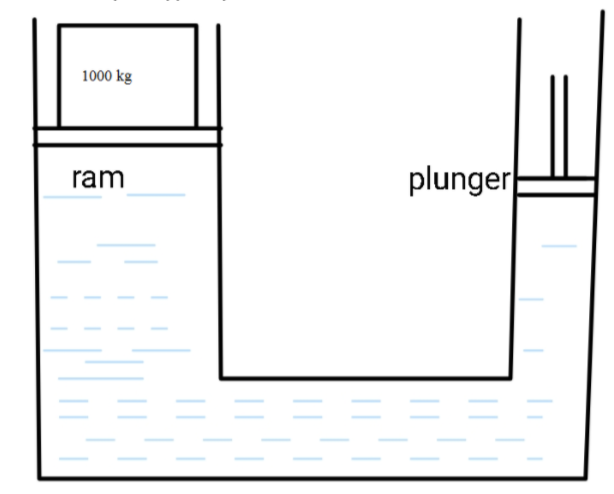
The hydraulic press consists of a tube filled with liquid. Therefore in a hydraulic press towards the ram side, replace the object to be lifted and this side has a bigger area ($A_2$) and on the plunger side, the tube has a smaller area ($A_1$). The ratio of applied force to the area of that side remains equal. Therefore, towards the plunger side, the denominator is small, which requires a small numerator to keep the balance. Towards the ram side, the area is more so Force in the numerator has to be more. When we apply a small force towards the plunger side (downwards), the object placed on the ram side experiences a greater force upwards and gets lifted.
Equating the pressures on two sides:
$\dfrac{F_2}{A_2} = \dfrac{F_1}{A_1}$
We are given:
$R_1 = 1.5 $cm
$R_2 = 15 $cm
$F_2 = 1000 kg$
Keeping the values we get:
$\dfrac{1000}{\pi (15)^2} = \dfrac{F_1}{\pi (1.5)^2}$
Which gives us
$F_1 = 10 kg$
Therefore, the correct answer is option (A) 10 kg.
Note: Here we expressed force in terms of unit of mass. Here we can do so because the g on both sides will get cancelled automatically so we need not bother about it as it will not affect our result anyway. Also so we did not bother to convert centimeters into meters as the unit gets cancelled anyway. But it is advisable to check the unit system first and make unit conversions and then solve the question in any other circumstance.
Formula used:
From the fact that pressure at all points is same, we get:
$F_1 = \dfrac{A_1}{A_2} \times F_2$
Complete step-by-step solution:
In a hydraulic press when we apply pressure on one end, it gets distributed and pressure everywhere in the liquid becomes the same. Pressure is nothing but force per unit area:
$P = \dfrac{force}{area}$
The hydraulic press consists of a tube filled with liquid. Therefore in a hydraulic press towards the ram side, replace the object to be lifted and this side has a bigger area ($A_2$) and on the plunger side, the tube has a smaller area ($A_1$). The ratio of applied force to the area of that side remains equal. Therefore, towards the plunger side, the denominator is small, which requires a small numerator to keep the balance. Towards the ram side, the area is more so Force in the numerator has to be more. When we apply a small force towards the plunger side (downwards), the object placed on the ram side experiences a greater force upwards and gets lifted.
Equating the pressures on two sides:
$\dfrac{F_2}{A_2} = \dfrac{F_1}{A_1}$
We are given:
$R_1 = 1.5 $cm
$R_2 = 15 $cm
$F_2 = 1000 kg$
Keeping the values we get:
$\dfrac{1000}{\pi (15)^2} = \dfrac{F_1}{\pi (1.5)^2}$
Which gives us
$F_1 = 10 kg$
Therefore, the correct answer is option (A) 10 kg.
Note: Here we expressed force in terms of unit of mass. Here we can do so because the g on both sides will get cancelled automatically so we need not bother about it as it will not affect our result anyway. Also so we did not bother to convert centimeters into meters as the unit gets cancelled anyway. But it is advisable to check the unit system first and make unit conversions and then solve the question in any other circumstance.
Recently Updated Pages
Master Class 11 Computer Science: Engaging Questions & Answers for Success

Master Class 11 Business Studies: Engaging Questions & Answers for Success
Master Class 11 Economics: Engaging Questions & Answers for Success
Master Class 11 English: Engaging Questions & Answers for Success
Master Class 11 Maths: Engaging Questions & Answers for Success
Master Class 11 Biology: Engaging Questions & Answers for Success
Trending doubts
One Metric ton is equal to kg A 10000 B 1000 C 100 class 11 physics CBSE
There are 720 permutations of the digits 1 2 3 4 5 class 11 maths CBSE
Discuss the various forms of bacteria class 11 biology CBSE
Draw a diagram of a plant cell and label at least eight class 11 biology CBSE
State the laws of reflection of light
Explain zero factorial class 11 maths CBSE