




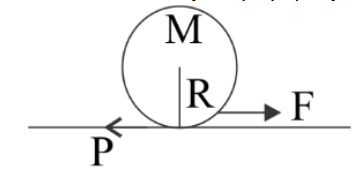
A lawn roller in the form of a thin-walled hollow cylinder of mass M is pulled with a constant horizontal force F applied by a handle attached to the axle.
It rolls without shipping.
(A) The frictional force $F/2$
(B) Acceleration is $F/2M$
(C) Acceleration is $F/M$
(D) The frictional force is $3F/4$
Answer
 Verified
586.5k+ views
Hint:To solve this type of problem we have to show the picture of the information. Then by applying proper formulas we can solve the problem. Here use a lavish holler so inertia is applied.
Complete step by step answer:
Definition:
Torque is the tendency of a force to rotate the body to which it is applied.
\[\tau = I\alpha \]
There are two types of acceleration, linear acceleration and angular acceleration. For a pure rolling system the linear acceleration is zero and for a pure horizontal motion the angular acceleration will be zero.
Given, mass of cylinder\[ = {\text{ }}M\]
Horizontal force or applied force \[ = F.\]
So the free body diagram is,
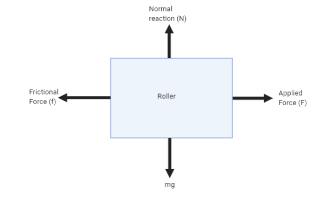
Let, be the angular acceleration, Risa constant of them, we can write
Angular acceleration,\[\alpha \]is,
\[\alpha = \dfrac{{d\omega }}{{dt}}\]
And
Velocity,v is
\[v = r\omega \]
From this we need to find relation between linear and angular acceleration,
\[
\dfrac{{dv}}{{dt}} = r\dfrac{{d\omega }}{{dt}}.\omega \dfrac{{dr}}{{dt}} \\
\\
\]
Since r is constant,
\[\dfrac{{dr}}{{dt}} = 0\]
So ,
\[\dfrac{{dv}}{{dt}} = r\dfrac{{d\omega }}{{dt}}\]
Here \[\dfrac{{dv}}{{dt}}\]= linear acceleration, \[\dfrac{{d\omega }}{{dt}}\] = angular acceleration
So,
\[a = r\alpha \]
\[a = R\alpha {\text{ }}\left( {for{\text{ }}no{\text{ }}slipping} \right)\]
where a is linear acceleration.
Again, we know, \[\tau = fR = I\alpha \]
Where f is frictional force, \[I\]is Inertia, and \[\tau \] is the torque.
The moment of inertia of this system is,
\[I = M{R^2}\]
Then we can write.
\[fR = M{R^2}\alpha \]
\[\therefore I = M{R^2}\] for a cylinder having mass \[M\] and radius \[R.\]
\[F = MR\alpha \]
Again, we know, \[{f_{total}} = Ma\] by the Newton law of motion.
\[\therefore Ma = F - f\]
\[\therefore Ma = F - ma\]
\[2Ma = F\]
\[a = \dfrac{F}{{2M}}\]
\[\therefore practical\;{\text{force f = M}}{\text{.a}}{\text{.}}\]
\[{\text{ = M}}{\text{.}}\dfrac{F}{
2M \\
\\
}\]
\[ = \;F/2\]
\[\therefore \] option \[A\] and \[B\] both are true.
Note:To know about this solution. We have to know about the relation between angular and linear acceleration, force, inertia, etc. If we got to know about their relationship then we can find out the problem. Also we have to drain the relation picture of the current then we get to know which force applied in which direction.
Complete step by step answer:
Definition:
Torque is the tendency of a force to rotate the body to which it is applied.
\[\tau = I\alpha \]
There are two types of acceleration, linear acceleration and angular acceleration. For a pure rolling system the linear acceleration is zero and for a pure horizontal motion the angular acceleration will be zero.
Given, mass of cylinder\[ = {\text{ }}M\]
Horizontal force or applied force \[ = F.\]
So the free body diagram is,
Let, be the angular acceleration, Risa constant of them, we can write
Angular acceleration,\[\alpha \]is,
\[\alpha = \dfrac{{d\omega }}{{dt}}\]
And
Velocity,v is
\[v = r\omega \]
From this we need to find relation between linear and angular acceleration,
\[
\dfrac{{dv}}{{dt}} = r\dfrac{{d\omega }}{{dt}}.\omega \dfrac{{dr}}{{dt}} \\
\\
\]
Since r is constant,
\[\dfrac{{dr}}{{dt}} = 0\]
So ,
\[\dfrac{{dv}}{{dt}} = r\dfrac{{d\omega }}{{dt}}\]
Here \[\dfrac{{dv}}{{dt}}\]= linear acceleration, \[\dfrac{{d\omega }}{{dt}}\] = angular acceleration
So,
\[a = r\alpha \]
\[a = R\alpha {\text{ }}\left( {for{\text{ }}no{\text{ }}slipping} \right)\]
where a is linear acceleration.
Again, we know, \[\tau = fR = I\alpha \]
Where f is frictional force, \[I\]is Inertia, and \[\tau \] is the torque.
The moment of inertia of this system is,
\[I = M{R^2}\]
Then we can write.
\[fR = M{R^2}\alpha \]
\[\therefore I = M{R^2}\] for a cylinder having mass \[M\] and radius \[R.\]
\[F = MR\alpha \]
Again, we know, \[{f_{total}} = Ma\] by the Newton law of motion.
\[\therefore Ma = F - f\]
\[\therefore Ma = F - ma\]
\[2Ma = F\]
\[a = \dfrac{F}{{2M}}\]
\[\therefore practical\;{\text{force f = M}}{\text{.a}}{\text{.}}\]
\[{\text{ = M}}{\text{.}}\dfrac{F}{
2M \\
\\
}\]
\[ = \;F/2\]
\[\therefore \] option \[A\] and \[B\] both are true.
Note:To know about this solution. We have to know about the relation between angular and linear acceleration, force, inertia, etc. If we got to know about their relationship then we can find out the problem. Also we have to drain the relation picture of the current then we get to know which force applied in which direction.
Recently Updated Pages
Master Class 11 Computer Science: Engaging Questions & Answers for Success

Master Class 11 Business Studies: Engaging Questions & Answers for Success
Master Class 11 Economics: Engaging Questions & Answers for Success
Master Class 11 English: Engaging Questions & Answers for Success
Master Class 11 Maths: Engaging Questions & Answers for Success
Master Class 11 Biology: Engaging Questions & Answers for Success
Trending doubts
One Metric ton is equal to kg A 10000 B 1000 C 100 class 11 physics CBSE
There are 720 permutations of the digits 1 2 3 4 5 class 11 maths CBSE
Discuss the various forms of bacteria class 11 biology CBSE
Draw a diagram of a plant cell and label at least eight class 11 biology CBSE
State the laws of reflection of light
Explain zero factorial class 11 maths CBSE