




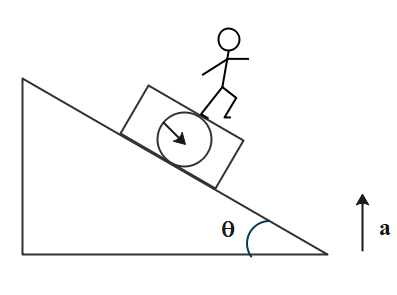
A man of mass m = 60kg is standing on a weighing machine fixed on a triangular wedge of angle $\theta = {60^ \circ }$ with horizontal as shown in the figure. The wedge is moving up with an upward acceleration $a = 2m/{s^2}$. The weight registered by machine is
A. 360N
B.1440N
C.600N
D.240N
Answer
 Verified
573k+ views
Hint: The normal force is known as a force of contact. When two surfaces are not in contact with each other, then a normal force cannot be exerted on one another. In order to find the solution of the given question we will first find the components of the forces acting on the man and then solve accordingly.
Formula Used: N = $ma\cos \theta + mg\cos \theta $
Complete answer:
For better understanding of the question let us draw a rough diagram of the given question showing the forces which will be acting on the man standing on the wedge.
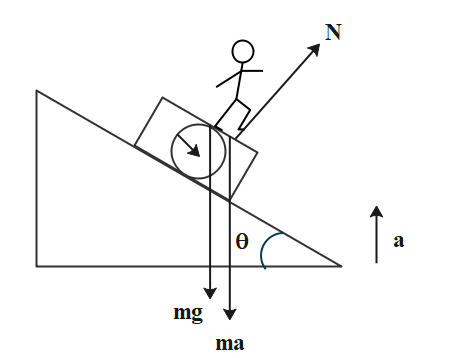
As the wedge on which the man is standing is moving in the upward direction then the pseudo force ‘ma’ acting on the man would be in the downward direction. Also, the weight of the man ‘mg’ would also act in the downward direction.
Now, the weight registered by machine would be the normal reaction of the man. Here, normal reaction would be the component of the ‘mg’ and ‘ma’.
It is given that, the mass of the man = 60kg, angle $\theta = {60^ \circ }$
So, according to the given question,
Normal reaction, N = $ma\cos \theta + mg\cos \theta $
$\eqalign{
& \Rightarrow N = 60 \times 2 \times \dfrac{1}{2} + 60 \times 10 \times \dfrac{1}{2} \cr
& \Rightarrow N = 60 + 60 \times 5 \cr
& \Rightarrow N = 60 + 300 \cr
& \therefore N = 360N \cr} $
Thus, the weight registered by the weighing machine is 360N.
Hence, option (A) is the correct answer.
Note:
The Pseudo force is defined as an apparent force which acts on all the masses whose motion is described using a non-inertial frame of reference frame, such as a rotating reference frame. It said to be in effect if the frame of reference starts accelerating as compared to a non-accelerating frame of reference.
Formula Used: N = $ma\cos \theta + mg\cos \theta $
Complete answer:
For better understanding of the question let us draw a rough diagram of the given question showing the forces which will be acting on the man standing on the wedge.
As the wedge on which the man is standing is moving in the upward direction then the pseudo force ‘ma’ acting on the man would be in the downward direction. Also, the weight of the man ‘mg’ would also act in the downward direction.
Now, the weight registered by machine would be the normal reaction of the man. Here, normal reaction would be the component of the ‘mg’ and ‘ma’.
It is given that, the mass of the man = 60kg, angle $\theta = {60^ \circ }$
So, according to the given question,
Normal reaction, N = $ma\cos \theta + mg\cos \theta $
$\eqalign{
& \Rightarrow N = 60 \times 2 \times \dfrac{1}{2} + 60 \times 10 \times \dfrac{1}{2} \cr
& \Rightarrow N = 60 + 60 \times 5 \cr
& \Rightarrow N = 60 + 300 \cr
& \therefore N = 360N \cr} $
Thus, the weight registered by the weighing machine is 360N.
Hence, option (A) is the correct answer.
Note:
The Pseudo force is defined as an apparent force which acts on all the masses whose motion is described using a non-inertial frame of reference frame, such as a rotating reference frame. It said to be in effect if the frame of reference starts accelerating as compared to a non-accelerating frame of reference.
Recently Updated Pages
Master Class 11 Computer Science: Engaging Questions & Answers for Success

Master Class 11 Business Studies: Engaging Questions & Answers for Success
Master Class 11 Economics: Engaging Questions & Answers for Success
Master Class 11 English: Engaging Questions & Answers for Success
Master Class 11 Maths: Engaging Questions & Answers for Success
Master Class 11 Biology: Engaging Questions & Answers for Success
Trending doubts
One Metric ton is equal to kg A 10000 B 1000 C 100 class 11 physics CBSE
There are 720 permutations of the digits 1 2 3 4 5 class 11 maths CBSE
Discuss the various forms of bacteria class 11 biology CBSE
Draw a diagram of a plant cell and label at least eight class 11 biology CBSE
State the laws of reflection of light
Explain zero factorial class 11 maths CBSE