




A mason construct a wall of dimensions $270{\text{ cm }} \times {\text{ 300 cm }} \times {\text{ 350 cm}}$ with the bricks each of size $22.5{\text{ cm }} \times {\text{ 11}}{\text{.25 cm }} \times {\text{ 8}}{\text{.75 cm}}$ and it is assumed that $\dfrac{1}{8}$ space is covered by the mortar. Then the number of bricks used to construct the wall is
$\left( a \right)$ 11100
$\left( b \right)$ 11200
$\left( c \right)$ 11000
$\left( d \right)$ 11300
Answer
 Verified
592.8k+ views
Hint: In this particular question use the concept that volume of one brick (i.e. space covered by one brick) is given as, $\left( {lbh} \right)$, where symbols have their usual meaning, same concept to calculate the volume of the wall, so the number of bricks required is the ratio of volume of wall to the volume of 1 brick so use these concepts to reach the solution of the question.
Complete step by step answer:
Given data
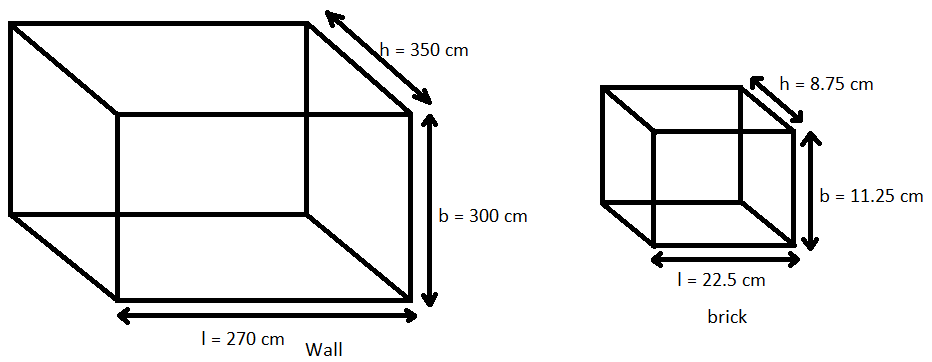
Dimension of the brick is $22.5{\text{ cm }} \times {\text{ 11}}{\text{.25 cm }} \times {\text{ 8}}{\text{.75 cm}}$
So, length (l) of brick is 22.5 cm
Breath (b) of brick is 11.25 cm
Height (h) of brick is 8.75 cm
Now we know that the space covered by the one brick i.e. volume of one brick = $\left( {lbh} \right)$
So, volume (V) of one brick = \[\left( {22.5 \times 11.25 \times 8.75} \right){\text{ c}}{{\text{m}}^3}\]
Dimension of the wall is $270{\text{ cm }} \times {\text{ 300 cm }} \times {\text{ 350 cm}}$
So, length (l) of brick is 270 cm
Breath (b) of brick is 300 cm
Height (h) of brick is 350 cm
Now we know that the space covered by the wall i.e. volume of the wall = $\left( {lbh} \right)$
So, volume (V’) of the wall = \[\left( {270 \times 300 \times 350} \right){\text{ c}}{{\text{m}}^3}\]
Now it is given that $\dfrac{1}{8}$ space is covered by the mortar so the remaining volume = volume of the wall - $\dfrac{1}{8}$ times the volume of the wall.
So the volume of the wall in which the bricks are applied,
\[ \Rightarrow \left( {270 \times 300 \times 350} \right){\text{ c}}{{\text{m}}^3}\] - \[\dfrac{1}{8}\left( {270 \times 300 \times 350} \right){\text{ c}}{{\text{m}}^3}\]
$ \Rightarrow \dfrac{7}{8}\left( {270 \times 300 \times 350} \right){\text{ c}}{{\text{m}}^3}$
Therefore the total number bricks (B) required $ = \dfrac{{{\text{volume of the wall in which the bricks are applied}}}}{{{\text{Volume of 1 brick}}}}$
$ \Rightarrow B = \dfrac{{\dfrac{7}{8}\left( {270 \times 300 \times 350} \right)}}{{22.5 \times 11.25 \times 8.75}}$
Now simplify we have,
$ \Rightarrow B = 11200$
So, the number of bricks that can be used to construct the wall are 11200.
So, the correct answer is “Option B”.
Note: Whenever we face such types of questions the key concept we have to remember is that if $\dfrac{1}{8}$ space is covered by the mortar so the remaining volume in which bricks are applied is the difference of the volume of the wall and the $\dfrac{1}{8}$ times the volume of the wall, and always recall that if length, breadth and height are given then the volume is the multiplication of these values.
Complete step by step answer:
Given data
Dimension of the brick is $22.5{\text{ cm }} \times {\text{ 11}}{\text{.25 cm }} \times {\text{ 8}}{\text{.75 cm}}$
So, length (l) of brick is 22.5 cm
Breath (b) of brick is 11.25 cm
Height (h) of brick is 8.75 cm
Now we know that the space covered by the one brick i.e. volume of one brick = $\left( {lbh} \right)$
So, volume (V) of one brick = \[\left( {22.5 \times 11.25 \times 8.75} \right){\text{ c}}{{\text{m}}^3}\]
Dimension of the wall is $270{\text{ cm }} \times {\text{ 300 cm }} \times {\text{ 350 cm}}$
So, length (l) of brick is 270 cm
Breath (b) of brick is 300 cm
Height (h) of brick is 350 cm
Now we know that the space covered by the wall i.e. volume of the wall = $\left( {lbh} \right)$
So, volume (V’) of the wall = \[\left( {270 \times 300 \times 350} \right){\text{ c}}{{\text{m}}^3}\]
Now it is given that $\dfrac{1}{8}$ space is covered by the mortar so the remaining volume = volume of the wall - $\dfrac{1}{8}$ times the volume of the wall.
So the volume of the wall in which the bricks are applied,
\[ \Rightarrow \left( {270 \times 300 \times 350} \right){\text{ c}}{{\text{m}}^3}\] - \[\dfrac{1}{8}\left( {270 \times 300 \times 350} \right){\text{ c}}{{\text{m}}^3}\]
$ \Rightarrow \dfrac{7}{8}\left( {270 \times 300 \times 350} \right){\text{ c}}{{\text{m}}^3}$
Therefore the total number bricks (B) required $ = \dfrac{{{\text{volume of the wall in which the bricks are applied}}}}{{{\text{Volume of 1 brick}}}}$
$ \Rightarrow B = \dfrac{{\dfrac{7}{8}\left( {270 \times 300 \times 350} \right)}}{{22.5 \times 11.25 \times 8.75}}$
Now simplify we have,
$ \Rightarrow B = 11200$
So, the number of bricks that can be used to construct the wall are 11200.
So, the correct answer is “Option B”.
Note: Whenever we face such types of questions the key concept we have to remember is that if $\dfrac{1}{8}$ space is covered by the mortar so the remaining volume in which bricks are applied is the difference of the volume of the wall and the $\dfrac{1}{8}$ times the volume of the wall, and always recall that if length, breadth and height are given then the volume is the multiplication of these values.
Recently Updated Pages
Master Class 10 Computer Science: Engaging Questions & Answers for Success

Master Class 10 General Knowledge: Engaging Questions & Answers for Success
Master Class 10 English: Engaging Questions & Answers for Success
Master Class 10 Social Science: Engaging Questions & Answers for Success
Master Class 10 Maths: Engaging Questions & Answers for Success
Master Class 10 Science: Engaging Questions & Answers for Success
Trending doubts
What is the median of the first 10 natural numbers class 10 maths CBSE
Which women's tennis player has 24 Grand Slam singles titles?
Who is the Brand Ambassador of Incredible India?
Why is there a time difference of about 5 hours between class 10 social science CBSE
Write a letter to the principal requesting him to grant class 10 english CBSE
A moving boat is observed from the top of a 150 m high class 10 maths CBSE