




A mass $M$ is held in place by an applied force $F$ and a pulley system as shown in figure. The pulley are massless and frictionless.
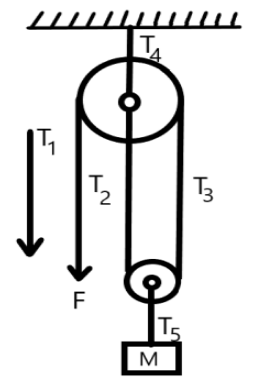
(a) Draw a free body diagram for each pulley
(b) Find tension in each section of rope ${T_1}$ , ${T_2}$ , ${T_3}$ , ${T_4}$
(c) Find the magnitude of $F$
Answer
 Verified
565.2k+ views
Hint: Here, a mass is attached by a string which rolls over the pulley. Here, different tensions will occur in each rope. All, the tensions will act downwards except ${T_4}$ as it is acting in the upward direction. As shown in the figure, the force $F$ will be equal to the tension ${T_1}$.
Complete step by step answer:
Consider a mass which is held by a pulley with a massless string which is shown below
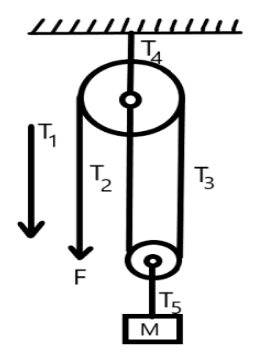
(a) Now, the free diagram of the system shown above is given below
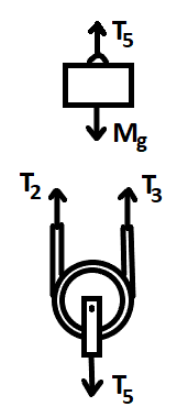
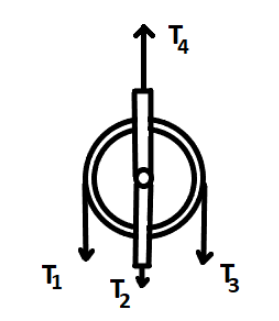
Here all the forces are working in the vertical direction. Now, as the pulleys are massless and frictionless, therefore, the tension in the strings will be the same along the full rope. Also, the downward will be equal to the three tensions that will put the mass. Therefore, $F - {T_1} = 0$
(b) Now, the rope will go through the pulley, therefore, the net force acting downward will be
${T_4} = {T_1} + {T_2} + {T_3}$
Now, the tensions ${T_1}$ , ${T_2}$ and ${T_3}$ are acting downward, therefore, all the tensions will be equal to the weight of the pulley and is given by
${T_1} = {T_2} = {T_3} = \dfrac{{Mg}}{2}$
Therefore the first equation will become
${T_4} = \dfrac{{Mg}}{2} + \dfrac{{Mg}}{2} + \dfrac{{Mg}}{2}$
$ \Rightarrow \,{T_4} = \dfrac{{3Mg}}{2}$
Therefore, the tension in each rope is ${T_1} = \dfrac{{Mg}}{2}$ , ${T_2} = \dfrac{{Mg}}{2}$ , ${T_3} = \dfrac{{Mg}}{2}$ and ${T_4} = \dfrac{{3Mg}}{2}$
(c) Now, from the option (a) we can say that the magnitude of force is given by
$F = {T_1}$
$ \therefore F = \dfrac{{Mg}}{2}$
Therefore the magnitude is $\dfrac{{Mg}}{2}$ .
Note:Here, we have not talked about the tension ${T_5}$ as it is in the same direction as that of the tension ${T_4}$. Also, it will be equal to the mass of the body that is hanged, that is, ${T_5} = Mg$ . Also, the above system is frictionless and is not rotating.
Complete step by step answer:
Consider a mass which is held by a pulley with a massless string which is shown below
(a) Now, the free diagram of the system shown above is given below
Here all the forces are working in the vertical direction. Now, as the pulleys are massless and frictionless, therefore, the tension in the strings will be the same along the full rope. Also, the downward will be equal to the three tensions that will put the mass. Therefore, $F - {T_1} = 0$
(b) Now, the rope will go through the pulley, therefore, the net force acting downward will be
${T_4} = {T_1} + {T_2} + {T_3}$
Now, the tensions ${T_1}$ , ${T_2}$ and ${T_3}$ are acting downward, therefore, all the tensions will be equal to the weight of the pulley and is given by
${T_1} = {T_2} = {T_3} = \dfrac{{Mg}}{2}$
Therefore the first equation will become
${T_4} = \dfrac{{Mg}}{2} + \dfrac{{Mg}}{2} + \dfrac{{Mg}}{2}$
$ \Rightarrow \,{T_4} = \dfrac{{3Mg}}{2}$
Therefore, the tension in each rope is ${T_1} = \dfrac{{Mg}}{2}$ , ${T_2} = \dfrac{{Mg}}{2}$ , ${T_3} = \dfrac{{Mg}}{2}$ and ${T_4} = \dfrac{{3Mg}}{2}$
(c) Now, from the option (a) we can say that the magnitude of force is given by
$F = {T_1}$
$ \therefore F = \dfrac{{Mg}}{2}$
Therefore the magnitude is $\dfrac{{Mg}}{2}$ .
Note:Here, we have not talked about the tension ${T_5}$ as it is in the same direction as that of the tension ${T_4}$. Also, it will be equal to the mass of the body that is hanged, that is, ${T_5} = Mg$ . Also, the above system is frictionless and is not rotating.
Recently Updated Pages
Master Class 11 Computer Science: Engaging Questions & Answers for Success

Master Class 11 Business Studies: Engaging Questions & Answers for Success
Master Class 11 Economics: Engaging Questions & Answers for Success
Master Class 11 English: Engaging Questions & Answers for Success
Master Class 11 Maths: Engaging Questions & Answers for Success
Master Class 11 Biology: Engaging Questions & Answers for Success
Trending doubts
One Metric ton is equal to kg A 10000 B 1000 C 100 class 11 physics CBSE
There are 720 permutations of the digits 1 2 3 4 5 class 11 maths CBSE
Discuss the various forms of bacteria class 11 biology CBSE
Draw a diagram of a plant cell and label at least eight class 11 biology CBSE
State the laws of reflection of light
Explain zero factorial class 11 maths CBSE