




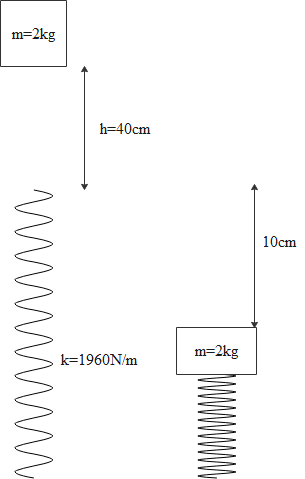
A mass of $2kg$ falls from a height of $40cm$ on a spring of force constant $1960N{{m}^{-1}}$. The spring is compressed by a value of,
$\begin{align}
& A.10cm \\
& B.0.4cm \\
& C.0.01cm \\
& D.0.04cm \\
\end{align}$
Answer
 Verified
586.2k+ views
Hint: The gain in the elastic potential energy of the string will be equal to the loss in gravitational potential energy of falling mass. The elastic potential energy is given by the half of the product of force constant and the square of the distance to which spring compressed. And the gravitational potential energy is given as the product of the mass, acceleration due to gravity and the total distance of the travel of the mass. These all may help you to solve this question.
Complete step by step answer:
The terms mentioned in the questions are,
Mass of the particle falling down,
$m=2kg$
Height of the fall is given as,
$h=40cm$
And the force constant is given as,
$k=1960N{{m}^{-1}}$
Let us assume that the distance to which the spring gets compressed is expressed as \[x\]. Therefore the gain in the elastic potential energy of the string will be equal to the loss in gravitational potential energy of falling mass. This can be written in mathematical way as,
\[\dfrac{1}{2}k{{x}^{2}}=mg\left( h+x \right)\]
Where \[g\]be the acceleration due to gravity which is given as,
\[g=9.8m{{s}^{-2}}\]
And the height in metres is,
\[h=0.4m\]
Substituting the values in it will give,
\[\dfrac{1}{2}\times 1960\times {{x}^{2}}=2\times 9.8\left( 0.4+x \right)\]
Simplifying the equation will give,
\[980{{x}^{2}}=7.84+19.6x\]
This can be written in the form of a quadratic equation as,
\[980{{x}^{2}}-19.6x-7.84=0\]
Therefore the value of the distance to which the spring is compressed will be,
\[\dfrac{19.6\pm \sqrt{{{\left( 19.6 \right)}^{2}}-4\times 980\times -7.84}}{2\times 980}=x\]
Simplifying this equation will give,
\[x=10cm\]
Therefore the correct answer is obtained. This is given as the option A.
Note:
The force provided by a spring on bodies fixed to its ends is proportional to the spring's variation in length away from its equilibrium length and this will always be directed towards its equilibrium position. The proportionality constant in this relation is known as the spring constant. It gives the amount of the spring's stiffness.
Complete step by step answer:
The terms mentioned in the questions are,
Mass of the particle falling down,
$m=2kg$
Height of the fall is given as,
$h=40cm$
And the force constant is given as,
$k=1960N{{m}^{-1}}$
Let us assume that the distance to which the spring gets compressed is expressed as \[x\]. Therefore the gain in the elastic potential energy of the string will be equal to the loss in gravitational potential energy of falling mass. This can be written in mathematical way as,
\[\dfrac{1}{2}k{{x}^{2}}=mg\left( h+x \right)\]
Where \[g\]be the acceleration due to gravity which is given as,
\[g=9.8m{{s}^{-2}}\]
And the height in metres is,
\[h=0.4m\]
Substituting the values in it will give,
\[\dfrac{1}{2}\times 1960\times {{x}^{2}}=2\times 9.8\left( 0.4+x \right)\]
Simplifying the equation will give,
\[980{{x}^{2}}=7.84+19.6x\]
This can be written in the form of a quadratic equation as,
\[980{{x}^{2}}-19.6x-7.84=0\]
Therefore the value of the distance to which the spring is compressed will be,
\[\dfrac{19.6\pm \sqrt{{{\left( 19.6 \right)}^{2}}-4\times 980\times -7.84}}{2\times 980}=x\]
Simplifying this equation will give,
\[x=10cm\]
Therefore the correct answer is obtained. This is given as the option A.
Note:
The force provided by a spring on bodies fixed to its ends is proportional to the spring's variation in length away from its equilibrium length and this will always be directed towards its equilibrium position. The proportionality constant in this relation is known as the spring constant. It gives the amount of the spring's stiffness.
Recently Updated Pages
Master Class 11 Computer Science: Engaging Questions & Answers for Success

Master Class 11 Business Studies: Engaging Questions & Answers for Success
Master Class 11 Economics: Engaging Questions & Answers for Success
Master Class 11 English: Engaging Questions & Answers for Success
Master Class 11 Maths: Engaging Questions & Answers for Success
Master Class 11 Biology: Engaging Questions & Answers for Success
Trending doubts
One Metric ton is equal to kg A 10000 B 1000 C 100 class 11 physics CBSE
There are 720 permutations of the digits 1 2 3 4 5 class 11 maths CBSE
Discuss the various forms of bacteria class 11 biology CBSE
Draw a diagram of a plant cell and label at least eight class 11 biology CBSE
State the laws of reflection of light
Explain zero factorial class 11 maths CBSE