




A particle is constrained to move in a circle with a 10-meter radius. At one instant, the particle’s speed is \[10\,{\text{m/s}}\] and is increasing at a rate of \[10\,{\text{m/}}{{\text{s}}^2}\]. The angle between the particle’s velocity and acceleration vectors is
A.\[0^\circ \]
B.\[30^\circ \]
C.\[45^\circ \]
D.\[60^\circ \]
Answer
 Verified
580.5k+ views
Hint: Use the formula for the radial acceleration of the particle in circular motion.
Also use the formula for the angle made by the acceleration vector with the components of acceleration.
Formula used:
The radial component \[{a_r}\] of acceleration of a particle in circular motion is given by
\[{a_r} = \dfrac{{{v^2}}}{r}\] …… (1)
Here, \[v\] is the velocity of the particle and \[r\] is the radius of the circle.
The angle \[\theta \] made by the resultant acceleration vector is
\[\theta = {\tan ^{ - 1}}\left( {\dfrac{{{a_r}}}{{{a_t}}}} \right)\] …… (2)
Here, \[{a_t}\] is the tangential component of acceleration and \[{a_r}\] is the radial component of acceleration.
Complete step by step answer:
The particle is moving in a circle of radius \[10\,{\text{m}}\].
The instantaneous speed \[v\] of the particle is \[10\,{\text{m/s}}\] and is increasing at a rate of \[10\,{\text{m/}}{{\text{s}}^2}\].
\[v = 10\,{\text{m/s}}\]
Hence, the tangential acceleration \[{a_t}\] of the particle is \[10\,{\text{m/}}{{\text{s}}^2}\].
\[{a_t} = 10\,{\text{m/}}{{\text{s}}^2}\]
The directions of the velocity, tangential and radial acceleration of the particle in the circular motion is as follows:
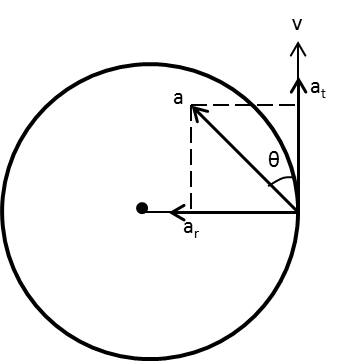
Calculate the radial acceleration of the particle.
Substitute \[10\,{\text{m/s}}\] for \[v\] and \[10\,{\text{m}}\] for \[r\] in equation (1).
\[{a_r} = \dfrac{{{{\left( {10\,{\text{m/s}}} \right)}^2}}}{{10\,{\text{m}}}}\]
\[ \Rightarrow {a_r} = 10\,{\text{m/}}{{\text{s}}^2}\]
Hence, the radial acceleration of the particle is \[10\,{\text{m/}}{{\text{s}}^2}\].
Calculate the angle made by the resultant acceleration of the particle with the velocity vector.
Substitute \[10\,{\text{m/}}{{\text{s}}^2}\] for \[{a_r}\] and \[10\,{\text{m/}}{{\text{s}}^2}\] for \[{a_t}\] in equation (2).
\[\theta = {\tan ^{ - 1}}\left( {\dfrac{{10\,{\text{m/}}{{\text{s}}^2}}}{{10\,{\text{m/}}{{\text{s}}^2}}}} \right)\]
\[ \Rightarrow \theta = {\tan ^{ - 1}}\left( 1 \right)\]
\[ \Rightarrow \theta = 45^\circ \]
Hence, the angle made by the resultant acceleration vector with the components of acceleration (tangential acceleration) is \[45^\circ \].
Therefore, the angle between the acceleration and velocity vectors is \[45^\circ \].
So, the correct answer is “Option C”.
Note:
The rate of change of instantaneous velocity is \[10\,{\text{m/}}{{\text{s}}^2}\].
Hence, the acceleration \[10\,{\text{m/}}{{\text{s}}^2}\] is the tangential acceleration.
Calculate the angle made by the resultant acceleration of the particle with the velocity vector.
Also use the formula for the angle made by the acceleration vector with the components of acceleration.
Formula used:
The radial component \[{a_r}\] of acceleration of a particle in circular motion is given by
\[{a_r} = \dfrac{{{v^2}}}{r}\] …… (1)
Here, \[v\] is the velocity of the particle and \[r\] is the radius of the circle.
The angle \[\theta \] made by the resultant acceleration vector is
\[\theta = {\tan ^{ - 1}}\left( {\dfrac{{{a_r}}}{{{a_t}}}} \right)\] …… (2)
Here, \[{a_t}\] is the tangential component of acceleration and \[{a_r}\] is the radial component of acceleration.
Complete step by step answer:
The particle is moving in a circle of radius \[10\,{\text{m}}\].
The instantaneous speed \[v\] of the particle is \[10\,{\text{m/s}}\] and is increasing at a rate of \[10\,{\text{m/}}{{\text{s}}^2}\].
\[v = 10\,{\text{m/s}}\]
Hence, the tangential acceleration \[{a_t}\] of the particle is \[10\,{\text{m/}}{{\text{s}}^2}\].
\[{a_t} = 10\,{\text{m/}}{{\text{s}}^2}\]
The directions of the velocity, tangential and radial acceleration of the particle in the circular motion is as follows:
Calculate the radial acceleration of the particle.
Substitute \[10\,{\text{m/s}}\] for \[v\] and \[10\,{\text{m}}\] for \[r\] in equation (1).
\[{a_r} = \dfrac{{{{\left( {10\,{\text{m/s}}} \right)}^2}}}{{10\,{\text{m}}}}\]
\[ \Rightarrow {a_r} = 10\,{\text{m/}}{{\text{s}}^2}\]
Hence, the radial acceleration of the particle is \[10\,{\text{m/}}{{\text{s}}^2}\].
Calculate the angle made by the resultant acceleration of the particle with the velocity vector.
Substitute \[10\,{\text{m/}}{{\text{s}}^2}\] for \[{a_r}\] and \[10\,{\text{m/}}{{\text{s}}^2}\] for \[{a_t}\] in equation (2).
\[\theta = {\tan ^{ - 1}}\left( {\dfrac{{10\,{\text{m/}}{{\text{s}}^2}}}{{10\,{\text{m/}}{{\text{s}}^2}}}} \right)\]
\[ \Rightarrow \theta = {\tan ^{ - 1}}\left( 1 \right)\]
\[ \Rightarrow \theta = 45^\circ \]
Hence, the angle made by the resultant acceleration vector with the components of acceleration (tangential acceleration) is \[45^\circ \].
Therefore, the angle between the acceleration and velocity vectors is \[45^\circ \].
So, the correct answer is “Option C”.
Note:
The rate of change of instantaneous velocity is \[10\,{\text{m/}}{{\text{s}}^2}\].
Hence, the acceleration \[10\,{\text{m/}}{{\text{s}}^2}\] is the tangential acceleration.
Calculate the angle made by the resultant acceleration of the particle with the velocity vector.
Recently Updated Pages
Master Class 11 Computer Science: Engaging Questions & Answers for Success

Master Class 11 Business Studies: Engaging Questions & Answers for Success
Master Class 11 Economics: Engaging Questions & Answers for Success
Master Class 11 English: Engaging Questions & Answers for Success
Master Class 11 Maths: Engaging Questions & Answers for Success
Master Class 11 Biology: Engaging Questions & Answers for Success
Trending doubts
One Metric ton is equal to kg A 10000 B 1000 C 100 class 11 physics CBSE
There are 720 permutations of the digits 1 2 3 4 5 class 11 maths CBSE
Discuss the various forms of bacteria class 11 biology CBSE
Draw a diagram of a plant cell and label at least eight class 11 biology CBSE
State the laws of reflection of light
Explain zero factorial class 11 maths CBSE