




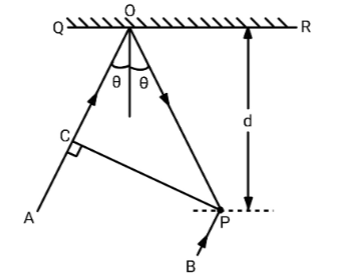
A plane wave of wavelength $\lambda $ is incident at an angle $\theta $ on a plane mirror. Maximum intensity will be observed at P, when
(A) $\cos \theta = \dfrac{{3\lambda }}{{2d}}$
(B) $\sec \theta - \cos \theta = \dfrac{{3\lambda }}{{4d}}$
(C) $\cos \theta = \dfrac{\lambda }{{4d}}$
(D) $\sec \theta - \cos \theta = \dfrac{\lambda }{{4d}}$
Answer
 Verified
558k+ views
Hint: Here, the first light ray will travel through point A, reflect at point O and then will reach the point P. Another ray of light directly reaches point P. These light rays interfere at point P. For the intensity to be maximum, think of what kind of interference should occur at this point P. One more thing to keep in mind to solve this question is, there is a relationship between the intensity and the amplitude of the electric field of the light, consider this relationship and find the intensity.
Complete step by step solution:
The equation of a light is given by $E = {E_0}\sin \left( {kx - \omega t} \right)$. Let the equations of the two light rays meeting at point P be given as $E = {E_{01}}\sin \left( {kx - \omega t} \right)$ and $E = {E_{02}}\sin \left( {kx - \omega t + \phi } \right)$. The light rays are from a plane wave and therefore they are supposed to be identical. Hence, the amplitude of the two light waves will be equal $ {E_{01}} = {E_{02}} = {E_0}$.
When these light rays interfere at point P, by superposition theorem, the resultant of these two waves will be the sum of the two equations. Hence, we have
$
E = {E_1} + {E_2} \\
E = {E_{01}}\sin \left( {kx - \omega t} \right) + {E_{02}}\sin \left( {kx - \omega t + \phi } \right)
\\
E = {E_0}\left( {\sin \left( {kx - \omega t} \right) + \sin \left( {kx - \omega t + \phi } \right)} \right)
\\
$
Now, let us expand and simplify this above resultant $E$ by using trigonometric properties.
\[
E = {E_0}\left( {\sin \left( {kx - \omega t} \right) + \sin \left( {kx - \omega t} \right)\cos \phi +
\cos \left( {kx - \omega t} \right)\sin \phi } \right) \\
E = {E_0}\left[ {\left( {1 + \cos \phi } \right)\sin \left( {kx - \omega t} \right) + \left( {\sin \phi }
\right)\cos \left( {kx - \omega t} \right)} \right] \\
\]
Let \[1 + \cos \phi = A\] and $\sin \phi = B$
$E = {E_0}\left[ {A\sin \left( {kx - \omega t} \right) + B\cos \left( {kx - \omega t} \right)} \right]$
Multiply and divide the equation by $\sqrt {{A^2} + {B^2}} $
\[E = {E_0}\left( {\sqrt {{A^2} + {B^2}} } \right)\left[ {\dfrac{A}{{\sqrt {{A^2} + {B^2}} }}\sin \left(
{kx - \omega t} \right) + \dfrac{B}{{\sqrt {{A^2} + {B^2}} }}\cos \left( {kx - \omega t} \right)}
\right]\]
As the values \[\dfrac{A}{{\sqrt {{A^2} + {B^2}} }}\] and \[\dfrac{B}{{\sqrt {{A^2} + {B^2}} }}\] are less than $1$, they can be considered as sine and cosine of some angle $\delta $. Therefore, $\sin \delta = \dfrac{A}{{\sqrt {{A^2} + {B^2}} }}$ and $\cos \delta = \dfrac{B}{{\sqrt {{A^2} + {B^2}} }}$
$ \to E = {E_0}'\left( {\sin \delta \sin \left( {kx - \omega t} \right) + \cos \delta \cos \left( {kx - \omega t} \right)} \right)$
$E = {E_0}'\cos \left( {kx - \omega t - \delta } \right)$, where ${E_0}' = \left( {\sqrt {{A^2} + {B^2}} }
\right){E_0}$
The square of the amplitude of the resultant is
\[
{\left( {{E_0}'} \right)^2} = {\left( {\sqrt {{A^2} + {B^2}} } \right)^2}{E_0}^2 \\
{\left( {{E_0}'} \right)^2} = \left( {{A^2} + {B^2}} \right)\left( {{E_0}^2} \right) \\
{\left( {{E_0}'} \right)^2} = \left( {{{\left( {1 + \cos \phi } \right)}^2} + {{\left( {\sin \phi }
\right)}^2}} \right)\left( {{E_0}^2} \right) \\
{\left( {{E_0}'} \right)^2} = {E_0}^2\left( {1 + {{\cos }^2}\phi + 2\cos \phi + {{\sin }^2}\phi }
\right) \\
{\left( {{E_0}'} \right)^2} = 2{E_0}^2\left( {1 + \cos \phi } \right) \\
\]
Let the resultant intensity at point P be $I'$ which is corresponding to ${E_0}'$ and the intensity due to the plane wave be ${I_0}$ which is corresponding to ${E_0}$.
Now, the intensity is proportional to the square of the amplitude and therefore we get
$
I' = 2{I_0}\left( {1 + \cos \phi } \right) \\
I' = 2{I_0}\left( {2{{\cos }^2}\dfrac{\phi }{2}} \right) \\
I' = 4{I_0}{\cos ^2}\dfrac{\phi }{2} \\
$
Hence, the intensity due to the interference at point P is given as$4{I_0}{\cos ^2}\dfrac{\phi }{2}$.
Here, the $\phi $ is the phase difference (see the equation of the two light rays). For intensity to be maximum, we should have${\cos ^2}\dfrac{\phi }{2} = 1 \to {\cos ^2}\dfrac{\phi }{2} = {\cos ^2}0
\to \dfrac{\phi }{2} = 0$. The general solution of this equation is $\dfrac{\phi }{2} = n\pi \pm 0 \to
\phi = 2n\pi $
The phase difference and path difference are related to each other by the equation $\phi =
\dfrac{{2\pi }}{\lambda }\Delta x$.
$
\therefore \dfrac{{2\pi }}{\lambda }\Delta x = 2n\pi \\
\Delta x = n\lambda \\
$
In the above case, the path difference is $OC + OP$
From figure, the alternate angle of the reflected angle $\theta $ is also $\theta $ and the cosine of $\theta $ will be given as$\cos \theta = \dfrac{d}{{OP}} \to OP = d\sec \theta $.
Now,
$
\cos 2\theta = \dfrac{{OC}}{{OP}} \\
\cos 2\theta = \dfrac{{OC}}{{\left( {\dfrac{d}{{\cos \theta }}} \right)}} \\
\cos 2\theta = \dfrac{{\left( {\cos \theta } \right)\left( {OC} \right)}}{d} \\
2{\cos ^2}\theta - 1 = \dfrac{{\left( {\cos \theta } \right)\left( {OC} \right)}}{d} \\
\to OC = d\left( {2\cos \theta - \sec \theta } \right) \\
$
Therefore, the path difference will be
$
OC + OP = d\left( {2\cos \theta - \sec \theta } \right) + d\sec \theta \\
OC + OP = 2d\cos \theta \\
$
$
\Delta x = n\lambda = 2d\cos \theta \\
\to \cos \theta = \dfrac{{n\lambda }}{{2d}} \\
$
For $n = 3$, we have $\cos \theta = \dfrac{{3\lambda }}{{2d}}$.
Therefore, maximum intensity will be observed at P, when $\cos \theta = \dfrac{{3\lambda
}}{{2d}}$
Option (A) is correct.
Note: Whenever you are asked to find maximum or minimum intensity at a point, apply the condition for interference. If, at a point, maximum intensity is observed, then constructive interference takes place and if minimum intensity is observed at a point, then destructive interference occurs. Always remember to keep the track of rays of light. In this case, one ray of light is reaching the point P directly and the other ray is first hitting the mirror, getting reflected and then reaches the point P. Also keep in mind that the angle of incidence is equal to the angle of reflection.
Complete step by step solution:
The equation of a light is given by $E = {E_0}\sin \left( {kx - \omega t} \right)$. Let the equations of the two light rays meeting at point P be given as $E = {E_{01}}\sin \left( {kx - \omega t} \right)$ and $E = {E_{02}}\sin \left( {kx - \omega t + \phi } \right)$. The light rays are from a plane wave and therefore they are supposed to be identical. Hence, the amplitude of the two light waves will be equal $ {E_{01}} = {E_{02}} = {E_0}$.
When these light rays interfere at point P, by superposition theorem, the resultant of these two waves will be the sum of the two equations. Hence, we have
$
E = {E_1} + {E_2} \\
E = {E_{01}}\sin \left( {kx - \omega t} \right) + {E_{02}}\sin \left( {kx - \omega t + \phi } \right)
\\
E = {E_0}\left( {\sin \left( {kx - \omega t} \right) + \sin \left( {kx - \omega t + \phi } \right)} \right)
\\
$
Now, let us expand and simplify this above resultant $E$ by using trigonometric properties.
\[
E = {E_0}\left( {\sin \left( {kx - \omega t} \right) + \sin \left( {kx - \omega t} \right)\cos \phi +
\cos \left( {kx - \omega t} \right)\sin \phi } \right) \\
E = {E_0}\left[ {\left( {1 + \cos \phi } \right)\sin \left( {kx - \omega t} \right) + \left( {\sin \phi }
\right)\cos \left( {kx - \omega t} \right)} \right] \\
\]
Let \[1 + \cos \phi = A\] and $\sin \phi = B$
$E = {E_0}\left[ {A\sin \left( {kx - \omega t} \right) + B\cos \left( {kx - \omega t} \right)} \right]$
Multiply and divide the equation by $\sqrt {{A^2} + {B^2}} $
\[E = {E_0}\left( {\sqrt {{A^2} + {B^2}} } \right)\left[ {\dfrac{A}{{\sqrt {{A^2} + {B^2}} }}\sin \left(
{kx - \omega t} \right) + \dfrac{B}{{\sqrt {{A^2} + {B^2}} }}\cos \left( {kx - \omega t} \right)}
\right]\]
As the values \[\dfrac{A}{{\sqrt {{A^2} + {B^2}} }}\] and \[\dfrac{B}{{\sqrt {{A^2} + {B^2}} }}\] are less than $1$, they can be considered as sine and cosine of some angle $\delta $. Therefore, $\sin \delta = \dfrac{A}{{\sqrt {{A^2} + {B^2}} }}$ and $\cos \delta = \dfrac{B}{{\sqrt {{A^2} + {B^2}} }}$
$ \to E = {E_0}'\left( {\sin \delta \sin \left( {kx - \omega t} \right) + \cos \delta \cos \left( {kx - \omega t} \right)} \right)$
$E = {E_0}'\cos \left( {kx - \omega t - \delta } \right)$, where ${E_0}' = \left( {\sqrt {{A^2} + {B^2}} }
\right){E_0}$
The square of the amplitude of the resultant is
\[
{\left( {{E_0}'} \right)^2} = {\left( {\sqrt {{A^2} + {B^2}} } \right)^2}{E_0}^2 \\
{\left( {{E_0}'} \right)^2} = \left( {{A^2} + {B^2}} \right)\left( {{E_0}^2} \right) \\
{\left( {{E_0}'} \right)^2} = \left( {{{\left( {1 + \cos \phi } \right)}^2} + {{\left( {\sin \phi }
\right)}^2}} \right)\left( {{E_0}^2} \right) \\
{\left( {{E_0}'} \right)^2} = {E_0}^2\left( {1 + {{\cos }^2}\phi + 2\cos \phi + {{\sin }^2}\phi }
\right) \\
{\left( {{E_0}'} \right)^2} = 2{E_0}^2\left( {1 + \cos \phi } \right) \\
\]
Let the resultant intensity at point P be $I'$ which is corresponding to ${E_0}'$ and the intensity due to the plane wave be ${I_0}$ which is corresponding to ${E_0}$.
Now, the intensity is proportional to the square of the amplitude and therefore we get
$
I' = 2{I_0}\left( {1 + \cos \phi } \right) \\
I' = 2{I_0}\left( {2{{\cos }^2}\dfrac{\phi }{2}} \right) \\
I' = 4{I_0}{\cos ^2}\dfrac{\phi }{2} \\
$
Hence, the intensity due to the interference at point P is given as$4{I_0}{\cos ^2}\dfrac{\phi }{2}$.
Here, the $\phi $ is the phase difference (see the equation of the two light rays). For intensity to be maximum, we should have${\cos ^2}\dfrac{\phi }{2} = 1 \to {\cos ^2}\dfrac{\phi }{2} = {\cos ^2}0
\to \dfrac{\phi }{2} = 0$. The general solution of this equation is $\dfrac{\phi }{2} = n\pi \pm 0 \to
\phi = 2n\pi $
The phase difference and path difference are related to each other by the equation $\phi =
\dfrac{{2\pi }}{\lambda }\Delta x$.
$
\therefore \dfrac{{2\pi }}{\lambda }\Delta x = 2n\pi \\
\Delta x = n\lambda \\
$
In the above case, the path difference is $OC + OP$
From figure, the alternate angle of the reflected angle $\theta $ is also $\theta $ and the cosine of $\theta $ will be given as$\cos \theta = \dfrac{d}{{OP}} \to OP = d\sec \theta $.
Now,
$
\cos 2\theta = \dfrac{{OC}}{{OP}} \\
\cos 2\theta = \dfrac{{OC}}{{\left( {\dfrac{d}{{\cos \theta }}} \right)}} \\
\cos 2\theta = \dfrac{{\left( {\cos \theta } \right)\left( {OC} \right)}}{d} \\
2{\cos ^2}\theta - 1 = \dfrac{{\left( {\cos \theta } \right)\left( {OC} \right)}}{d} \\
\to OC = d\left( {2\cos \theta - \sec \theta } \right) \\
$
Therefore, the path difference will be
$
OC + OP = d\left( {2\cos \theta - \sec \theta } \right) + d\sec \theta \\
OC + OP = 2d\cos \theta \\
$
$
\Delta x = n\lambda = 2d\cos \theta \\
\to \cos \theta = \dfrac{{n\lambda }}{{2d}} \\
$
For $n = 3$, we have $\cos \theta = \dfrac{{3\lambda }}{{2d}}$.
Therefore, maximum intensity will be observed at P, when $\cos \theta = \dfrac{{3\lambda
}}{{2d}}$
Option (A) is correct.
Note: Whenever you are asked to find maximum or minimum intensity at a point, apply the condition for interference. If, at a point, maximum intensity is observed, then constructive interference takes place and if minimum intensity is observed at a point, then destructive interference occurs. Always remember to keep the track of rays of light. In this case, one ray of light is reaching the point P directly and the other ray is first hitting the mirror, getting reflected and then reaches the point P. Also keep in mind that the angle of incidence is equal to the angle of reflection.
Recently Updated Pages
Master Class 11 Computer Science: Engaging Questions & Answers for Success

Master Class 11 Business Studies: Engaging Questions & Answers for Success
Master Class 11 Economics: Engaging Questions & Answers for Success
Master Class 11 English: Engaging Questions & Answers for Success
Master Class 11 Maths: Engaging Questions & Answers for Success
Master Class 11 Biology: Engaging Questions & Answers for Success
Trending doubts
One Metric ton is equal to kg A 10000 B 1000 C 100 class 11 physics CBSE
There are 720 permutations of the digits 1 2 3 4 5 class 11 maths CBSE
Discuss the various forms of bacteria class 11 biology CBSE
Draw a diagram of a plant cell and label at least eight class 11 biology CBSE
State the laws of reflection of light
Explain zero factorial class 11 maths CBSE