




What is a projectile? Give examples.
Answer
 Verified
588.6k+ views
Hint: When we hit a cricket ball with a bat, the ball will travel a curved path before finally falling into the ground. This is the basics of a projectile motion. Any particle moving through a curved path with a velocity at an angle to the horizontal will have projectile motion.
Complete step by step answer:
When a particle is thrown at an angle with the earth’s surface, the particle follows a curved path before falling into the ground. This is called the projectile motion. The path that the particle follows is called the projectile and the motion of the particle is called the projectile motion.
In projectile motion, the velocity of the particle can be broken into its component along the x-axis and the y-axis. The velocity along the x-axis gives the horizontal motion of the particle and the velocity of the particle along y-axis gives the vertical motion of the particle.
When the particle moves in the projectile, the only acceleration acting on the particle is the acceleration due to gravity. The acceleration due to gravity acts on the particle in the vertical direction. In the horizontal direction, no acceleration acts on the particle.
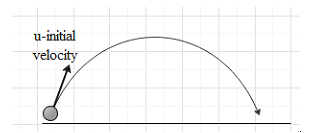
Consider throwing a ball at angle with the horizontal or the surface of the earth. The ball will travel in a curved path before falling into the ground. This motion is projectile motion and the path the ball travers is called the projectile of the ball.
Note:
We can use the basic kinematic equation on a projectile motion by breaking the velocity of the projectile into its vertical and horizontal components. From this we can find the equation of motion, maximum height, range of the projectile.
Complete step by step answer:
When a particle is thrown at an angle with the earth’s surface, the particle follows a curved path before falling into the ground. This is called the projectile motion. The path that the particle follows is called the projectile and the motion of the particle is called the projectile motion.
In projectile motion, the velocity of the particle can be broken into its component along the x-axis and the y-axis. The velocity along the x-axis gives the horizontal motion of the particle and the velocity of the particle along y-axis gives the vertical motion of the particle.
When the particle moves in the projectile, the only acceleration acting on the particle is the acceleration due to gravity. The acceleration due to gravity acts on the particle in the vertical direction. In the horizontal direction, no acceleration acts on the particle.
Consider throwing a ball at angle with the horizontal or the surface of the earth. The ball will travel in a curved path before falling into the ground. This motion is projectile motion and the path the ball travers is called the projectile of the ball.
Note:
We can use the basic kinematic equation on a projectile motion by breaking the velocity of the projectile into its vertical and horizontal components. From this we can find the equation of motion, maximum height, range of the projectile.
Recently Updated Pages
Master Class 11 Computer Science: Engaging Questions & Answers for Success

Master Class 11 Business Studies: Engaging Questions & Answers for Success
Master Class 11 Economics: Engaging Questions & Answers for Success
Master Class 11 English: Engaging Questions & Answers for Success
Master Class 11 Maths: Engaging Questions & Answers for Success
Master Class 11 Biology: Engaging Questions & Answers for Success
Trending doubts
One Metric ton is equal to kg A 10000 B 1000 C 100 class 11 physics CBSE
There are 720 permutations of the digits 1 2 3 4 5 class 11 maths CBSE
Discuss the various forms of bacteria class 11 biology CBSE
Draw a diagram of a plant cell and label at least eight class 11 biology CBSE
State the laws of reflection of light
Explain zero factorial class 11 maths CBSE