




A pyramid of biomass is based on the number of organisms at each trophic level.
A) True
B) False
Answer
 Verified
564.9k+ views
Hint: Within a given food web or food chain, the amount of matter or energy held within each trophic level can be described using an ecological pyramid. Ecological pyramids are of three types, namely, pyramids of numbers (also known as the Eltonian pyramid), biomass, and energy.
Complete answer: A biomass pyramid is an ecological pyramid that expresses the total biomass of the organisms present at each trophic level of the ecosystem.
In a given sample the biomass can be calculated using a Bomb calorimeter to determine the mass of living organisms that are present at each trophic level. Biomass can be represented as calories per unit area or dry weight in graphs. A trophic level can be defined as the specific place occupied by a living organism in a food chain.
A biomass pyramid consists of producers, primary, secondary and tertiary consumers. The first trophic level is the producers present at the base, followed by primary consumers on top, which is further followed by secondary and tertiary consumers at the top of primary consumers. The biomass pyramid exhibits the flow of energy from producers to consumers. About 10 percent of the energy is transferred from one trophic level to the next while the rest is either utilized for metabolic functions or is excreted out.
The below diagrammatic representation of a biomass pyramid shows that the grass occupies the base of the pyramid and consists of the highest Biomass. This is followed by primary consumers which may include herbivores such as rabbits. This is further followed by secondary and tertiary consumers which may include lizards, snakes, and eagles respectively.
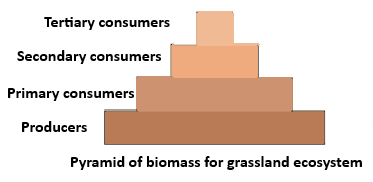
However, the ecological pyramid of numbers represents the total number of individual organisms present at each trophic level of an ecosystem. It exhibits the population at each stage in a food chain. It is represented as a bar chart.
Hence the above-mentioned statement is false.
Note: The Eltonian pyramid, which is the pyramid of numbers was developed by Charles Elton in the year 1927. This was later expressed in terms of biomass by Bodenheimer in 1938. Biomass has the ability to work as a renewable energy resource, decreasing the ever-growing dependence on fossil fuels and helping fight off air pollution.
Complete answer: A biomass pyramid is an ecological pyramid that expresses the total biomass of the organisms present at each trophic level of the ecosystem.
In a given sample the biomass can be calculated using a Bomb calorimeter to determine the mass of living organisms that are present at each trophic level. Biomass can be represented as calories per unit area or dry weight in graphs. A trophic level can be defined as the specific place occupied by a living organism in a food chain.
A biomass pyramid consists of producers, primary, secondary and tertiary consumers. The first trophic level is the producers present at the base, followed by primary consumers on top, which is further followed by secondary and tertiary consumers at the top of primary consumers. The biomass pyramid exhibits the flow of energy from producers to consumers. About 10 percent of the energy is transferred from one trophic level to the next while the rest is either utilized for metabolic functions or is excreted out.
The below diagrammatic representation of a biomass pyramid shows that the grass occupies the base of the pyramid and consists of the highest Biomass. This is followed by primary consumers which may include herbivores such as rabbits. This is further followed by secondary and tertiary consumers which may include lizards, snakes, and eagles respectively.
However, the ecological pyramid of numbers represents the total number of individual organisms present at each trophic level of an ecosystem. It exhibits the population at each stage in a food chain. It is represented as a bar chart.
Hence the above-mentioned statement is false.
Note: The Eltonian pyramid, which is the pyramid of numbers was developed by Charles Elton in the year 1927. This was later expressed in terms of biomass by Bodenheimer in 1938. Biomass has the ability to work as a renewable energy resource, decreasing the ever-growing dependence on fossil fuels and helping fight off air pollution.
Recently Updated Pages
Master Class 10 Computer Science: Engaging Questions & Answers for Success

Master Class 10 General Knowledge: Engaging Questions & Answers for Success
Master Class 10 English: Engaging Questions & Answers for Success
Master Class 10 Social Science: Engaging Questions & Answers for Success
Master Class 10 Maths: Engaging Questions & Answers for Success
Master Class 10 Science: Engaging Questions & Answers for Success
Trending doubts
What is the median of the first 10 natural numbers class 10 maths CBSE
Which women's tennis player has 24 Grand Slam singles titles?
Who is the Brand Ambassador of Incredible India?
Why is there a time difference of about 5 hours between class 10 social science CBSE
Write a letter to the principal requesting him to grant class 10 english CBSE
A moving boat is observed from the top of a 150 m high class 10 maths CBSE