




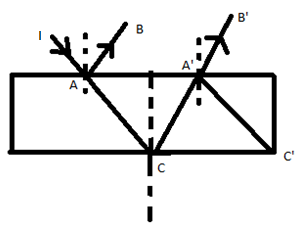
A ray of light intensity $I$ is incident on a parallel glass slab and refraction. At each reflection, $25\% $ of incident energy is reflected. The rays $AB$ and $A'B'$ undergo interference. The ratio of ${I_{max}}$ and ${I_{\min }}$ is
A. $49:1$
B. $7:1$
C. $4:1$
D. $8:1$
Answer
 Verified
569.1k+ views
Hint:
Here first we have to find the value of $AB$ and $A'B'$ and then the ratio of $AB$ and $A'B'$ .At last we have to find the ratio of ${I_{max}}$ and ${I_{\min }}$
Complete step by step solution:
Given,
A ray of light intensity $I$ is incident on a parallel glass slab and refraction.
At each reflection, $25\% $ of incident energy is reflected.
The rays $AB$ and $A'B'$ undergo interference.
Since, $I$ is incident on a parallel glass slab and $25\% $ incident energy is reflected.
So, $AB = \dfrac{I}{4}$
$
AC = (100 - 25)\% \times I \\
= 75\% \times I \\
= \dfrac{{3I}}{4}
$
$
A'C = 75\% \times 25\% I \\
= \dfrac{{3I}}{{16}}
$
$
A'B' = 75\% \times 25\% \times 75\% I \\
= \dfrac{{9I}}{{64}}
$
Now let ${I_1} = \dfrac{I}{4}$ and ${I_2} = \dfrac{{9I}}{{64}}$
Now let us find the ratio of ${I_{max}}$ and ${I_{\min }}$
$
\Rightarrow \dfrac{{{I_{\max }}}}{{{I_{\min }}}} = {\left( {\dfrac{{\sqrt {\dfrac{{{I_2}}}{{{I_1}}}} + 1}}{{\sqrt {\dfrac{{{I_2}}}{{{I_1}}}} - 1}}} \right)^2} \\
\Rightarrow \dfrac{{{I_{\max }}}}{{{I_{\min }}}} = {\left( {\dfrac{{\sqrt {\dfrac{9}{{16}}} + 1}}{{\sqrt {\dfrac{9}{{16}}} - 1}}} \right)^2} \\
\Rightarrow \dfrac{{{I_{\max }}}}{{{I_{\min }}}} = \dfrac{{49}}{1}
$
So, the ratio of ${I_{max}}$ and ${I_{\min }}$ is $\dfrac{{49}}{1}$
Hence, option A is correct.
Additional information:
Total internal reflection and critical angle- In optics total internal reflection is the complete reflection of a beam of light in a medium such as water or glass back onto the medium from the surrounding surfaces. If the angle of incidence is greater than a certain limiting angle, called the critical angle, the phenomenon of total internal reflection occurs.
Reflection on a glass slab- As light penetrates the glass slab through air, they are refracted and bend towards the normal. The path of the refracted ray now shifts again as it comes into the air from the glass plate. If the beam of light passes from a denser to a rarer medium, it bends away from the normal.
Note:
Here we have to keep in mind that at each reflection, $25\% $ incident energy is reflected. So, the value of each incident ray will be different. Also for the formula of $\dfrac{{{I_{\max }}}}{{{I_{\min }}}} = \left( {\dfrac{{\sqrt {\dfrac{{{I_2}}}{{{I_1}}}} + 1}}{{\sqrt {\dfrac{{{I_2}}}
{{{I_1}}}} - 1}}} \right)$, we cannot swap the numerator and denominator in confusion. So, we have to be very careful while solving this.
Here first we have to find the value of $AB$ and $A'B'$ and then the ratio of $AB$ and $A'B'$ .At last we have to find the ratio of ${I_{max}}$ and ${I_{\min }}$
Complete step by step solution:
Given,
A ray of light intensity $I$ is incident on a parallel glass slab and refraction.
At each reflection, $25\% $ of incident energy is reflected.
The rays $AB$ and $A'B'$ undergo interference.
Since, $I$ is incident on a parallel glass slab and $25\% $ incident energy is reflected.
So, $AB = \dfrac{I}{4}$
$
AC = (100 - 25)\% \times I \\
= 75\% \times I \\
= \dfrac{{3I}}{4}
$
$
A'C = 75\% \times 25\% I \\
= \dfrac{{3I}}{{16}}
$
$
A'B' = 75\% \times 25\% \times 75\% I \\
= \dfrac{{9I}}{{64}}
$
Now let ${I_1} = \dfrac{I}{4}$ and ${I_2} = \dfrac{{9I}}{{64}}$
Now let us find the ratio of ${I_{max}}$ and ${I_{\min }}$
$
\Rightarrow \dfrac{{{I_{\max }}}}{{{I_{\min }}}} = {\left( {\dfrac{{\sqrt {\dfrac{{{I_2}}}{{{I_1}}}} + 1}}{{\sqrt {\dfrac{{{I_2}}}{{{I_1}}}} - 1}}} \right)^2} \\
\Rightarrow \dfrac{{{I_{\max }}}}{{{I_{\min }}}} = {\left( {\dfrac{{\sqrt {\dfrac{9}{{16}}} + 1}}{{\sqrt {\dfrac{9}{{16}}} - 1}}} \right)^2} \\
\Rightarrow \dfrac{{{I_{\max }}}}{{{I_{\min }}}} = \dfrac{{49}}{1}
$
So, the ratio of ${I_{max}}$ and ${I_{\min }}$ is $\dfrac{{49}}{1}$
Hence, option A is correct.
Additional information:
Total internal reflection and critical angle- In optics total internal reflection is the complete reflection of a beam of light in a medium such as water or glass back onto the medium from the surrounding surfaces. If the angle of incidence is greater than a certain limiting angle, called the critical angle, the phenomenon of total internal reflection occurs.
Reflection on a glass slab- As light penetrates the glass slab through air, they are refracted and bend towards the normal. The path of the refracted ray now shifts again as it comes into the air from the glass plate. If the beam of light passes from a denser to a rarer medium, it bends away from the normal.
Note:
Here we have to keep in mind that at each reflection, $25\% $ incident energy is reflected. So, the value of each incident ray will be different. Also for the formula of $\dfrac{{{I_{\max }}}}{{{I_{\min }}}} = \left( {\dfrac{{\sqrt {\dfrac{{{I_2}}}{{{I_1}}}} + 1}}{{\sqrt {\dfrac{{{I_2}}}
{{{I_1}}}} - 1}}} \right)$, we cannot swap the numerator and denominator in confusion. So, we have to be very careful while solving this.
Recently Updated Pages
Master Class 11 Computer Science: Engaging Questions & Answers for Success

Master Class 11 Business Studies: Engaging Questions & Answers for Success
Master Class 11 Economics: Engaging Questions & Answers for Success
Master Class 11 English: Engaging Questions & Answers for Success
Master Class 11 Maths: Engaging Questions & Answers for Success
Master Class 11 Biology: Engaging Questions & Answers for Success
Trending doubts
One Metric ton is equal to kg A 10000 B 1000 C 100 class 11 physics CBSE
There are 720 permutations of the digits 1 2 3 4 5 class 11 maths CBSE
Discuss the various forms of bacteria class 11 biology CBSE
Draw a diagram of a plant cell and label at least eight class 11 biology CBSE
State the laws of reflection of light
Explain zero factorial class 11 maths CBSE