




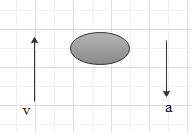
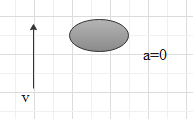
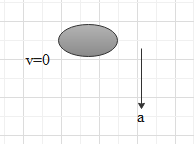
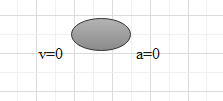
A rock is thrown upward from the ground, in the absence of air resistance. Which one of the following diagrams shows the correct direction of velocity (v) and acceleration (a) of the rock when it is at its highest position?
A.
B.
C.
D.
Answer
 Verified
584.7k+ views
Hint-In this case we know that as the rock goes upward it experiences a force downward due to gravity of earth. Because of which the speed of rock will decrease and finally comes to stop at the highest position. In the entire flight of the rock acceleration due to gravity always acts downwards.
Complete step-by-step answer:
It is given that a rock is thrown upwards in the absence of air resistance. We need to find the velocity and acceleration at its highest position.
Let us analyse the situation.
When we throw a rock upward it means we are providing a velocity to the rock initially. As the rock goes upward with the force that we give to it experiences a force downward due to gravity of earth. We know that earth exerts gravitational pull on all objects on earth and this force is always attractive acting towards the centre of earth.
We throw the ball upward so its direction of motion is upward but gravity is acting downward against the direction of motion. That is why the velocity of the ball decreases as it goes higher and higher. The ball will slow down and finally come to rest, that is the velocity becomes zero and then falls back to the ground. The height at which it reaches zero velocity is the maximum height the ball can attain.
Therefore at the highest position the ball momentarily stops resulting in a zero velocity . But it doesn’t mean that the acceleration is zero there. The acceleration in the entire flight of the rock is provided by the acceleration due to gravity which is always present even at the highest position of zero velocity. It is this acceleration that results in the change in direction of motion of rock after coming to rest. That is why it falls back to earth. The direction of acceleration due to gravity is always downwards and its magnitude is $9.8\,m/{s^2}$
Hence from the given options we can see that option C is the correct answer.
Note: Remember that the acceleration is not zero even when velocity is zero. Acceleration is the change of velocity over a time interval. At the highest position the ball stops momentarily. So we got the instantaneous velocity to be zero. But if there is no acceleration at the highest position then the ball will not fall back. So, there is acceleration which causes the change in direction of velocity immediately after coming to rest. Gravitational acceleration always acts downwards.
Complete step-by-step answer:
It is given that a rock is thrown upwards in the absence of air resistance. We need to find the velocity and acceleration at its highest position.
Let us analyse the situation.
When we throw a rock upward it means we are providing a velocity to the rock initially. As the rock goes upward with the force that we give to it experiences a force downward due to gravity of earth. We know that earth exerts gravitational pull on all objects on earth and this force is always attractive acting towards the centre of earth.
We throw the ball upward so its direction of motion is upward but gravity is acting downward against the direction of motion. That is why the velocity of the ball decreases as it goes higher and higher. The ball will slow down and finally come to rest, that is the velocity becomes zero and then falls back to the ground. The height at which it reaches zero velocity is the maximum height the ball can attain.
Therefore at the highest position the ball momentarily stops resulting in a zero velocity . But it doesn’t mean that the acceleration is zero there. The acceleration in the entire flight of the rock is provided by the acceleration due to gravity which is always present even at the highest position of zero velocity. It is this acceleration that results in the change in direction of motion of rock after coming to rest. That is why it falls back to earth. The direction of acceleration due to gravity is always downwards and its magnitude is $9.8\,m/{s^2}$
Hence from the given options we can see that option C is the correct answer.
Note: Remember that the acceleration is not zero even when velocity is zero. Acceleration is the change of velocity over a time interval. At the highest position the ball stops momentarily. So we got the instantaneous velocity to be zero. But if there is no acceleration at the highest position then the ball will not fall back. So, there is acceleration which causes the change in direction of velocity immediately after coming to rest. Gravitational acceleration always acts downwards.
Recently Updated Pages
Master Class 11 Computer Science: Engaging Questions & Answers for Success

Master Class 11 Business Studies: Engaging Questions & Answers for Success
Master Class 11 Economics: Engaging Questions & Answers for Success
Master Class 11 English: Engaging Questions & Answers for Success
Master Class 11 Maths: Engaging Questions & Answers for Success
Master Class 11 Biology: Engaging Questions & Answers for Success
Trending doubts
One Metric ton is equal to kg A 10000 B 1000 C 100 class 11 physics CBSE
There are 720 permutations of the digits 1 2 3 4 5 class 11 maths CBSE
Discuss the various forms of bacteria class 11 biology CBSE
Draw a diagram of a plant cell and label at least eight class 11 biology CBSE
State the laws of reflection of light
Explain zero factorial class 11 maths CBSE