




A staircase contains three steps each 10cm high and 20cm wide. What should be the minimum horizontal velocity of a ball rolling off the uppermost plane so as to hit directly the lowest plane?
$
A)42m{s^{ - 1}} \\
B)2m{s^{ - 1}} \\
C)24m{s^{ - 1}} \\
D)2.4m{s^{ - 1}} \\
$
Answer
 Verified
594.9k+ views
Hint: In order to solve this question, firstly we will convert the given height and width in centimeter to meter. Then we will apply the equation of motion i.e.$h = ut + \dfrac{1}{2}g{t^2}$to find the minimum horizontal velocity required to hit the lowest floor.
Formula used:
$h = ut + \dfrac{1}{2}g{t^2}$
Complete step by step answer:
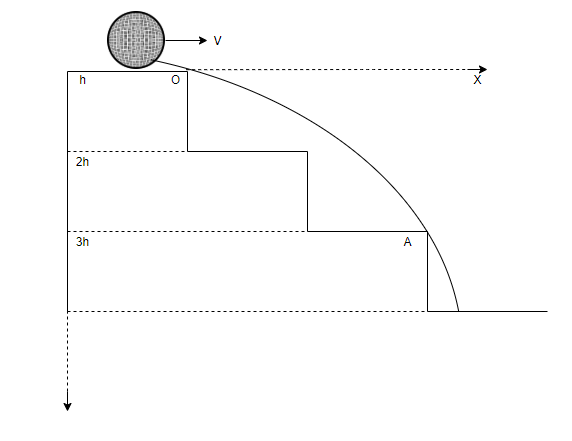
Here we are given that-
Height of each step = 10cm
Width of each step = 20cm
The ball will need to clear point B to hit the lowest plane directly.
A horizontal distance equal to 40 cm will move the ball from A to B.
Converting horizontal distance between cm and m,
We 're getting 0.4 m
And the vertical distance is 20 cm.
Converting vertical distance between cm and m,
We 're having -0.2 m
let t be the time taken to reach point B.
In this time, vertical motion under the gravity has data-
U = 0, h = 0,
Using the equation of h, where h is the distance a projectile has fallen after time (t), assuming a starting velocity of zero.
This means,$h = ut + \dfrac{1}{2}g{t^2}$
Here, h = 0.2
u = 0 (vertical motion)
g = 9.8,
Substituting these values,
We get-
$0.2 = 0 + \dfrac{1}{2}\left( {9.8} \right){t^2}$
Or ${t^2} = \dfrac{{0.4}}{{9.8}}$
Or ${t^2} = 0.04$
$\therefore t = 0.2$
Let v be the ball's horizontal speed,
Then the horizontal distance traveled by the ball = 0.2v
To be explicit on point B, it must be at least = 0.4,
So the minimum velocity required to hit the lowest floor is 0.2v = 0.4
$ \Rightarrow v = 2m{s^{ - 1}}$
Therefore, the minimum velocity required to hit the lowest floor, $v = 2m{s^{ - 1}}$.
So, the correct answer is “Option B”.
Note:
In order to solve this question, one must know about the equation of motion. In physics, it is defined as the equation that explains the behaviour of a physical system with regards to motion as a function of time. By using this basic approach we can solve such types of questions.
Formula used:
$h = ut + \dfrac{1}{2}g{t^2}$
Complete step by step answer:
Here we are given that-
Height of each step = 10cm
Width of each step = 20cm
The ball will need to clear point B to hit the lowest plane directly.
A horizontal distance equal to 40 cm will move the ball from A to B.
Converting horizontal distance between cm and m,
We 're getting 0.4 m
And the vertical distance is 20 cm.
Converting vertical distance between cm and m,
We 're having -0.2 m
let t be the time taken to reach point B.
In this time, vertical motion under the gravity has data-
U = 0, h = 0,
Using the equation of h, where h is the distance a projectile has fallen after time (t), assuming a starting velocity of zero.
This means,$h = ut + \dfrac{1}{2}g{t^2}$
Here, h = 0.2
u = 0 (vertical motion)
g = 9.8,
Substituting these values,
We get-
$0.2 = 0 + \dfrac{1}{2}\left( {9.8} \right){t^2}$
Or ${t^2} = \dfrac{{0.4}}{{9.8}}$
Or ${t^2} = 0.04$
$\therefore t = 0.2$
Let v be the ball's horizontal speed,
Then the horizontal distance traveled by the ball = 0.2v
To be explicit on point B, it must be at least = 0.4,
So the minimum velocity required to hit the lowest floor is 0.2v = 0.4
$ \Rightarrow v = 2m{s^{ - 1}}$
Therefore, the minimum velocity required to hit the lowest floor, $v = 2m{s^{ - 1}}$.
So, the correct answer is “Option B”.
Note:
In order to solve this question, one must know about the equation of motion. In physics, it is defined as the equation that explains the behaviour of a physical system with regards to motion as a function of time. By using this basic approach we can solve such types of questions.
Recently Updated Pages
Master Class 11 Computer Science: Engaging Questions & Answers for Success

Master Class 11 Business Studies: Engaging Questions & Answers for Success
Master Class 11 Economics: Engaging Questions & Answers for Success
Master Class 11 English: Engaging Questions & Answers for Success
Master Class 11 Maths: Engaging Questions & Answers for Success
Master Class 11 Biology: Engaging Questions & Answers for Success
Trending doubts
One Metric ton is equal to kg A 10000 B 1000 C 100 class 11 physics CBSE
There are 720 permutations of the digits 1 2 3 4 5 class 11 maths CBSE
Discuss the various forms of bacteria class 11 biology CBSE
Draw a diagram of a plant cell and label at least eight class 11 biology CBSE
State the laws of reflection of light
Explain zero factorial class 11 maths CBSE