




A stone of mass 6kg is revolved in a vertical circle of diameter 6m, such that its speed at a point is minimum. If the K.E at the same point is 250J, then the P.E. at this point is
A. 200J
B. 150J
C. 100J
D. 450J
Answer
 Verified
580.8k+ views
Hint: The minimum velocity required for a particle to loop a loop while going in a vertical circle of radius r is $\sqrt {5gr} $. At the base, the P.E. of a body is zero and there will be only K.E. Use the law of conservation of mass to find the P.E. of the body at a point where the speed is minimum.
Complete step by step answer:
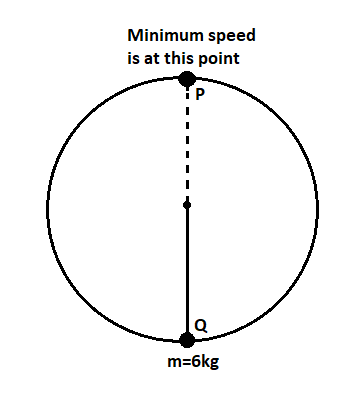
We are given that a stone of mass 6kg is revolved in a vertical circle of diameter 6m, such that its speed at a point is minimum. The point is P from the above figure. The K.E. at point P is 250J.
We have to find the Potential Energy at point P.
Q is the starting point for the stone. At Q, the potential energy is zero and only kinetic energy will be there.
The velocity of the stone at point Q is $\sqrt {5gr} $, where r is the radius and g is the acceleration due to gravity.
$
r = \dfrac{d}{2} \\
d = 6m \\
\Rightarrow r = \dfrac{6}{2} = 3m \\
r = 3m, g = 10m/{s^2} \\
$
$
\Rightarrow v = \sqrt {5gr} \\
\Rightarrow v = \sqrt {5 \times 10 \times 3} \\
\Rightarrow v = \sqrt {150} = 5\sqrt 6 m/s \\
$
By Law of conservation of Energy, total mechanical energy is equal to sum of kinetic energy and potential energy. The Mechanical energy at point P and Q must be equal as the energy can be neither created nor destroyed but can only be transformed.
$
M.{E_p} = M.{E_q} \\
\Rightarrow K.{E_p} + P.{E_p} = K.{E_q} + P.{E_q} \\
P.{E_q} = 0 \\
K.{E_p} = 250J \\
\Rightarrow K.{E_q} + 0 = 250J + P.{E_p} \\
K.{E_q} = \dfrac{1}{2}m{v^2} \\
v = 5\sqrt 6 m/s \\
\Rightarrow K.{E_q} = \dfrac{1}{2} \times 6 \times {\left( {5\sqrt 6 } \right)^2} \\
\Rightarrow K.{E_q} = 3 \times 150 = 450J \\
\Rightarrow 450J = 250J + P.{E_p} \\
\Rightarrow P.{E_p} = 450 - 250 = 200J \\
$
The potential energy at a point where the speed is minimum is 200J.
The correct answer is Option A.
Note:Kinetic energy of a system is the energy acquired by it by virtue of its motion whereas potential energy of a system is the energy acquired by it by virtue of its position. They are not the same. So do not confuse Kinetic Energy with Potential energy.
Complete step by step answer:
We are given that a stone of mass 6kg is revolved in a vertical circle of diameter 6m, such that its speed at a point is minimum. The point is P from the above figure. The K.E. at point P is 250J.
We have to find the Potential Energy at point P.
Q is the starting point for the stone. At Q, the potential energy is zero and only kinetic energy will be there.
The velocity of the stone at point Q is $\sqrt {5gr} $, where r is the radius and g is the acceleration due to gravity.
$
r = \dfrac{d}{2} \\
d = 6m \\
\Rightarrow r = \dfrac{6}{2} = 3m \\
r = 3m, g = 10m/{s^2} \\
$
$
\Rightarrow v = \sqrt {5gr} \\
\Rightarrow v = \sqrt {5 \times 10 \times 3} \\
\Rightarrow v = \sqrt {150} = 5\sqrt 6 m/s \\
$
By Law of conservation of Energy, total mechanical energy is equal to sum of kinetic energy and potential energy. The Mechanical energy at point P and Q must be equal as the energy can be neither created nor destroyed but can only be transformed.
$
M.{E_p} = M.{E_q} \\
\Rightarrow K.{E_p} + P.{E_p} = K.{E_q} + P.{E_q} \\
P.{E_q} = 0 \\
K.{E_p} = 250J \\
\Rightarrow K.{E_q} + 0 = 250J + P.{E_p} \\
K.{E_q} = \dfrac{1}{2}m{v^2} \\
v = 5\sqrt 6 m/s \\
\Rightarrow K.{E_q} = \dfrac{1}{2} \times 6 \times {\left( {5\sqrt 6 } \right)^2} \\
\Rightarrow K.{E_q} = 3 \times 150 = 450J \\
\Rightarrow 450J = 250J + P.{E_p} \\
\Rightarrow P.{E_p} = 450 - 250 = 200J \\
$
The potential energy at a point where the speed is minimum is 200J.
The correct answer is Option A.
Note:Kinetic energy of a system is the energy acquired by it by virtue of its motion whereas potential energy of a system is the energy acquired by it by virtue of its position. They are not the same. So do not confuse Kinetic Energy with Potential energy.
Recently Updated Pages
Master Class 11 Computer Science: Engaging Questions & Answers for Success

Master Class 11 Business Studies: Engaging Questions & Answers for Success
Master Class 11 Economics: Engaging Questions & Answers for Success
Master Class 11 English: Engaging Questions & Answers for Success
Master Class 11 Maths: Engaging Questions & Answers for Success
Master Class 11 Biology: Engaging Questions & Answers for Success
Trending doubts
One Metric ton is equal to kg A 10000 B 1000 C 100 class 11 physics CBSE
There are 720 permutations of the digits 1 2 3 4 5 class 11 maths CBSE
Discuss the various forms of bacteria class 11 biology CBSE
Draw a diagram of a plant cell and label at least eight class 11 biology CBSE
State the laws of reflection of light
Explain zero factorial class 11 maths CBSE