




A tetrahedral molecule,$X{Y_4}$ , would be formed if X were used in which of the following orbital hybridization.
A.${p^2}$
B.${s^2}$
C.$sp$
D.$s{p^2}$
E.$s{p^3}$
Answer
 Verified
468.9k+ views
Hint: Tetrahedral-Tetra signifies four, and hedral relates to a face of a solid tetrahedral literally means having four faces. This shape is found when there are four bonds all on one central atom, with no lone electron pairs. In accordance with the VSEPR theory, the bond angles between the electron bonds are ${109.5^ \circ }$
Complete step by step answer:
In a tetrahedral molecular geometry, a central atom is located at the center with four substituents that are located at the corners of a tetrahedron. When all four substituents are the same, as in methane as well as its heavier analogues. Methane and other perfectly symmetrical tetrahedral molecules belong to the point group, but most tetrahedral molecules have lower symmetry. Tetrahedral molecules can be chiral. Some examples of tetrahedral molecules include the ammonium ion, methane ion, and phosphate ion.
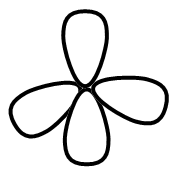
A tetrahedral molecule, $X{Y_4}$ , would be formed if X were used in $s{p^3}$ orbital hybridization.
The central atom X will have four bond pairs and zero lone pairs of electrons. These will occupy four $s{p^3}$ hybrid orbitals. This results in tetrahedral geometry.
So, the correct answer is (E) $s{p^3}$
Note:
The bond angle for a symmetric tetrahedral molecule such as methane may be calculated using the dot product of two vectors. The molecule can be inscribed in a cube with the tetravalent atom at the cube centre which is the origin of coordinates, O. The four monovalent atoms are at four corners of the cube chosen so that no two atoms are at adjacent corners linked by only one cube edge.
Complete step by step answer:
In a tetrahedral molecular geometry, a central atom is located at the center with four substituents that are located at the corners of a tetrahedron. When all four substituents are the same, as in methane as well as its heavier analogues. Methane and other perfectly symmetrical tetrahedral molecules belong to the point group, but most tetrahedral molecules have lower symmetry. Tetrahedral molecules can be chiral. Some examples of tetrahedral molecules include the ammonium ion, methane ion, and phosphate ion.
A tetrahedral molecule, $X{Y_4}$ , would be formed if X were used in $s{p^3}$ orbital hybridization.
The central atom X will have four bond pairs and zero lone pairs of electrons. These will occupy four $s{p^3}$ hybrid orbitals. This results in tetrahedral geometry.
So, the correct answer is (E) $s{p^3}$
Note:
The bond angle for a symmetric tetrahedral molecule such as methane may be calculated using the dot product of two vectors. The molecule can be inscribed in a cube with the tetravalent atom at the cube centre which is the origin of coordinates, O. The four monovalent atoms are at four corners of the cube chosen so that no two atoms are at adjacent corners linked by only one cube edge.
Recently Updated Pages
Master Class 11 Computer Science: Engaging Questions & Answers for Success

Master Class 11 Business Studies: Engaging Questions & Answers for Success
Master Class 11 Economics: Engaging Questions & Answers for Success
Master Class 11 English: Engaging Questions & Answers for Success
Master Class 11 Maths: Engaging Questions & Answers for Success
Master Class 11 Biology: Engaging Questions & Answers for Success
Trending doubts
One Metric ton is equal to kg A 10000 B 1000 C 100 class 11 physics CBSE
There are 720 permutations of the digits 1 2 3 4 5 class 11 maths CBSE
Discuss the various forms of bacteria class 11 biology CBSE
Draw a diagram of a plant cell and label at least eight class 11 biology CBSE
State the laws of reflection of light
Explain zero factorial class 11 maths CBSE