




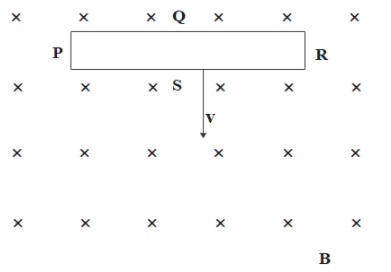
A thin solid conductor with sides PQRS is moving at constant velocity $v$, at right angles to a uniform magnetic field $B$, directed into the page as shown. Which side of the conductor has the greatest construction of electrons?
A. P
B. Q
C. R
D. S
Answer
 Verified
584.4k+ views
Hint: When a charge is moving in a magnetic field, it experiences a force known as magnetic force. The magnetic force is directly proportional to the cross product of velocity vector and magnetic field vector. The direction of magnetic force is given by right hand thumb rule.
Complete answer:
Just as static charges generate electric fields, magnetic fields are generated by moving charges. The magnetic field intensity at any point in space is defined as the magnetic force experienced by a unit positive charge moving with unit velocity in direction perpendicular to the magnetic force.
The magnetic force on a charge moving with velocity $\mathbf{v}$ in a magnetic field of intensity $\mathbf{B}$can be written as
${{\mathbf{F}}_{m}}=q(\mathbf{v}\times \mathbf{B})$
Magnetic force on a charge becomes zero if it moves parallel to the magnetic field.
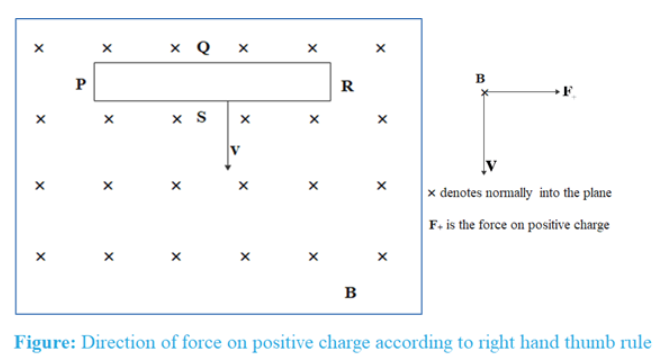
Direction of force can be determined by right hand thumb rule. According to right hand rule, if we curl our fingers from direction of motion of positive charge to magnetic field, the thumb of the same hand points in the direction of force.
Let us apply this rule in our question. We get direction of force towards R. But this is the direction of force on positive charge. Since electrons are charged negatively, they tend to move in direction opposite to it. Therefore, the concentration of electrons increases towards side P.
Hence, A is the correct answer.
Note:
If charge is at rest and not moving, the magnetic force it experiences is zero.
The direction of magnetic force on a moving charge can be determined by right hand thumb rule.
The force on a moving electric charge is the sum of electric force and magnetic force and is known as Lorentz force.
Complete answer:
Just as static charges generate electric fields, magnetic fields are generated by moving charges. The magnetic field intensity at any point in space is defined as the magnetic force experienced by a unit positive charge moving with unit velocity in direction perpendicular to the magnetic force.
The magnetic force on a charge moving with velocity $\mathbf{v}$ in a magnetic field of intensity $\mathbf{B}$can be written as
${{\mathbf{F}}_{m}}=q(\mathbf{v}\times \mathbf{B})$
Magnetic force on a charge becomes zero if it moves parallel to the magnetic field.
Direction of force can be determined by right hand thumb rule. According to right hand rule, if we curl our fingers from direction of motion of positive charge to magnetic field, the thumb of the same hand points in the direction of force.
Let us apply this rule in our question. We get direction of force towards R. But this is the direction of force on positive charge. Since electrons are charged negatively, they tend to move in direction opposite to it. Therefore, the concentration of electrons increases towards side P.
Hence, A is the correct answer.
Note:
If charge is at rest and not moving, the magnetic force it experiences is zero.
The direction of magnetic force on a moving charge can be determined by right hand thumb rule.
The force on a moving electric charge is the sum of electric force and magnetic force and is known as Lorentz force.
Recently Updated Pages
Master Class 11 Computer Science: Engaging Questions & Answers for Success

Master Class 11 Business Studies: Engaging Questions & Answers for Success
Master Class 11 Economics: Engaging Questions & Answers for Success
Master Class 11 English: Engaging Questions & Answers for Success
Master Class 11 Maths: Engaging Questions & Answers for Success
Master Class 11 Biology: Engaging Questions & Answers for Success
Trending doubts
One Metric ton is equal to kg A 10000 B 1000 C 100 class 11 physics CBSE
There are 720 permutations of the digits 1 2 3 4 5 class 11 maths CBSE
Discuss the various forms of bacteria class 11 biology CBSE
Draw a diagram of a plant cell and label at least eight class 11 biology CBSE
State the laws of reflection of light
Explain zero factorial class 11 maths CBSE