




A uniform cylinder of steel of mass M, radius R is placed on frictionless bearings and set to rotate about its vertical axis with angular velocity ${{\omega }_{0}}$. After the cylinder has reached the specified state of rotation it is heated, without any mechanical contact, from temperature ${{T}_{0}}$ to ${{T}_{0}}+\Delta T$. If $\dfrac{\Delta I}{I}$ is the fractional change in moment of inertia of the cylinder and $\dfrac{\Delta \omega }{{{\omega }_{0}}}$ be the fractional change in the angular velocity of the cylinder and $\alpha $ be the coefficient of linear expansion, then,
A.$\dfrac{\Delta I}{I}=\dfrac{2\Delta R}{R}$
B.$\dfrac{\Delta I}{I}=\dfrac{\Delta \omega }{{{\omega }_{0}}}$
C.$\dfrac{\Delta \omega }{{{\omega }_{0}}}=-2\alpha \Delta T$
D.$\dfrac{\Delta I}{I}=-\dfrac{2\Delta R}{R}$
Answer
 Verified
573k+ views
Hint: We know that by increasing the temperature of the cylinder, the radius of the cylinder will increase. Recalling the moment of inertia of a cylinder about its axis, find the change in moment of inertia in terms of the change in radius of the cylinder. Now apply the law of conservation of angular momentum to get the relation between change in moment of inertia and the angular velocity.
Formula used:
Moment of inertia of cylinder,
$I=\dfrac{M{{R}^{2}}}{2}$
Complete step by step solution:
We are given a steel cylinder of mass M and radius R and it is set to rotate about its vertical axis with angular velocity ${{\omega }_{0}}$. On reaching some specified state of motion, the cylinder is heated from ${{T}_{0}}$ to ${{T}_{0}}+\Delta T$. When there is an increase in the temperature of the cylinder, it means that the cylinder will undergo expansion.
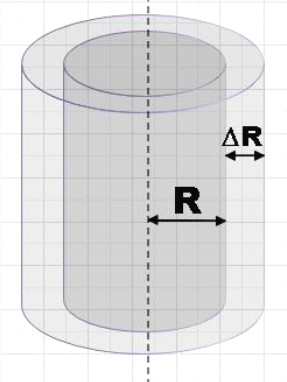
Let us recall the expression for moment of inertia of the cylinder about its axis which is given by,
$I=\dfrac{M{{R}^{2}}}{2}$
Since $\dfrac{M}{2}$ is a constant,
$\Rightarrow \dfrac{\Delta I}{I}=\dfrac{2\Delta R}{R}$ …………………………………… (1)
Hence, option A is found to be true and option D is false.
Also, if $\alpha $was the coefficient of linear expansion, then,
$\propto \Delta T=\dfrac{\Delta R}{R}$
Now (1) can be expressed as,
$\dfrac{\Delta I}{I}=2\alpha \Delta T$ …………………………… (2)
As there is no mention of the presence of an external torque, we could say that the angular momentum is conserved for the cylinder. That is,
$L=I\omega =k$
$\Rightarrow \omega \propto \dfrac{1}{I}$
That is, the angular velocity decreases with increase of moment of inertia. So,
$\dfrac{\Delta \omega }{{{\omega }_{0}}}=-\dfrac{\Delta I}{I}$
Hence, option B is false.
From (2),
$\dfrac{\Delta \omega }{{{\omega }_{0}}}=-2\alpha \Delta T$ ………………………………….. (3)
Hence, option C is true.
Therefore, we found that for the given case,
$\dfrac{\Delta I}{I}=\dfrac{2\Delta R}{R}$
$\dfrac{\Delta \omega }{{{\omega }_{0}}}=-2\alpha \Delta T$
Hence, option A and option C are true for the given question.
Note:
On solving this question we found that on increasing the temperature, the angular velocity of the cylinder is decreased. Also, the choice of thermal expansion coefficient is one depending on which dimension is considered important in a particular case. Thus, we have chosen here the coefficient of linear expansion as per the requirement.
Formula used:
Moment of inertia of cylinder,
$I=\dfrac{M{{R}^{2}}}{2}$
Complete step by step solution:
We are given a steel cylinder of mass M and radius R and it is set to rotate about its vertical axis with angular velocity ${{\omega }_{0}}$. On reaching some specified state of motion, the cylinder is heated from ${{T}_{0}}$ to ${{T}_{0}}+\Delta T$. When there is an increase in the temperature of the cylinder, it means that the cylinder will undergo expansion.
Let us recall the expression for moment of inertia of the cylinder about its axis which is given by,
$I=\dfrac{M{{R}^{2}}}{2}$
Since $\dfrac{M}{2}$ is a constant,
$\Rightarrow \dfrac{\Delta I}{I}=\dfrac{2\Delta R}{R}$ …………………………………… (1)
Hence, option A is found to be true and option D is false.
Also, if $\alpha $was the coefficient of linear expansion, then,
$\propto \Delta T=\dfrac{\Delta R}{R}$
Now (1) can be expressed as,
$\dfrac{\Delta I}{I}=2\alpha \Delta T$ …………………………… (2)
As there is no mention of the presence of an external torque, we could say that the angular momentum is conserved for the cylinder. That is,
$L=I\omega =k$
$\Rightarrow \omega \propto \dfrac{1}{I}$
That is, the angular velocity decreases with increase of moment of inertia. So,
$\dfrac{\Delta \omega }{{{\omega }_{0}}}=-\dfrac{\Delta I}{I}$
Hence, option B is false.
From (2),
$\dfrac{\Delta \omega }{{{\omega }_{0}}}=-2\alpha \Delta T$ ………………………………….. (3)
Hence, option C is true.
Therefore, we found that for the given case,
$\dfrac{\Delta I}{I}=\dfrac{2\Delta R}{R}$
$\dfrac{\Delta \omega }{{{\omega }_{0}}}=-2\alpha \Delta T$
Hence, option A and option C are true for the given question.
Note:
On solving this question we found that on increasing the temperature, the angular velocity of the cylinder is decreased. Also, the choice of thermal expansion coefficient is one depending on which dimension is considered important in a particular case. Thus, we have chosen here the coefficient of linear expansion as per the requirement.
Recently Updated Pages
Master Class 11 Computer Science: Engaging Questions & Answers for Success

Master Class 11 Business Studies: Engaging Questions & Answers for Success
Master Class 11 Economics: Engaging Questions & Answers for Success
Master Class 11 English: Engaging Questions & Answers for Success
Master Class 11 Maths: Engaging Questions & Answers for Success
Master Class 11 Biology: Engaging Questions & Answers for Success
Trending doubts
One Metric ton is equal to kg A 10000 B 1000 C 100 class 11 physics CBSE
There are 720 permutations of the digits 1 2 3 4 5 class 11 maths CBSE
Discuss the various forms of bacteria class 11 biology CBSE
Draw a diagram of a plant cell and label at least eight class 11 biology CBSE
State the laws of reflection of light
Explain zero factorial class 11 maths CBSE