




A wheel of radius \[r\]rolls without slipping on the ground, with speed \[v\]. When it is at a point $P$, a piece of mud flies off tangentially from its highest point, lands on the ground at point $Q$. Find the distance P Q ?
Answer
 Verified
523.2k+ views
Hint: The path of the piece of mud follows a path of projectile motion. Find the horizontal velocity of the piece of mud and calculate the time of flight to calculate the distance of PQ.
Formula used:
The displacement of a particle in one dimensional motion is given by,
\[s = ut + \dfrac{1}{2}a{t^2}\]
where, \[s\] is the displacement of the particle \[u\] is the initial velocity of the particle \[t\] is the time and \[a\] is the acceleration of the particle.
The velocity of a body, moving with a velocity while rolling is,
\[{V_{rot}} = {V_{cm}} + \omega \times r\]
where, \[{V_{rot}}\] is the velocity with respect to the origin, \[{V_{cm}}\] is the velocity with respect to the centre of mass and \[r\] is the radius of the body and \[\omega \] is angular velocity.
Complete step by step answer:
Since the body is moving while rolling so the speed of the piece of mud will be,
\[{V_{rot}} = {V_{cm}} + \omega \times r\]
Here, we have given, \[{V_{cm}} = v\]and since the radius of the wheel is \[r\] so, \[\omega \times r\]must be equal to \[v\]. So,
\[{V_{rot}} = v + v = 2v\].
Now, the piece of mud drops from a height of \[r + r = 2r\]. So, the time of flight is equal to time taken to drop from the height \[2r\].
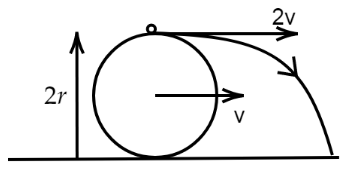
Hence, we can write for the vertical motion of piece of mud,
\[s = ut + \dfrac{1}{2}a{t^2}\]
\[\Rightarrow 2r = 0 + \dfrac{1}{2}g{t^2}\]
Up on simplifying we have, \[t = \sqrt {\dfrac{{4r}}{g}} \]
Now, the distance covered horizontally must be equal to the product of velocity and time of flight since the horizontal velocity does not change with time. Hence, the distance $PQ$ will be equal to,
\[d = (2v)t\]
Putting the value of time \[t\] we have,
\[d = 2v\sqrt {\dfrac{{4r}}{g}} \]
\[\therefore d = 4v\sqrt {\dfrac{r}{g}} \]
Hence, distance between the points P and Q is \[4v\sqrt {\dfrac{r}{g}} \].
Note: The piece of mud only travels the path of a half projectile. The path of the piece of mud is similar to when a stone or something is thrown horizontally from a height.For, a projectile motion time of flight is equal to, \[\dfrac{{2u\sin \theta }}{g}\] where \[u\sin \theta \] is vertical component of the velocity of the particle.
Formula used:
The displacement of a particle in one dimensional motion is given by,
\[s = ut + \dfrac{1}{2}a{t^2}\]
where, \[s\] is the displacement of the particle \[u\] is the initial velocity of the particle \[t\] is the time and \[a\] is the acceleration of the particle.
The velocity of a body, moving with a velocity while rolling is,
\[{V_{rot}} = {V_{cm}} + \omega \times r\]
where, \[{V_{rot}}\] is the velocity with respect to the origin, \[{V_{cm}}\] is the velocity with respect to the centre of mass and \[r\] is the radius of the body and \[\omega \] is angular velocity.
Complete step by step answer:
Since the body is moving while rolling so the speed of the piece of mud will be,
\[{V_{rot}} = {V_{cm}} + \omega \times r\]
Here, we have given, \[{V_{cm}} = v\]and since the radius of the wheel is \[r\] so, \[\omega \times r\]must be equal to \[v\]. So,
\[{V_{rot}} = v + v = 2v\].
Now, the piece of mud drops from a height of \[r + r = 2r\]. So, the time of flight is equal to time taken to drop from the height \[2r\].
Hence, we can write for the vertical motion of piece of mud,
\[s = ut + \dfrac{1}{2}a{t^2}\]
\[\Rightarrow 2r = 0 + \dfrac{1}{2}g{t^2}\]
Up on simplifying we have, \[t = \sqrt {\dfrac{{4r}}{g}} \]
Now, the distance covered horizontally must be equal to the product of velocity and time of flight since the horizontal velocity does not change with time. Hence, the distance $PQ$ will be equal to,
\[d = (2v)t\]
Putting the value of time \[t\] we have,
\[d = 2v\sqrt {\dfrac{{4r}}{g}} \]
\[\therefore d = 4v\sqrt {\dfrac{r}{g}} \]
Hence, distance between the points P and Q is \[4v\sqrt {\dfrac{r}{g}} \].
Note: The piece of mud only travels the path of a half projectile. The path of the piece of mud is similar to when a stone or something is thrown horizontally from a height.For, a projectile motion time of flight is equal to, \[\dfrac{{2u\sin \theta }}{g}\] where \[u\sin \theta \] is vertical component of the velocity of the particle.
Recently Updated Pages
Master Class 11 Business Studies: Engaging Questions & Answers for Success

Master Class 11 Economics: Engaging Questions & Answers for Success
Master Class 11 Computer Science: Engaging Questions & Answers for Success
Master Class 11 English: Engaging Questions & Answers for Success
Master Class 11 Maths: Engaging Questions & Answers for Success
Master Class 11 Biology: Engaging Questions & Answers for Success
Trending doubts
One Metric ton is equal to kg A 10000 B 1000 C 100 class 11 physics CBSE
Discuss the various forms of bacteria class 11 biology CBSE
Draw a diagram of a plant cell and label at least eight class 11 biology CBSE
State the laws of reflection of light
Explain zero factorial class 11 maths CBSE
10 examples of friction in our daily life