




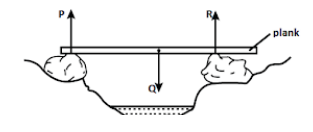
A wooden plank rests in equilibrium on two rocks on opposite sides of a narrow stream. Three forces $ P $ , $ Q $ and $ R $ act on the plank. How are the sizes of the force related?
(A)P + Q = R
(B)P + R = Q
(C)P = Q = R
(D)P = Q + R
Answer
 Verified
535.5k+ views
Hint :In order to solve this question, we are going to first see that what will be the condition in order for the plank to be balanced over the two rocks and be in equilibrium. After that, the mathematical equation is written for that condition which gives the correct answer as required.
Formula used: In order for an object to be in equilibrium, it is necessary that the total force acting on it,
$ {F_{net}} = 0 $
Complete Step By Step Answer:
As it is given in the question that the wooden plank rests on the two rocks as we can also see in the above figure. Now, as the plank is in equilibrium, so, we know that, the total force on the plank in the upwards direction must be balanced by the total force on the plank in the downward direction,
Thus, we can also write that
$ Total\,upwards\,force = Total\,downwards\,force $
Now calculating the forces in the two directions as given, we get
$ P + R = Q $
Hence, the option $ (B)P + R = Q $ is the correct answer.
Note :
It is important to note that you might think that the forces $ P $ and $ R $ are opposite to the force $ Q $ , thus, in the mathematical expression, there must be a negative sign. But it is not necessary to put the negative signs as the directions for the vectors of the forces are already given in the figure that makes it understood.
Formula used: In order for an object to be in equilibrium, it is necessary that the total force acting on it,
$ {F_{net}} = 0 $
Complete Step By Step Answer:
As it is given in the question that the wooden plank rests on the two rocks as we can also see in the above figure. Now, as the plank is in equilibrium, so, we know that, the total force on the plank in the upwards direction must be balanced by the total force on the plank in the downward direction,
Thus, we can also write that
$ Total\,upwards\,force = Total\,downwards\,force $
Now calculating the forces in the two directions as given, we get
$ P + R = Q $
Hence, the option $ (B)P + R = Q $ is the correct answer.
Note :
It is important to note that you might think that the forces $ P $ and $ R $ are opposite to the force $ Q $ , thus, in the mathematical expression, there must be a negative sign. But it is not necessary to put the negative signs as the directions for the vectors of the forces are already given in the figure that makes it understood.
Recently Updated Pages
Master Class 11 Computer Science: Engaging Questions & Answers for Success

Master Class 11 Business Studies: Engaging Questions & Answers for Success
Master Class 11 Economics: Engaging Questions & Answers for Success
Master Class 11 English: Engaging Questions & Answers for Success
Master Class 11 Maths: Engaging Questions & Answers for Success
Master Class 11 Biology: Engaging Questions & Answers for Success
Trending doubts
One Metric ton is equal to kg A 10000 B 1000 C 100 class 11 physics CBSE
There are 720 permutations of the digits 1 2 3 4 5 class 11 maths CBSE
Discuss the various forms of bacteria class 11 biology CBSE
Draw a diagram of a plant cell and label at least eight class 11 biology CBSE
State the laws of reflection of light
Explain zero factorial class 11 maths CBSE