




A-band of the myofibril contains
a) Only thick filaments
b) Only thin filaments
c) Both thick and thin filament
d) No filaments
Answer
 Verified
524.7k+ views
Hint: Myofibrils are a kind of muscle fibres that are present inside the muscle tissue. They are the basic unit of a muscle cell which is cylindrical in shape. These fibrils are common to striated muscles, that are voluntary muscles such as biceps and triceps.
Complete answer
The muscle cells are found to be long and tubular in structure which imparts fibrous anatomy. However, they are arranged in several bundles which are interconnected by connective tissues.
In a human body muscles have been broadly classified into the following:
Skeletal muscles: covering the bone structure. They are also called striated or voluntary muscles.
Cardiac muscles are specialised concerned with the functioning of the heart. These are involuntary muscles.
Smooth muscles: are the one to form internal organs such as the gut. These are also involuntary muscles.
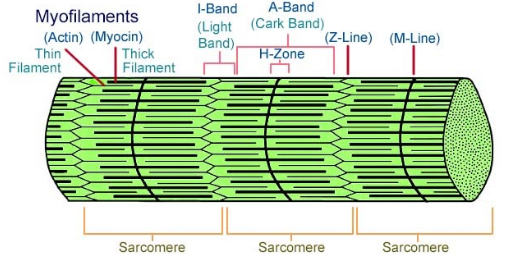
Striated muscles are made up of proteins called myosin (dark in colour) and actin (light in colour). These proteins are alternately arranged across these muscle structures in a band like pattern. The myosin band is called dark A band whereas actin band is called light I band. The myosin band is dark in colour due to presence of thick fluid that refracts light thus imparting it a dark colour whereas the I band is filled with thin filament which reflects most of the light thus appears light in colour. The A band of muscle helps in muscle contraction and in anchoring the movement of actin fibre.
Therefore, we can say that option A is the correct answer.
Note:
The tubular muscle cells are collectively termed as myocytes. They arise from the process of myogenesis. However, every A band is surrounded by two I bands on both the sides. This arrangement is termed as sarcomere, which is the functional unit of muscle cells.
Complete answer
The muscle cells are found to be long and tubular in structure which imparts fibrous anatomy. However, they are arranged in several bundles which are interconnected by connective tissues.
In a human body muscles have been broadly classified into the following:
Skeletal muscles: covering the bone structure. They are also called striated or voluntary muscles.
Cardiac muscles are specialised concerned with the functioning of the heart. These are involuntary muscles.
Smooth muscles: are the one to form internal organs such as the gut. These are also involuntary muscles.
Striated muscles are made up of proteins called myosin (dark in colour) and actin (light in colour). These proteins are alternately arranged across these muscle structures in a band like pattern. The myosin band is called dark A band whereas actin band is called light I band. The myosin band is dark in colour due to presence of thick fluid that refracts light thus imparting it a dark colour whereas the I band is filled with thin filament which reflects most of the light thus appears light in colour. The A band of muscle helps in muscle contraction and in anchoring the movement of actin fibre.
Therefore, we can say that option A is the correct answer.
Note:
The tubular muscle cells are collectively termed as myocytes. They arise from the process of myogenesis. However, every A band is surrounded by two I bands on both the sides. This arrangement is termed as sarcomere, which is the functional unit of muscle cells.
Recently Updated Pages
Master Class 11 Computer Science: Engaging Questions & Answers for Success

Master Class 11 Business Studies: Engaging Questions & Answers for Success
Master Class 11 Economics: Engaging Questions & Answers for Success
Master Class 11 English: Engaging Questions & Answers for Success
Master Class 11 Maths: Engaging Questions & Answers for Success
Master Class 11 Biology: Engaging Questions & Answers for Success
Trending doubts
One Metric ton is equal to kg A 10000 B 1000 C 100 class 11 physics CBSE
There are 720 permutations of the digits 1 2 3 4 5 class 11 maths CBSE
Discuss the various forms of bacteria class 11 biology CBSE
Draw a diagram of a plant cell and label at least eight class 11 biology CBSE
State the laws of reflection of light
10 examples of friction in our daily life