




\[AlC{l_3}\] behave as an Acid in accordance with:
A) Arrhenius concept
B) Bronsted -Lowery concept
C) Lewis concept
D) All of these
Answer
 Verified
566.7k+ views
Hint: Generally Acids are those substances which Turns blue litmus into red & are Sour in taste. They also show electrical conductance and give neutralization reaction when reacts with base.
Complete answer:
\[AlC{l_3}\] is electron deficient. It has three electrons in its valence shell. So when it forms a covalent compound with chlorine it forms three single bonds with chlorine. Three electrons of aluminium and three electrons of chlorine constitute 6 electrons in outermost orbit. So, It doesn't form an octet ( eight electrons in outermost orbit) by doing so, thus it can take two more electrons by forming a coordinate bond to complete an octet and thus it behaves as Lewis acid.
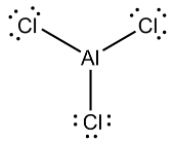
Lewis acid is defined as a compound which can take electrons from a donor compound. These compounds have a tendency to accept lone pairs. This is according to the Lewis concept.
Hence, option (C) is correct.
Note: Some other concepts related to acid are Arrhenius concept & Bronsted – Lowry concept.
According to Arrhenius, Acids are compounds which release $H^+$ ion in aqueous solution.
\[HCl{\text{ }} + {\text{ }}{H_2}O \to H_{(aq)}^ + \left( {aq.} \right){\text{ }} + {\text{ }}Cl_{(aq)}^ - {\text{ }}\]
While Bronsted – Lowry concepts states that the compounds which have a tendency to release protons in any solvent are acids.
\[HCl\left( {acid} \right){\text{ }} + {\text{ }}{H_2}O{\text{ }}\left( {solvent} \right) \to {H_3}{O^ + }\; + {\text{ }}C{l^ - }\]
Complete answer:
\[AlC{l_3}\] is electron deficient. It has three electrons in its valence shell. So when it forms a covalent compound with chlorine it forms three single bonds with chlorine. Three electrons of aluminium and three electrons of chlorine constitute 6 electrons in outermost orbit. So, It doesn't form an octet ( eight electrons in outermost orbit) by doing so, thus it can take two more electrons by forming a coordinate bond to complete an octet and thus it behaves as Lewis acid.
Lewis acid is defined as a compound which can take electrons from a donor compound. These compounds have a tendency to accept lone pairs. This is according to the Lewis concept.
Hence, option (C) is correct.
Note: Some other concepts related to acid are Arrhenius concept & Bronsted – Lowry concept.
According to Arrhenius, Acids are compounds which release $H^+$ ion in aqueous solution.
\[HCl{\text{ }} + {\text{ }}{H_2}O \to H_{(aq)}^ + \left( {aq.} \right){\text{ }} + {\text{ }}Cl_{(aq)}^ - {\text{ }}\]
While Bronsted – Lowry concepts states that the compounds which have a tendency to release protons in any solvent are acids.
\[HCl\left( {acid} \right){\text{ }} + {\text{ }}{H_2}O{\text{ }}\left( {solvent} \right) \to {H_3}{O^ + }\; + {\text{ }}C{l^ - }\]
Recently Updated Pages
Master Class 11 Computer Science: Engaging Questions & Answers for Success

Master Class 11 Business Studies: Engaging Questions & Answers for Success
Master Class 11 Economics: Engaging Questions & Answers for Success
Master Class 11 English: Engaging Questions & Answers for Success
Master Class 11 Maths: Engaging Questions & Answers for Success
Master Class 11 Biology: Engaging Questions & Answers for Success
Trending doubts
One Metric ton is equal to kg A 10000 B 1000 C 100 class 11 physics CBSE
There are 720 permutations of the digits 1 2 3 4 5 class 11 maths CBSE
Discuss the various forms of bacteria class 11 biology CBSE
Draw a diagram of a plant cell and label at least eight class 11 biology CBSE
State the laws of reflection of light
Explain zero factorial class 11 maths CBSE